There is little politicians can do about the cost of household energy bills and they should be bold enough to be honest and admit it, Tim Yeo has warned.
The chair of the Commons energy and climate change committee said that there is “a very limited amount” that parliamentarians can do to stop energy providers from raising consumer bills because “the biggest components are outside the control of any government, as the biggest component is the wholesale price of gas”. Speaking at the Institute of Mechanical Engineers at an event to mark the close of the Guardian’s year-long Big Energy Debate project, he attacked Labour policy for convincing voters otherwise.
“To announce 18 months in advance an energy price freeze is not in my view a coherent response,” he told an audience of 200 engineers and energy experts. “It ensures that the companies raise their prices in the meantime. It is a deterrent to new investment at a time when we need as much investment as we can get.”
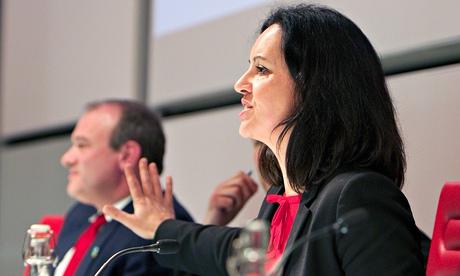
Labour energy spokesperson Caroline Flint rejected the claim, stating that there was still “a long way to go to restore people’s trust in the energy market” – especially when the average dual fuel gas and electricity bill stands £300 higher than in 2010.
“The regulator’s view is that competition is deteriorating in the energy market. That is the reality,” she said. “To restore people’s trust in this market we need to be sure that we can introduce changes that will make a difference.”
The panelists exchanged blows over the parties’ proposals for the energy sector after May’s general election. Labour’s short term freeze, which would allow the cost to the consumer to fall but not rise, would not be sufficient to solve the energy price crisis.
“We need a tough new regulator. And I welcome a little bit more aggression by Ofgem in recent times but we need to make sure we have a regulator fit for purpose,” Flint added, stating that energy suppliers should be stripped of their licence if they were shown to be mistreating their customers.
By contrast Yeo said it was the government’s responsibility to promote true competition in the energy sector, warning that popular price comparison websites often lacked transparency and that they would be brought to the select committee “for a little fireside chat” to discuss their influence.
Yeo also used the debate to call for greater speed on exploring the potential for a shale gas market in the UK. “We should try and find out if we really do have substantial shale gas reserves in this country. It’s not a panacea, but it could replace our dependence on imports. I strongly favour going ahead with fracking. We are satisfied that, given the proper regulatory structure... it’s perfectly OK,” he said.
Yeo dismissed fears about tremors and earthquakes, saying those experienced in pilot areas were weaker than the tremors commonly cause by coal mining which had been going on directly underneath people’s houses for decades. “We’ve got to overcome the understandable concerns of local communities but we need to try and take them with us, educate them and above all reward them,” he said.
However, in a departure from his party’s economic policy, Conservative MP Phillip Lee admitted his scrutiny of the energy sector had led him to conclude that “there are limits to markets”.
“It’s a bit counterintuitive I know, but ultimately I don’t see how you introduce a market in supplying one commodity along one piece of wire or pipe to a household. Where we’ve ended up is not where the architects of that [expected],” Lee said. “I just think we need to take the market out of the retail and distribution of energy in this country. I think that there may be a role here for co-operatives: if you’ve got the customer buying in to becoming members you might get a solution for the longer term and greater good without having to have state ownership.”
He concluded: “It’s a big idea; complicated, and difficult to achieve.”
Meanwhile Liberal Democrat Ed Davey, who holds the position of energy secretary in the coalition government, said his party would look to introduce five new green laws including two covering energy efficient homes and decarbonisation. Davey said his plan for a zero carbon Britain would “really boost the incentives and the certainty that the [energy] industry needs. It would build on the massive investment we’ve seen in low carbon and renewables under this government, doubling the investment pipeline.”
A future Liberal Democrat government would also knock £100 off the council tax bill every year for a decade for householders who improved their property’s energy efficiency performance by two bands.
Echoing the sentiment, Yeo said he would like the next government to look at more radical incentives to carry out energy efficiency works including cuts to council tax and business rates or a stamp duty rebate for new homeowners who install upgrades in the first year. This would work because, “psychologically, people love to get one over on the taxman”, he added.
This debate was designed and produced by the Guardian to a brief agreed by partners for the Big Energy Debate series. All content is editorially independent. Read more about the project here.