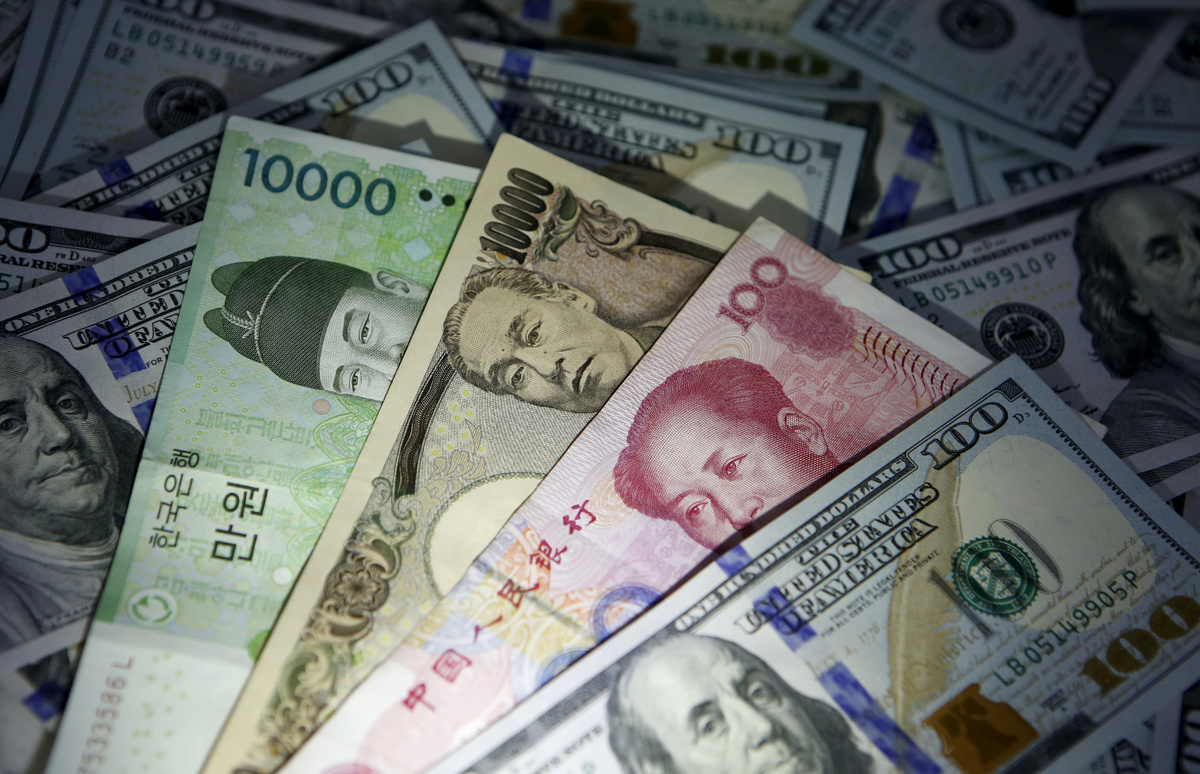
NEW YORK (Reuters) - The dollar weakened against the Japanese yen on Friday morning to a seven-month low after U.S. employment growth in July slowed as expected, which along with re-escalated U.S.-Chinese trade tensions, may make a case for the Federal Reserve to cut interest rates again in September.
Nonfarm payrolls increased by 164,000 jobs in July, less than the month prior, and wages increased modestly, the Labor Department aid. The report came a day after President Donald Trump announced an additional 10% tariff on $300 billion worth of Chinese imports starting Sept. 1, a move that led financial markets to almost fully price in a September rate cut.
The dollar fell 0.63% against the Japanese yen <JPY=> last at 106.65. Versus the euro <EUR=> it was 0.14% weaker at $1.1099. The Swiss franc <CHF=>, which like the yen serves as a safe-haven investment in volatile markets, was 0.66% stronger to 0.9836 franc per dollar.
"On balance it is probably a slightly dollar-negative number because I do think that the totality of the report increases the case for a Fed rate cut in September. We're already at the point where we're trading that," said Greg Anderson, global head of foreign exchange strategy at BMO Capital Markets in New York.
The U.S. central bank on Wednesday cut its short-term interest rate for the first time since 2008. Fed Chair Jerome Powell described the widely anticipated 25-basis-point monetary policy easing as a mid-cycle policy adjustment to protect U.S. expansion from the global economic slowdown happening outside its borders.
The dollar subsequently rose in sympathy with U.S. Treasury note prices, but that move had largely been retraced on Friday.
The chance of a September rate cut was 93.5% on Friday morning, according to CME Group's FedWatch tool, a large jump from 56.2% a week prior.
Trump on Thursday tweeted that a 10% tariff would be imposed on $300 billion worth of Chinese goods on Sept. 1 after U.S. negotiators returned from the latest round of trade talks without having made significant progress.
The trade tension is "one more thing that leads to dollar strength," said Anderson. These particular tariffs had not yet been implemented by the Trump administration because they cover products manufactured by American companies in China.
"This particular round will squeeze profits from U.S. companies, will raise prices of consumer goods in the U.S. somewhat also, but its design is to force those companies to rework their supply chains away from China."
Still, he explained, "for the short term chaos is generally good for the U.S. dollar."
(Reporting by Kate Duguid and Olga Cotaga; Editing by Steve Orlofsky)