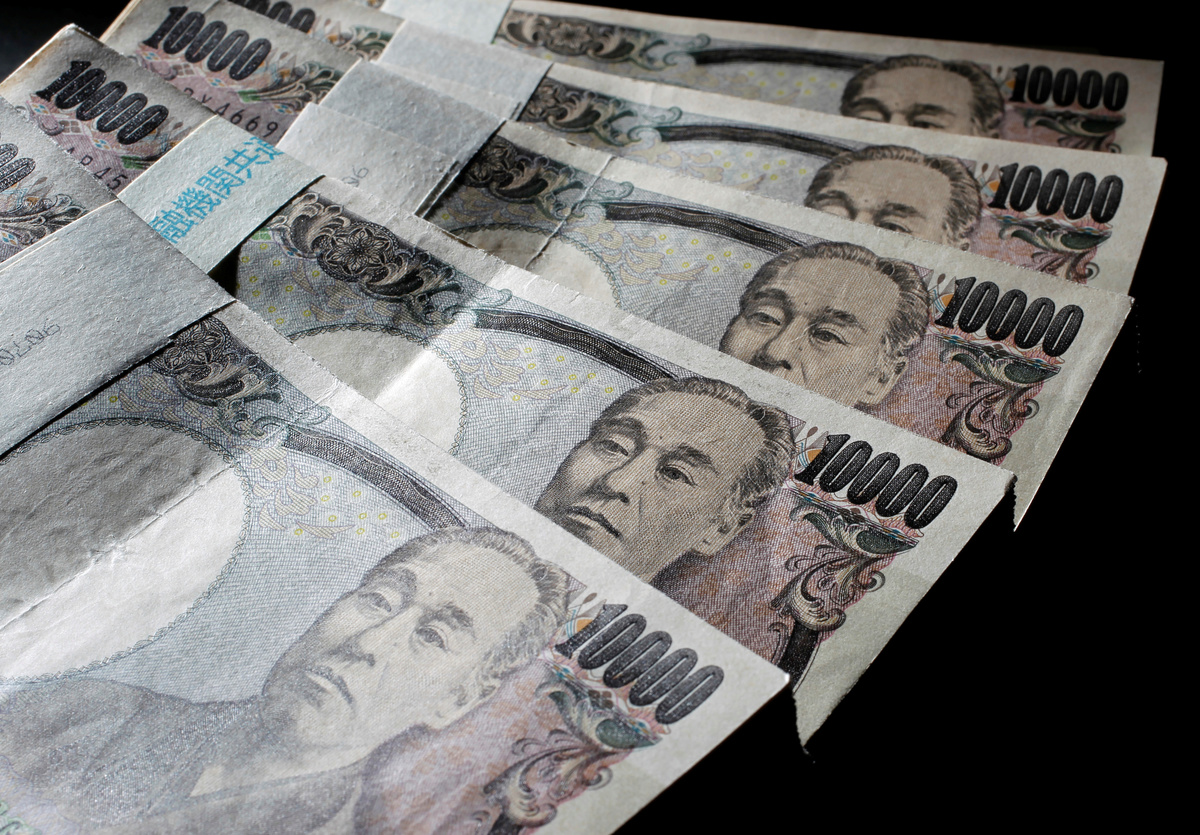
The safe-haven yen and Swiss franc surged on Monday, as risk appetite plummeted after a 30% crash in oil prices and tumbling stock markets panicked investors and sent currency prices swinging wildly.
The U.S. dollar, however, strengthened against the emerging market currencies.
Investors were also alarmed after U.S. Treasury yields declined to record lows, with the benchmark 10-year yield falling below 40 basis points <US10YT=RR> and the entire yield curve below 1% for the first time ever.
At the same time, oil prices fell 25% after Saudi Arabia pledged to slash prices and boost production following the collapse of an OPEC supply agreement. [O/R]
That further increased nervousness in the market already rattled by weeks of wild moves, as investors struggled to assess the economic damage caused by the coronavirus.
"The dollar will strengthen against Asia and will crush the EM countries, but the Europeans will be much stronger than the U.S. dollar as the Germans and the Swiss will attract funds while the Fed is out rescuing the world with unlimited repos - underwriting crisis funds for the 'Eurodollar market' wherever the hell that is," said John Taylor, president and founder of research firm Taylor Global Vision in New York.
The Federal Reserve on Monday increased daily cash injections to the banking system to ensure an ample supply of bank reserves.
On the coronavirus front, the number of people infected with the virus topped 110,000 across the world as the outbreak reached more countries and caused more economic damage.
As a result, currency volatility shot up.
A gauge of volatility in the euro/dollar market - the world's most-traded currency pair - shot to its highest since April 2017 as the euro surged more than 1% to its strongest since January 2019.
Dollar-yen one-month implied volatility surged to an 11-year high at more than 18% <JPY1MO=FN> as the dollar slid to its weakest since 2016.
In afternoon trading, the dollar fell as low as 101.20 <JPY=>, its lowest in more than three years. It was last down nearly 3% at 102.23 yen.
The yen posted its largest three-day gain since the 2008 financial crisis. It was up around 9% in a dozen trading days.
For a graphic on https://fingfx.thomsonreuters.com/gfx/mkt/13/3039/3004/yen%20vs%20dollar%20march%209.png
The euro <EUR=> rallied 1.4% to $1.1443 after earlier touching $1.1492, the highest since late January last year.
The dollar index dropped to its weakest since September 2018, and was last at 94.913, down 0.5% <=USD>.
The dollar also dropped 1.3% against the Swiss franc to 0.9280 <CHF=>.
There were also big moves in currencies linked to oil prices.
Norway's crown tumbled to record lows. The euro added 4% against the crown to 10.857 <EURNOK=D3> and the dollar gained 3.1% to 9.535 crowns <NOK=D3>.
The Canadian dollar shed 1.5% against the greenback, which was up at C$1.3620 <CAD=D3>.
The Australian <AUD=D3> and New Zealand <NZD=D3> dollars earlier fell nearly 2% before bouncing back.
(Reporting by Gertrude Chavez-Dreyfuss; Editing by Nick Macfie and Marguerita Choy)