Recently at my wood and across parts of our lawn I’ve been practising an al fresco number that involves a lot of heel grinding and foot stomping in methodical lines back and forth across the turf.
However, this jig is only part of the full routine. Earlier I’d close-mown both patches, roughed it up badly with a rake, sprinkled the bare ground with round papery seeds and finally jumped all over it. If I had to give a name to the performance I’d call it the yellow rattle dance.
Subtle and mischievous, yellow rattle is really the flower with everything. It was once found over millions of acres of British meadow, and just a few of the old names – bull’s pease, dog’s pennies, money-grass, poverty-weed and shacklebags – give a sense of the cultural stories once entwined round its erect, pubescent stem.
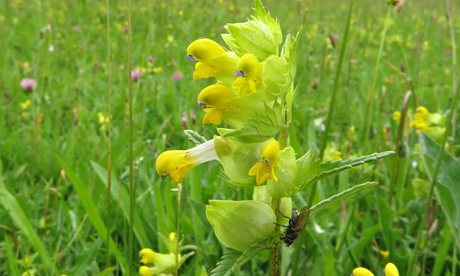
The flower has strange laterally flattened yellow petals, complete with violet “buck teeth”, that emerge from their calyx like a puppet’s head out of a box. But this species combines beauty with purpose, for its best trick is to filch nutrients from the roots of neighbouring grasses, and it’s this parasitism that I hope to incorporate into our lawn’s ecology.
I’m seeking the inverse of the standard engineered rye-grass monoculture. The yellow rattle dance is, in fact, the culmination of years of draining fertility from the lawn, and by weakening the grass further, this wonderful plant creates space for native flowers with good nectar sources for insects.
What a strange world we live in when the average crop field annually receives 20 chemical applications and the wider countryside has lost 97% of its flower-rich meadows, and when our gardens – amounting to just over 1m acres – are the last potential resource for places rich in wild flowers.
However, making mini-meadows of our gardens requires that we shuffle over a bit with the trampoline and barbie and let go a little on the lawnmower’s throttle. I can only suggest that the butterflies, hoverflies, moths, grasshoppers and BugLife will all love you more.