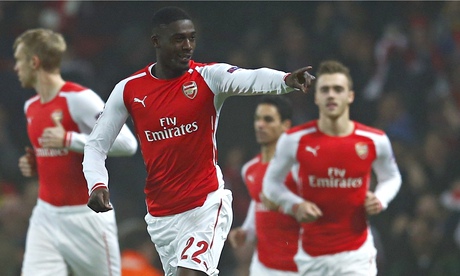
And so it came to pass. For the 60,000 or so inside the Emirates Stadium on a night of creeping drizzle – Arsenal fans, neutrals, the low rise yellow wall in the away end – this was a moment to say, yes, I saw it happen. I was there when Yaya Sanogo scored.
And what a nice goal it was, his first in 19 games for Arsenal. With just over a minute gone against Borussia Dortmund Sanogo picked up the ball with his back to goal, performed a high-kicking shuffle to find a yard of space, took a return pass from Santi Cazorla and poked a shot between Roman Weidenfeller’s legs from four yards out. The Emirates erupted. It was explosive. It was decisive. It was brilliantly assertive. It was offside (just).
But no matter. This was a lovely, self-contained moment of kicking back against the tide for a player who has been unfairly prominent in the chorus of dissent that has accompanied a slightly fraught period in Arsenal’s history: employed as a kind of punchline, a weary raise of the eyebrows, a one-man emblem of congealment and capped ambition.
As Arsenal’s immediate future struggles to emerge from the mist, it has been Sanogo’s lot to loiter on the periphery, an unlikely figure caught in the edge of the frame like the hot-dog seller in the background of history. Here, though, he started in attack and played such a vigorous part in a 2-0 victory, guaranteeing Arsenal’s qualification for the knockout stages, that he was rewarded with a standing ovation as he limped off after 80 minutes with a hamstring twang.
Sanogo deserved the moment after a gruelling 18 months for a player signed, in the manner of Laurent Koscielny, as a hunch, a grower, one to train on. Through no fault of his own, indeed through the fault of his manager’s own slow-twitch recruitment policies, Sanogo has instead been overexposed, asked to patch and fill at vital times, an unwitting emblem of the goatishness and eccentricity of late-Wengerism, but an ever-willing Joe Buck to Arsène Wenger’s fretful Ratso.
“Yaya Sanogo, he scores when he wants,” Arsenal’s fans chortled, and it is hard not to love the Frenchman a little for his industry, his optimism, his huge baggy shorts and the way he fell over even while in the process of scoring his first goal in club competition since a late consolation in a 4-2 defeat for Auxerre away to Nîmes in Ligue 2 in May 2013.
After that there was some neat hold-up play and one sprint in on goal from Aaron Ramsey’s nudged pass that ended with Matthias Ginter making a fine covering tackle. Beyond that he looked like what he is: a diligent workhorse-in-progress, his goal not a vindication of his manager’s transfer policy or an enduringly lopsided squad, but of his own determination and courage on a huge occasion for him personally.
For all the gloom of Arsenal’s worst start to a season in 32 years (matched by Dortmund in the Bundesliga) the players responded with a performance of great urgency. Kieran Gibbs had a fine game, pressing high up the pitch and intercepting well in the second half, while Alex Oxlade-Chamberlain again scurried with purpose and craft. Perhaps the most encouraging aspect was that Arsenal played Dortmund at their own game, breaking forward with a precision that was absent at the weekend for Alexis Sánchez’s second, a curling right-foot shot of such craft it was effectively un-saveable, bending outside Weidenfleller’s right-hand post and then back in. Wenger punched the air at a moment of tailored counter-Klopp, a goal on the break against a team who themselves employ a kind of Russian infantry defence, drawing an opponent in and then striking quickly once the lines are fatally stretched.
Arsenal’s manager will enjoy a moment of grace at the end of a difficult three weeks. And it is in a way a remarkable feat of plate-spinning – similar to the enduring ghost-ship momentum of Late Ferguson at Manchester United – that such a determinedly unbalanced team still keep on pushing on.
For all the ups and downs of the last six months Arsenal remain essentially the same, a team of obvious strengths – most notably Sánchez, who was waspishly high class throughout and who seems to be drawing greater depth out of Oxlade-Chamberlain, offering a template of feisty little quick-footed inside-forward play – and also of some obvious weaknesses.
Sanogo may or may not have a happier next 18 months of his Arsenal career: he remains a callow but willing centre-forward, overexposed by failings elsewhere and reduced at times to a social media fall guy, a kind of vine-gag made flesh. He will, though, always have Dortmund and those 75 seconds of golden Yaya time.