
/Electric%20car%20being%20recharged%20by%20Choochart%20Choochaikupt%20via%20iStock.jpg)
Electric vehicle (EV) maker Xpeng (XPEV) has made tremendous strides in AI and self-driving, enabling it to make a lucrative deal with Volkswagen (VWAGY) and helping it meaningfully boost its EV business. Based in China, the firm's impressive AI progress positions it to launch partnerships with other automakers in the future as well as become a major player in the robotaxi space.
But that's not all. Xpeng's flying car business, which is expected to be launched at the end of this year, looks quite promising. Meanwhile, the humanoid robots that the company is developing could also become a major positive catalyst for XPEV stock.
In light of these points, the valuation of XPEV appears quite low. Accordingly, long-term growth investors may want to consider Xpeng stock.
About Xpeng Stock
Founded in 2014, Xpeng is a leading Chinese AI-driven mobility company that designs, develops, manufactures, and markets EVs, catering to a growing base of tech-savvy consumers. With the rapid advancement of artificial intelligence, Xpeng aspires to become a global leader in AI mobility. In addition to electric vehicles, the company is developing robotaxis, advanced humanoid robots, and flying cars.
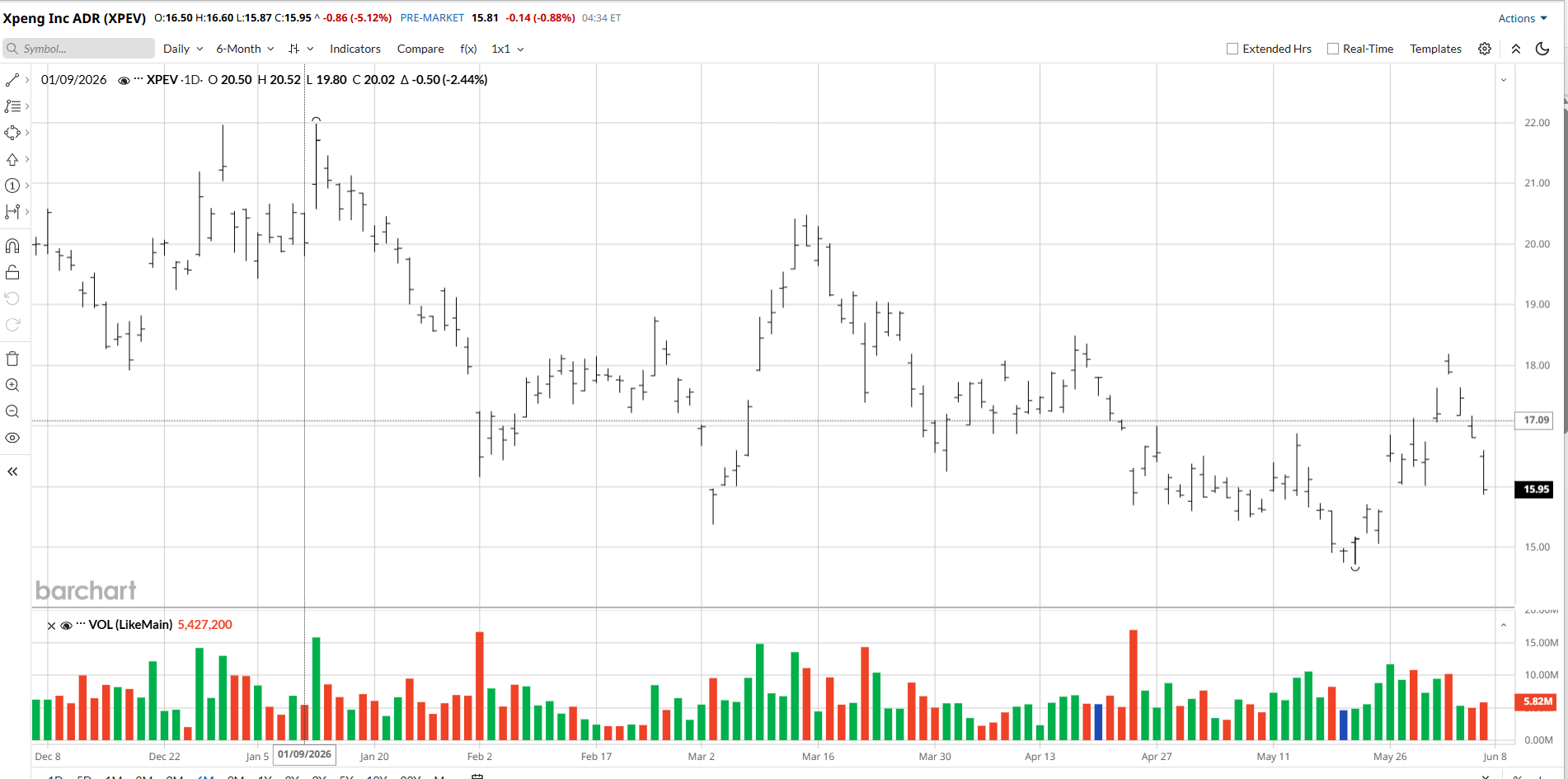
Xpeng has a market capitalization of about $15 billion, while XPEV stock has a price-to-sales (P/S) ratio of 1.38 times.
Xpeng's AI and Self-Driving Achievements
On the AI front, Xpeng's VLA 2.0 AI model — introduced late last year — becomes more effective at driving by learning from humans' actions behind the wheel. The company is reportedly shelling out $500 million annually to improve its AI training capabilities. One reviewer recently described Xpeng's autonomous driving (AD) system as “too natural, too variable, too human to be a machine.” Unlike other self-driving systems, Xpeng's tech is considerably adaptive in its driving approach, with the vehicle “reading available road space and adjusting its attitude on its own.”
Following the launch of VLA 2.0 in China, use of Xpeng's self-driving software has more than doubled in the country, according to CEO He Xiaopeng. In February, Xpeng also began testing Level 4 AD capabilities of its flagship GX SUV. Launched on May 20, orders for the GX have been impressive, with the firm reportedly struggling to keep up with demand.
Xpeng has become a leader in self-driving, so much so that its technological achievements led to Volkswagen entering a partnership with the company to adopt VLA 2.0 and invest $700 million. In the future, the EV firm could make similar deals with other major automakers. Xpeng has also said that it could expand its partnership with Volkswagen in the future.
Although Xpeng has not yet launched VLA 2.0 internationally, its tech expertise has helped boost exports. In fact, back in April, exports jumped 62% year-over-year (YOY) to 6,006 vehicles. In the first four months of 2026, exports surged 55% YOY to 17,563 vehicles. Xpeng has even held talks around buying a factory from Volkswagen in order to meet demand for its EVs in Europe. The company is reportedly looking to double its overseas sales in 2026.
Robotaxis, Flying Cars, and Robots Could Be Huge for Xpeng's Future
Xpeng has started to mass-produce robotaxis, a move that could open up a huge market in the not-too-distant future as multiple companies — including Uber (UBER) — begin launching their own robotaxi services. Notably, Xpeng is already testing Level 4 robotaxis on public roads, seeking to launch fully autonomous robotaxis by early 2027.
As of April, the company also had more than 7,000 orders for its flying cars, which it intends to start delivering by the end of this year. The vehicles are expected to cost roughly $280,000 each. If Xpeng can generate $70,000 of gross margin per vehicle and sell 10,000 of them in 2027, that would boost its gross margin by $700 million. In 2025, Xpeng's gross profit came in at $2 billion while its operating loss was $385.5 million, so the flying cars could be a huge needle mover next year.
Finally, in terms of advanced humanoid robots, Xpeng is trying to become the first company to mass-produce such systems. The company aims to do produce its IRON humanoid robot before the start of 2027.
The Bottom Line on XPEV Stock
In many respects, Xpeng does not seem very far behind Tesla (TSLA) from a tech perspective — yet its market capitalization is $15 billion versus Tesla's $1.53 trillion. With plenty of tech advancements arriving or on the way, XPEV stock could be a real bargain for long-term investors.