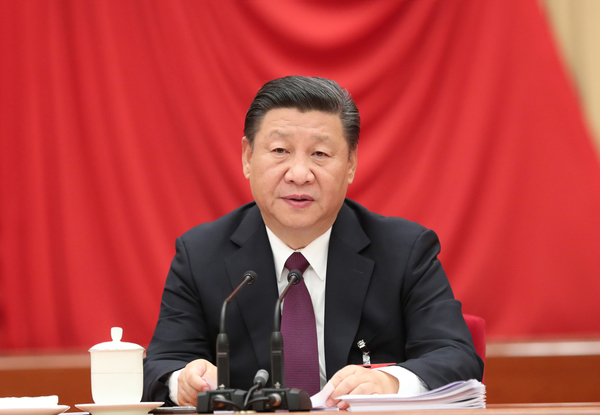
HONG KONG _ President Xi Jinping kicks off China's most important political event on Wednesday, a twice-a-decade meeting of party leaders that may signal if Xi will appoint a successor to rule after 2022.
Xi will start the weeklong event with what's known as the work report, seen as the ruling Communist Party's most significant policy document. It will cover achievements since Xi took power in 2012, and lay out his vision for everything from party building to the economy to the military.
At stake is whether Xi will amass enough power to push through tough reforms as the world's second-largest economy faces structural challenges over the next five years. At the same time, he's seeking to boost China's global clout with infrastructure spending while seeking to avoid a conflict with U.S. President Donald Trump over North Korea.
While economic growth has surprised on the upside in recent quarters, inefficient state-owned enterprises and ballooning corporate debt pose threats to stability. Last year, China saw its slowest full-year growth in about a quarter century, and S&P Global Ratings last month cut China's sovereign rating for the first time since 1999.
"The 19th Party Congress is effectively a confirmation of what we all know: Xi is the boss," said Jonathan Sullivan, director of China Policy Institute at University of Nottingham. "The question for the 19th is to what extent Xi's unquestioned dominance is manifest, not just in personnel and succession plans, but in terms of the next stage of 'reform.' "
Throughout the week, more than 2,000 delegates to 19th Party Congress will discuss and approve Xi's report and revisions to the party charter. They will also appoint a new Central Committee, which will elect the party's Politburo and its Standing Committee _ China's most powerful body _ the day after the congress ends on Oct. 24.
Xi is set to emerge as one of the country's top three leaders along with Deng Xiaoping and Mao Zedong, who founded the People's Republic of China in 1949. He'll be looking to secure a majority of allies on the new Standing Committee, which may potentially include possible successors who could rule until 2032.
The speech on Wednesday will likely run for more than an hour and include sections on politics, the economy, national defense, foreign policy and Hong Kong and Taiwan.
Last week Xi briefed Communist Party leaders on a draft of the work report, which included input from more than 4,700 people. It described the past five years as "an extraordinary period" with "ground-breaking" changes that put China's development at a "a new historical starting point."
On the economy, past practice shows the report will likely endorse detailed policies laid out in previous documents, including the 13th Five-Year Plan that began last year. It's likely to reaffirm the goal of attaining a "moderately prosperous society" by 2020.
One clue to gauge Xi's power will be the wording used in the speech on Wednesday to describe his political ideology. If the party constitution is revised to include Xi's name along with his philosophy as a "guiding principle," it would be an accolade that only Mao received previously while in office.
Another document that helped lay the groundwork for his report was a speech made late July to a party congress workshop attended by more than 300 provincial and ministerial level officials. It said China has evolved from "standing up" under Mao, to "getting rich" under Deng and is now "becoming strong" under Xi.
Xi is expected to recommit to the anti-corruption campaign, which has ensnared some 1 million officials since 2012 and sidelined many of his would-be rivals. Tuo Zhen, spokesman for the Party Congress, said at a briefing on Tuesday that the anti-corruption campaign "has achieved an unstoppable momentum" after five years.
He'll get a chance to summarize other major domestic and international programs he launched, from military reforms to the Belt-and-Road Initiative infrastructure initiative now involving about 70 countries.
"The past five years have seen a great change in China's position in the world," said Gu Su, professor of philosophy and law at Nanjing University. "The country has gradually jettisoned the 'lay-low' stance it's been practicing for three decades, and adopted a more proactive approach. It'd be interesting to see whether he'll officially set the tone for this new foreign policy approach."