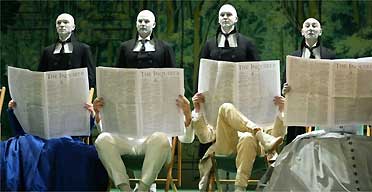
On the surface, Nicholas Hytner's production of Xerxes is a lavish realisation of Handel's light-hearted comedy. The opening scene sets an appropriately absurdist tone as Xerxes, sung by Sarah Connolly, sings of his love for a plane tree, in one of Handel's most famous arias, Ombra Mai Fu. English National Opera's revival, directed by Michael Walling, misses none of the burlesque immediacy of Handel's drama, but it also captures the work's emotional seriousness.
The production dramatises the variety of Handel's music with compelling subtlety. David Fielding's sets create an elaborate pleasure garden of aesthetic contemplation, with giant Abyssinian frescoes, luminous eggs, collapsing bridges, and a statue of Handel himself. The central characters are set in relief from the rest of Xerxes' court. The courtiers, dressed in grey and black, are played like moving statues, and process with a stiff formality and slowness. Amid this monochrome world, the passions and colours of Xerxes, Arsamenes, and Romilda are transcendental forces. This makes a powerful analogy with Handel's music, which moves away from the established forms of Italian opera, and instead of long sequences of arias there are vibrant ensemble pieces and fluid musical forms.
For all its intricacies of direction and design, it is the cast that brings this production to life, and their excellent vocal performances are complemented by effective acting. Sarah Connolly manages to turn the indulgent and selfish Xerxes into a sympathetic character, expressing his consuming lust for Romilda. But Rebecca Evans's Romilda and Robin Blaze's Arsamenes are the emotional heart of the piece, and the story of their separation and reunion encompasses everything from high drama to low farce. Iain Paterson plays Elviro with expert comic timing, and Mark Richardson's Ariodates has a bluff, stentorian splendour. Mary Nelson sings the flighty and deceitful Atalanta, trying her to ensnare Arsamenes for herself.
The playing of the ENO orchestra does not match the style and finesse of the rest of the production, but conductor Harry Bicket provides sympathetic support for the singers. But what is most impressive about this staging is the way the imagery so effortlessly illuminates Handel's music. At the end of the opera, Xerxes, surrounded by the detritus of statues he has just destroyed, realises the error of his actions, and resolves to marry Amastris. In the final number, his power and authority lie in ruins around him, as the cast sing in praise of love and happiness.
· In rep until November 30. Box office: 020-7632 8300.