NARUTO, Tokushima -- During World War I, a model for prisoner-of-war camps existed in Naruto, Tokushima Prefecture. It was named Bando Furyo Shuyojo.
A historic anecdote in which Toyohisa Matsue, head of the POW camp, treated the detained soldiers humanely, became widely known following the release of a movie.
The prison camp operated from 1917 to 1920, holding about 1,000 detainees, mainly German soldiers captured by the Imperial Japanese Army in Qingdao, China.
Inside the facility, the Germans proactively engaged in various activities such as music, dramatic plays and sports. They were also allowed to circulate their own newspaper.
Management of the camp was performed in a way that respected the prisoners' autonomy.
It is said that Matsue remarked about the camp: "The war prisoners are patriotic people, not criminals. I want to treat them with the same mercy samurai have.
Matsue's father was a samurai warrior with the former Aizu clan, which fought the new government forces in the Boshin War in the waning years of the Edo period. The entire Aizu clan was stigmatized as enemies of the emperor.
Because he had an up-close experience of watching the humiliation and sorrow on the side of the losers while growing up in wartime, it has been said Matsue was a person who never forgot to have gentleness and respect toward losing side.
He also encouraged exchange between the POWs and local residents that eventually created strong ties that went beyond the boundaries of friend and foe.
The movie, "Baruto no Gakuen," included scenes with the prisoners holding an exhibition of their works in front of Ryozenji temple (the first worshiping site of tours to holy spiritual spots in the Shikoku region), and the men enjoying sea bathing and going on an excursion. The captives also taught gymnastics to local middle school students.
The movie depicts exchanges between residents of Naruto and German war prisoners in the POW camp, which was located in the city's Oasacho area during World War I.
The 2006 release starred by Ken Matsudaira working under director Masanobu Deme. The ruins of the POW camp, where a cenotaph for German soldiers is now, was designated as a national historical site by the government in fiscal 2018.
It is currently run as an amusement facility called the German Village Park.
Production of the movie became a reality after Keisuke Hayashi, the eldest son of Yutaka Hayashi who is the basis for the mail delivery boy character in the film, studied the history of the POW camp by himself. He excavated areas on the site and encouraged the movie production company to make the film.
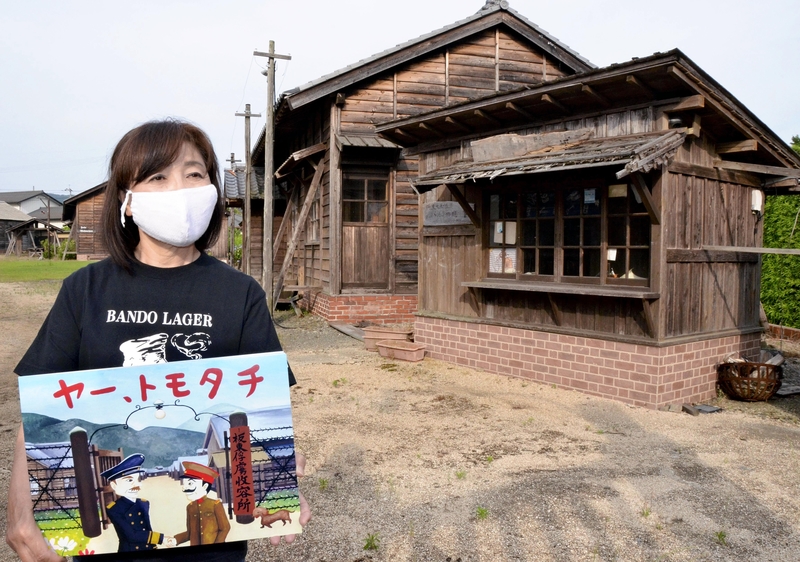
A number of on-location sets used during filming, including those within the city limits, and military barracks at the camp were relocated and still remain at the park.
Said Hiromi Hatakayama, 65, head of Doitsumura Bando Rokemura Hozonkai, a nonprofit organization: "We want to inherit the history of exchange that was achieved through Matsue's tolerant mentality toward the German soldiers."
She has continued giving lectures about the camp as a volunteer. Hatakayama published a set of picture-story shows entitled, "Ya, tomotachi," and holds informative meetings with members of the NPO, mainly in elementary schools within the city.
"In addition to Matsue's humanity toward the prisoners of war, the Bando area's local tradition, in which cultures of hospitality are deeply rooted, also contributed to the warm treatment toward them. I want to pass down the historical affair that was regarded as a POW camp miracle to future generations," she said.
At the POW camp, an orchestra was formed. Symphony No. 9, composed by Ludwig van Beethoven, was performed on June 1, 1918, in the city for the first time in Asia.
A concert to commemorate the 100th anniversary of the first performance of Symphony No. 9 and an unveiling ceremony of a bronze statue of Matsue were held in Naruto in June 2018. Descendants of the German war prisoners attended the events.
At the time, Yoshiko Hayashi, 54, the eldest daughter of Keisuke Hayashi, invited some of the descendants of the German soldiers to her home, in accordance with her late father's will.
"This exchange has continued for 100 years along three generations of us. I want to better grasp the details in the letters left by the German prisoners of war. By doing such things, I want to impart the facts about the 'miracle in Bando,' something my father spent a lifetime gathering, to future generations."
The Tokushima prefectural government and Germany have a increasing enthusiasm that they push for documents about the POW camp to be registered as a Memory of the World of UNESCO.
The understanding between Japan and Germany that has existed for more than a century goes beyond borders and remains active in the minds of many.
Read more from The Japan News at https://japannews.yomiuri.co.jp/