Ros Asquith writes:
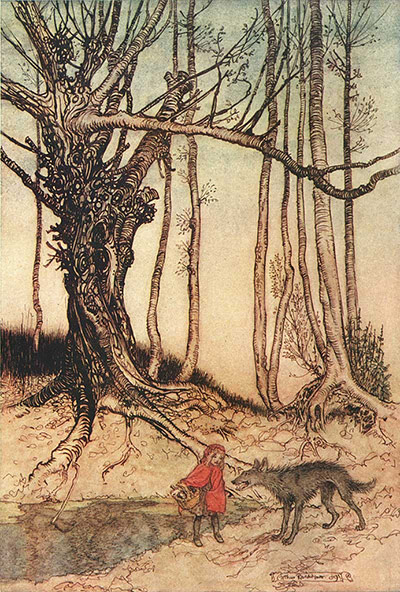
I discovered Arthur Rackham’s illustrations for Grimm's Fairy Tales aged seven and experienced simultaneous love, terror, enchantment and envy. Fairy tales should evoke such emotions but it was Rackham who drew me in. Here, Red Riding Hood innocently reveals her destination to the wolf, so enabling him to devour her grandmother. Dwarfed by her surroundings, she makes the reader long to cry out a warning. Rackham’s varied, fluent lines – a staccato wolf, vigorous tree, limpid girl – are overlaid with menace. Grimm's, for me, remains his masterpiece, but look too at his Gulliver’s Travels and Peter Pan, of which a contemporary critic wrote 'Mr Rackham seems to have dropped out of some cloud in Mr Barrie’s fairyland, sent by a special providence to make pictures in tune to his whimsical genius.'
Illustration: Arthur Rackham
Michael Rosen writes:
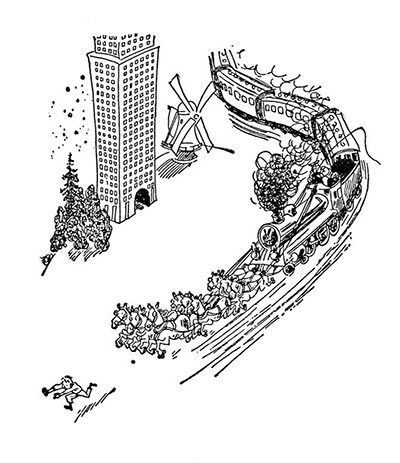
As a child, I was Emil, travelling from the suburbs to see friends in inner London; as an adult I admire what Kästner did to create one of the world’s first books which celebrate the excitement of the city. This illustration by Walter Trier represents Emil’s subversive moment and its consequence: it’s a representation of his nightmare as he is pursued for having drawn a moustache on a statue of the Grand Duke Charles. The wide space coupled with the speed in the picture seems exciting to me even now.
Illustration: Walter Trier
Jenny Uglow writes:
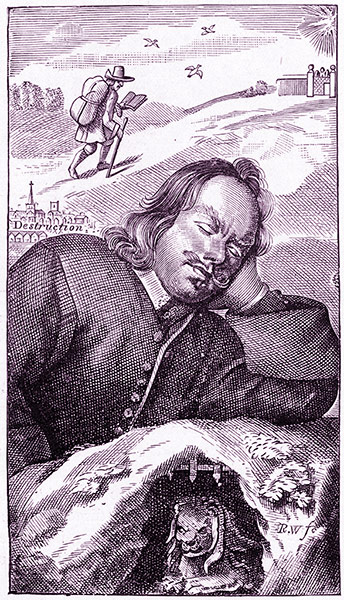
Robert White’s 1679 frontispiece to Bunyan’s Pilgrim’s Progress is faithful not only to the story but to the deep process of imagination itself: 'As I walked through the wilderness of this world, I lighted on a certain place, where there was a Denn; And I laid me down in the place to sleep: And as I slept I dreamed a dream.' He sees a man clothed with rags, a book in his hand, crying 'What shall I do?' We can almost feel the dreamer’s mind floating between visions and terrors, while the sensual lion looks out from his cave.
Photograph: Alamy
Martin Rowson writes:
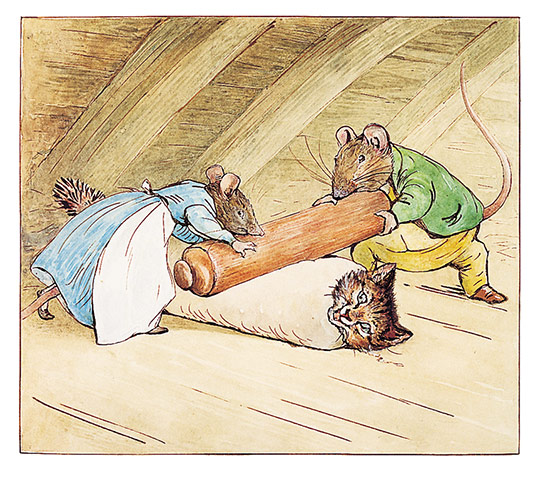
Beatrix Potter, despite the efforts of Graham Greene and many others, is still tarred with a certain National Trust tweeness, even though her tales of murder and separation are among the darkest if funniest books ever written. Those books would be nothing without their illustrations, and in her masterpiece, The Tale of Samuel Whiskers, she should have firmly established herself in a direct line of gothic illustrators stretching from Fuseli and Blake to Mervyn Peake. This picture, of Tom Kitten being turned into a roly-poly pudding, is among the funniest yet also most terrifying illustrations of the 20th century.
© Frederick Warne & Co. 2012
Bryan Talbot writes:
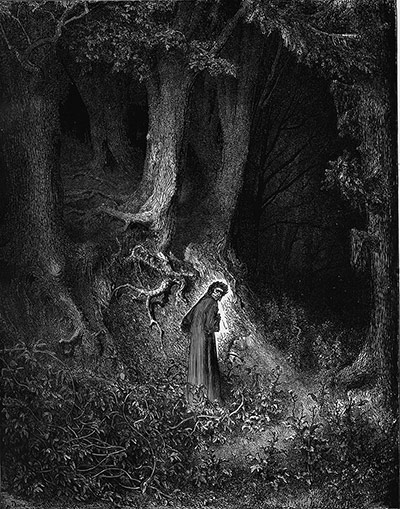
Deciding on a Gustave Doré illustration, given his prolific output, it’s hard to know which to choose. From his profusely illustrated Bible to his engravings of Coleridge’s 'Rime of The Ancient Mariner', his were the leading book illustrations both in Britain and in France, for more than three decades in the middle of the 19th century. He defined our image of Don Quixote and visually documented the London poor and their environs in London: A Pilgrimage, with iconic scenes of slums, prisons, street life and, famously, an opium den. This illustration, from the beginning of Dante’s Divine Comedy is a masterclass in composition, rendering and atmosphere. It exudes foreboding and dread, foreshadowing Dante’s imminent descent into a nightmare vision of hell.
Illustration: Gustave Doré
Roger Sabin writes:
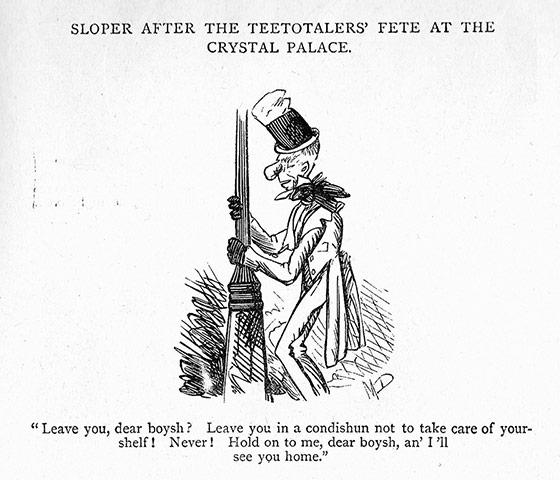
Ally Sloper, the character in this illustration from 1873, was one of the most recognisable comedy creations in the Victorian period – his name being a pun on sloping down the alleyway to avoid the rent collector. The signature MD stands for Marie Duval, arguably the first female cartoonist, and the gag was probably written by her husband, Charles Ross, the inventor of Sloper. Her scratchy style was perfect for the knockabout content, and a world away from the intensely 'inspectable' illustration associated with Punch. The image comes from a 210-page 'autobiography' of Sloper, entitled A Moral Lesson, which some historians count as the first graphic novel.
Illustration: Marie Duval
Will Self writes:
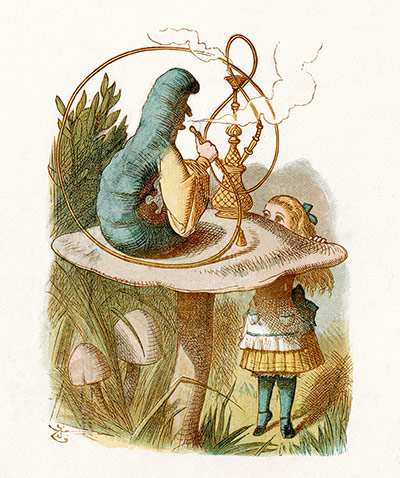
When I was a child my parents had a splendid edition of Alice in Wonderland with some of the Tenniel illustrations as shiny colour plates. I was obsessed by Alice – and the illustration that particularly gripped me was of the caterpillar sitting on the toadstool smoking his hookah. It’s easy to see why it exerted such a hold: Tenniel has used the cap and stalk of the toadstool to bisect it vertically and horizontally, and to suggest a strong lateral sightline by positioning Alice so that she looks towards the caterpillar (and beyond him, the reader). This deepens and extends the pictorial space into and out of the picture, so that the two static figures are paradoxically imbued with movement. It’s a suitably hallucinogenic effect – although we don’t know what the caterpillar is smoking in his hookah.
Photograph: Alamy
Philip Ardagh writes:
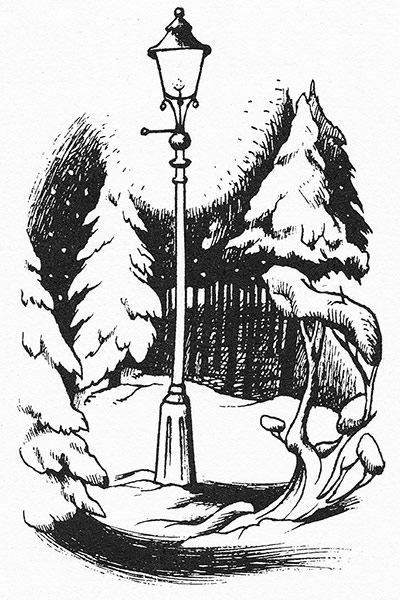
The childhood illustration with mythical properties for me is by Pauline Baynes. It is very small, and black and white: our first glimpse of Narnia in The Lion, the Witch and the Wardrobe, after the soft folds of the coats are replaced with rough tree branches, and the wood of the wardrobe replaced by 'something soft and powdery'. Lucy sees a light and, 10 minutes later, finds its source: a lamppost illuminating a small clearing of snow-laden trees. It fills me with all the magic of Christmas, and acts as a beacon for the amazing adventures that are to come. It also brings back the treasured memory of my father reading me a chapter, on the sofa, every Saturday morning.
© CS Lewis Pte Ltd 1950
Posy Simmonds writes:
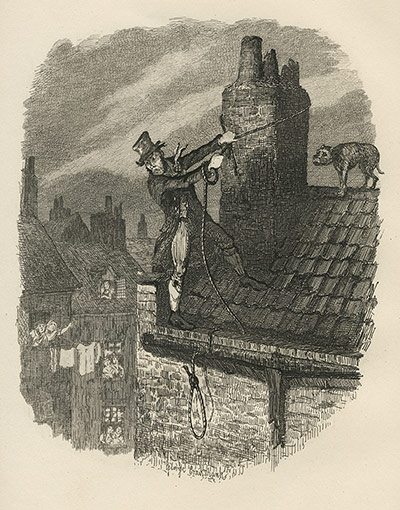
This is one of Cruikshank’s illustrations for Oliver Twist, depicting Bill Sykes’s desperate attempt to escape the mob. It was a scene that Charles Dickens, in a letter to the artist, advised him not to try to illustrate: 'It is so complicated, with such a multitude of figures, such violent action and torchlight, to boot, that a small plate could not take in the slightest idea of it.' But in an etching of four inches by four, Cruikshank produced a thrillingly macabre and haunting image, the drama emphasised by the diagonals of clouds, rope and tiles. These seem to edge Sykes towards the vertical space to the left, down which he will shortly plunge to his death.
Photograph: Alamy
Alexandra Harris writes:
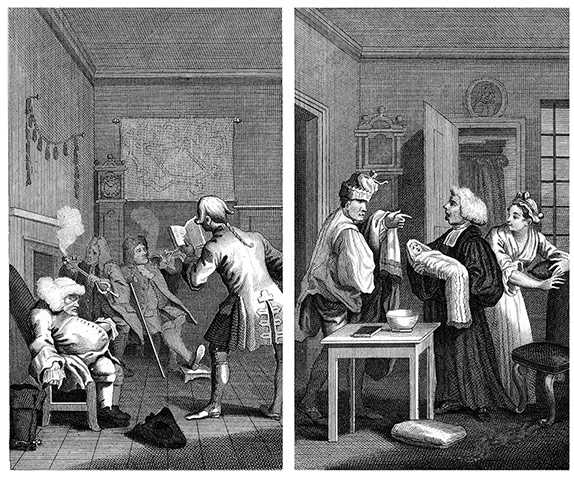
The illustrator Sterne most wanted to work with was Hogarth: “What would I not give,” he wrote, “to have but ten Strokes of Howgarth’s witty Chissel.” Here is Corporal Trim in a pose carefully adopted for reading a sermon aloud, “bent forwards just so far as to make an angle of 85 degrees and a half”. Walter and Toby lounge by the clock, puffing and ruminating. Dr Slop is snoozing quietly. Above them all, Hogarth brilliantly draws in the spacious architecture of a room that seems to have been expecting inhabitants of a different stature. Somewhere nearby, poor Mrs Shandy is trying to give birth. But Hogarth’s figures, utterly absorbed and absorbing, will go on ignoring her forever. Photograph: Alamy








.png?w=600)