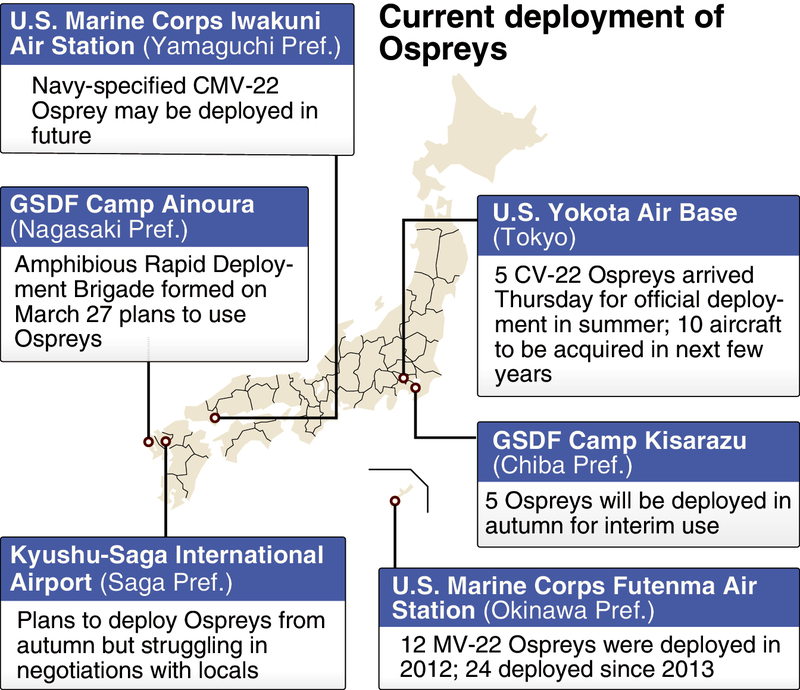
The central government and the U.S. side face the task of explaining about the safety of the CV-22 Osprey and other relevant issues to people living around Yokota Air Base following the arrival of five of the aircraft at the facility.
Since 2015, when the U.S. government first announced its plan to deploy the aircraft at the base, five cities and a town in the vicinity of the base have demanded that relevant authorities present evidence confirming their safety. Although they said they cannot accept the deployment without confirming the safety of the aircraft, sufficient explanation has not been given.
The Yokota base occupies one-third of the city area of Fussa in western Tokyo. Fussa Mayor Ikuo Kato said, "On top of safety issues, we'd like to provide information about flight routes and training to citizens."
Ome Mayor Keiichi Hamanaka on Thursday sent a letter to Foreign Minister Taro Kono and Defense Minister Itsunori Onodera that read: "The Japanese government should take responsibility for explaining the deployment to citizens."
Residents have mixed feelings. Kazutada Tsuruta, a member of a citizens group opposing the Yokota base, said, "There are many houses and schools in the neighborhood, and the deployment is absolutely unacceptable."
However, an 82-year-old Fussa man said, "There is no choice but to deploy [the Ospreys] as there are concerns about North Korea's moves."
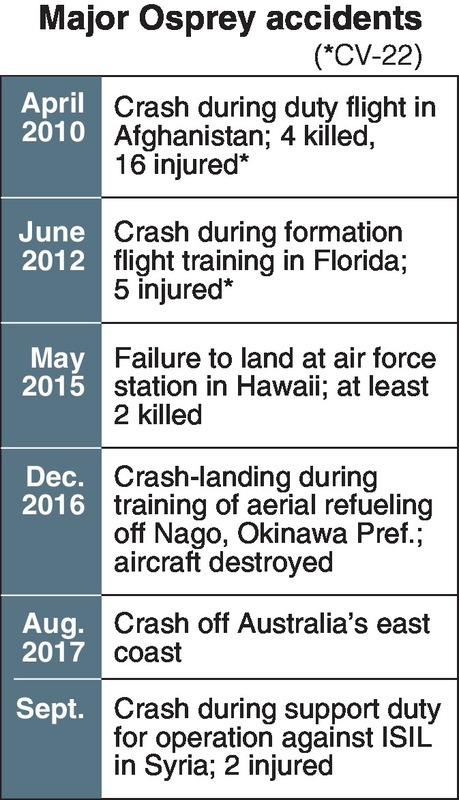
A series of accidents involving Ospreys has been reported in and outside Japan.
In December 2016, an Osprey belonging to the U.S. Marine Corps' Futenma Air Station in Ginowan, Okinawa Prefecture, crash-landed off the coast of Nago, also in the prefecture.
According to the Defense Ministry, the rate of serious accidents per 100,000 flight hours of the U.S. Marine Corps' MV-22 Osprey's was 3.24 as of the end of September last year -- higher than the average rate of 2.72 for all Marine Corps aircraft. There is no comparable data available for the CV-22, but the aircraft's basic structure is the same as the MV-22.
An agreement between Japan and the United States on the MV-22 deployment includes a clause stipulating that the aircraft must avoid flying over densely populated areas as much as possible. The U.S. side has said it will comply with the agreement for the CV-22 as well.
The Defense Ministry will call for safe operations, such as by choosing safe flight routes.
Read more from The Japan News at https://japannews.yomiuri.co.jp/