
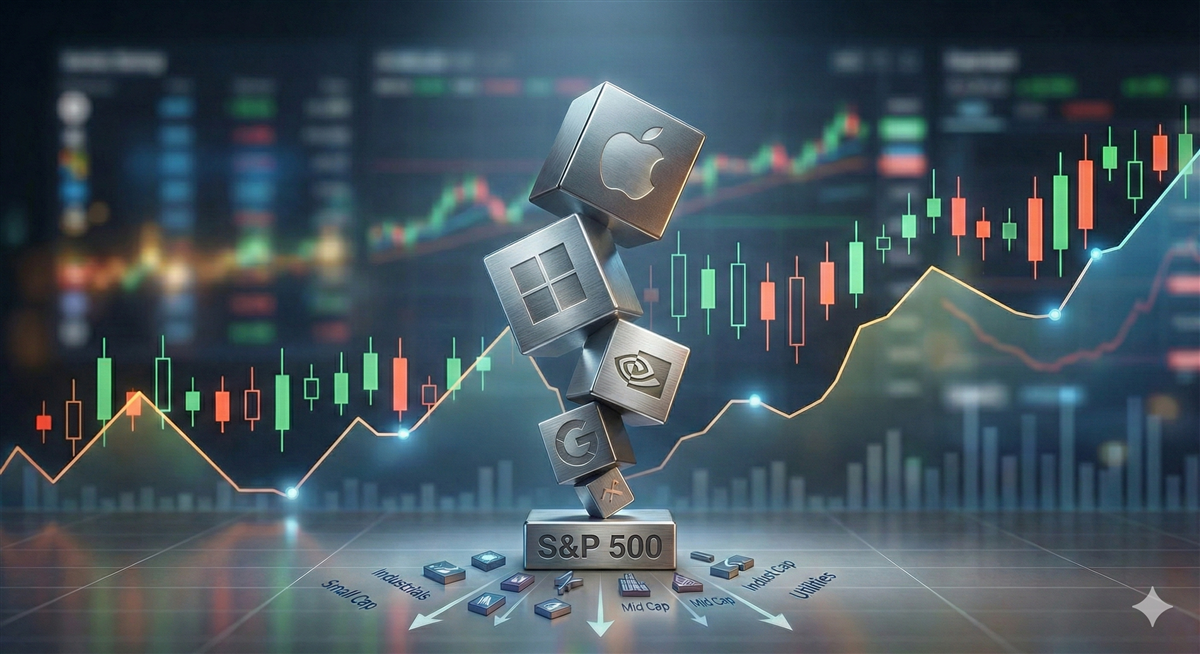
As the world’s largest companies keep growing larger, it is increasingly important for investors to understand concentration risk. Below, we’ll detail what concentration risk is and why it is becoming more relevant. We’ll also dive into a key ETF that can help investors counteract it.
Concentration Risk Is Rising, Amplified by “AI Bubble” Fears
Concentration risk refers to the growing dominance of a small group of stocks in a portfolio or index. As this occurs, a portfolio becomes increasingly dependent on the success of a few companies. This creates potential upside—but also heightened vulnerability if those companies falter.
The Magnificent Seven provides a straightforward way to understand concentration risk. As of Nov. 28, those seven companies combined make up around 35% of the S&P 500 Index’s weighting. While accounting for less than 2% of the 500 stocks in the index, they determine 35% of its return. One can see how this makes the performance of an S&P 500 investment highly predicated on the performance of a small number of stocks. This is a clear representation of concentration risk.
Investors broadly exposed to the S&P 500 are more susceptible to this trend. In 2015, the top ten stocks made up only 20% of the index, per data from Columbia Threadneedle Investments. That figure is significantly higher today at 35%.
Concentration risk becomes an even bigger issue when considering the possibility of an AI bubble. The Magnificent Seven contains the companies that are investing the most in AI. If this bubble were to burst, as many fear, these stocks would likely be among the hardest hit.
Understanding the S&P 500’s Weighting: The Big Get Bigger
Concentration within the S&P 500 Index is rising because of its weighting methodology. Market capitalization determines the index's weighting—the higher a company’s market cap, the higher the percentage of the index it accounts for. NVIDIA (NASDAQ: NVDA) has the highest market cap of any company in the world at around $4.4 trillion. As a result, it also makes up the highest percentage of any stock in the S&P 500 at around 7.4%.
As the Magnificent Seven stocks have often outperformed the S&P 500, they are becoming a larger portion of the index. Over the past two years, the Roundhill Magnificent Seven ETF (BATS: MAGS) has delivered a total return of around 110%. That is more than double the S&P 500’s return near 52%. This illustrates how concentrated gains—and risks—have become.
RSP: Using Equal Weighting to Reduce Concentration Risk
That’s where the Invesco S&P 500 Equal Weight ETF (NYSEARCA: RSP) comes in, with a weighting methodology that can help mitigate concentration risk.
Instead of weighting each stock in the S&P 500 Index by market cap, RSP weights each one equally.
At the beginning of each quarter, Invesco rebalances RSP so that every stock makes up approximately 0.2% of the fund.
This weighting ensures that a giant like NVIDIA would have the same influence on the fund's return as Conagra Brands (NYSE: CAG), one of the smallest stocks in the S&P 500.
This helps mitigate concentration risk, as each of the 500 stocks is equally important to the fund’s overall return.
It also helps diffuse AI-related risks, as many S&P 500 stocks are not directly tied to this investment theme.
Investors should be aware that the actual weight of each stock in the RSP will fluctuate between quarter-end dates. Warner Bros. Discovery (NASDAQ: WBD) is up 26% in Q3, pushing its allocation within RSP to nearly 0.4%. Down 29% in Q3, Oracle (NYSE: ORCL) has fallen to around 0.1% of RSP.
It's important to note that over long time periods, RSP has underperformed the S&P 500. Over the past 10 years, RSP’s total return has been approximately 186%. That compares to an approximately 286% return for the S&P 500.
This performance gap reflects how the market-cap approach has favored larger, faster-growing companies. While past performance is no guarantee of future results, this history suggests that avoiding concentration risk may come with trade-offs in returns.
Where Should You Invest $1,000 Right Now?
Before you make your next trade, you'll want to hear this.
MarketBeat keeps track of Wall Street's top-rated and best performing research analysts and the stocks they recommend to their clients on a daily basis.
Our team has identified the five stocks that top analysts are quietly whispering to their clients to buy now before the broader market catches on... and none of the big name stocks were on the list.
They believe these five stocks are the five best companies for investors to buy now...
The article "Worried About Mag 7 Concentration Risk? This ETF Could Help" first appeared on MarketBeat.