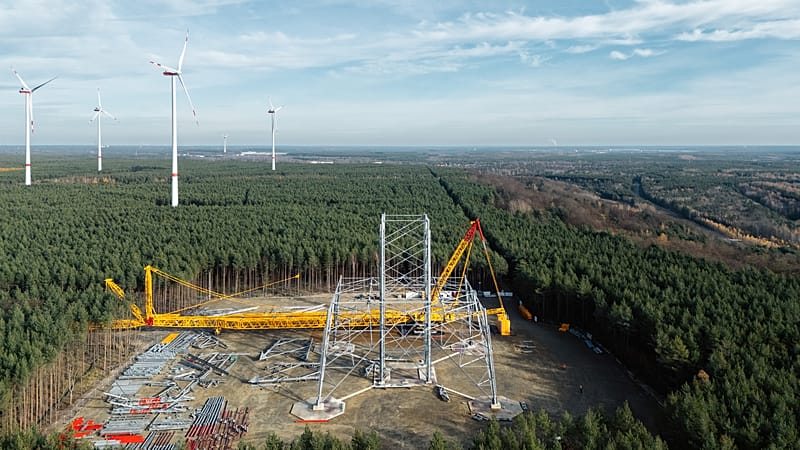
In a region of Germany once dominated by coal mines, a remarkable pivot to clean energy is underway.
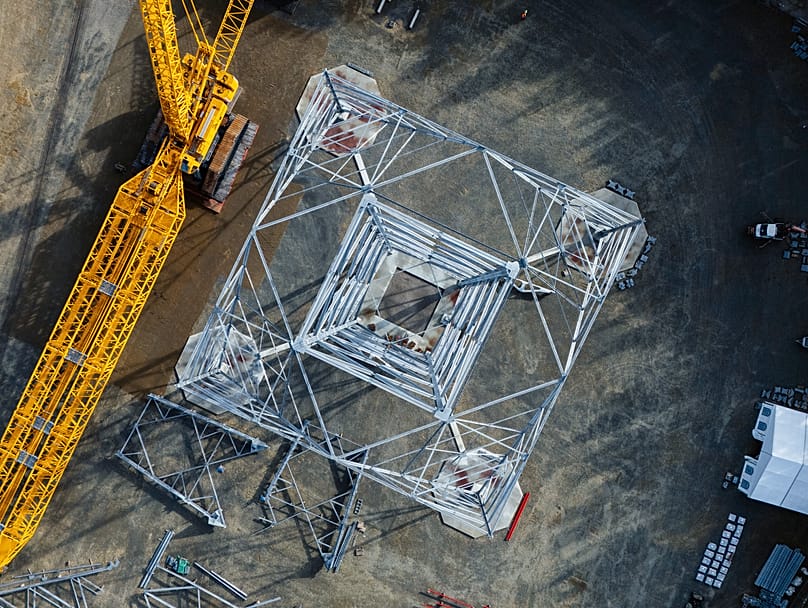
A huge crane is in position, steel girders are being assembled and a lattice mast is gradually rising into the sky. If all goes to plan, the world's tallest wind turbine will be built here in Schipkau, a small town in Brandenburg.
At a time when the Iran war is driving up energy prices for Europeans, the project could not be more needed. "This will help us to become independent of oil and gas from other regions of the world," says Germany's Federal Environment Minister Carsten Schneider.
A telescopic device will raise the wind turbine up to its full height
Once completed, the turbine will be 360m high, equivalent to a 100-storey building. It will be the second tallest structure in Germany, after the Berlin television tower which stands at 368m.
What's the advantage of such a giant structure? The wind blows more strongly and steadily above 300m, allowing for more wind energy to be produced.
You might be wondering how a structure as narrow and free standing as a turbine can possibly be built this high. Conventional cranes are not up to the job, after all. Instead, a patented telescopic device will be used.
The turbine will initially reach a height of 150 metres, then the telescopic device will raise is up to 300 metres.
The groundbreaking project has not been without its challenges. At the end of 2025, problems were discovered with steel parts meaning work had to be stopped. Construction is thankfully now back on track. "Safety and quality have absolute priority in this globally unique project," says Jochen Großmann, construction company GICON's CEO and founder .
If all goes to plan, the wind power giant should be connected to the grid towards the end of 2026.
How much energy will the wind turbine produce?
GICON say they hope for an annual electricity yield of 30-33 gigawatt hours and electricity production costs of less than five cents per kilowatt hour. This is 220 per cent more than conventional turbines nearby and could supply approximately 7,500 four-person households with electricity.
High-altitude wind turbines could be a win in less windy European countries
The higher a wind turbine stands, the stronger and more evenly the wind usually blows. GICON, which says it has been working on the technology since 2010, wanted to scientifically validate this assumption.
On behalf of beventum GmbH, a subsidiary of the Federal Agency for Leap Innovations (SPRIND), the company erected a wind-measuring mast in neighbouring Klettwitz. This showed that the wind does in fact blow more steadily and strongly at a height of 300 metres than at the height of conventional wind turbines.
Large parts of Europe, from eastern Poland to the Iberian Peninsula, have trouble benefitting from wind power due to weak ground winds. High-altitude wind towers could be the answer. SPRIND emphasises: "Europe needs a strong position in wind turbine construction in order to guarantee its own energy production."
Where is the world's tallest wind turbine?
Schipkau is located in Lusatia, a region that was characterised by coal for decades before going through remarkable changes. Authorities in the area now incentivise clean energy projects, offering space, infrastructure and political support.
In the long term, the site is to be developed into a hybrid power plant, with two levels of wind power and a solar park on the ground.
This triple use should quintuple the energy yield compared to pure solar use. The combination of different energy sources should also make it possible to generate electricity year round.
Clean energy is wasted all over Europe due to outdated grids
This ambitious project highlights a problem which is becoming more and more obvious all over Europe: outdated grids can not keep up with the booming growth in renewable infrastructure.
In Germany this creates an expensive irony: if more electricity flows into the grid in windy north-east Germany than the lines can transport to the high-consumption south, wind turbines have to be throttled back or switched off. This means fossil gas and other dirty fuels have to fill the gap, driving increases in prices for consumers as well as more carbon emissions.
According to analysis by German media Tagesspiegel, around 9.3 terawatt hours of wind power were lost in 2023 alone. The costs for congestion management amounted to almost €3 billion and these are borne by consumers via the grid fees that are added to their electricity bills.
GICON and its client SPRIND argue that high-altitude wind towers could alleviate this dilemma in the long term: because high-altitude winds blow more evenly and turbines could also be operated economically where ground winds are too weak, expansion could be more decentralised.
Europe favours wind power
At the end of 2025, around 304 gigawatts of wind power were installed onshore and offshore in Europe, according to the German Wind Energy Association.
With around 77.7 gigawatts of installed capacity, Germany was ahead of the UK with 31.6 gigawatts and Spain with 31.2 gigawatts.
With 5,735 megawatts of newly installed capacity, Germany added more than any other European country in 2025.
Germany is pushing for more renewable energy
At the end of March, German Federal Environment Minister Carsten Schneider presented the Climate Protection Programme 2026 in the Bundestag: 67 measures aimed at saving an additional 25 million tonnes of CO₂ by 2030.
2,000 more wind turbines are to be awarded in the upcoming tenders than previously planned. In addition, 12 gigawatts of wind power capacity will be put out to tender to be connected to the grid by 2030.