Information communications technology (ICT) is increasingly being used worldwide to help prevent the new coronavirus from spreading further, including tracking infection clusters and ascertaining the movements of people in such groups.
Tracking the locations of such people via smartphone apps has been effective in some Asian countries, and the United States and European countries are following suit.
At the suggestion of a goverment expert panel, Japan has also established an ICT task force comprising members from different ministries and agencies, and from both the public and private sectors.
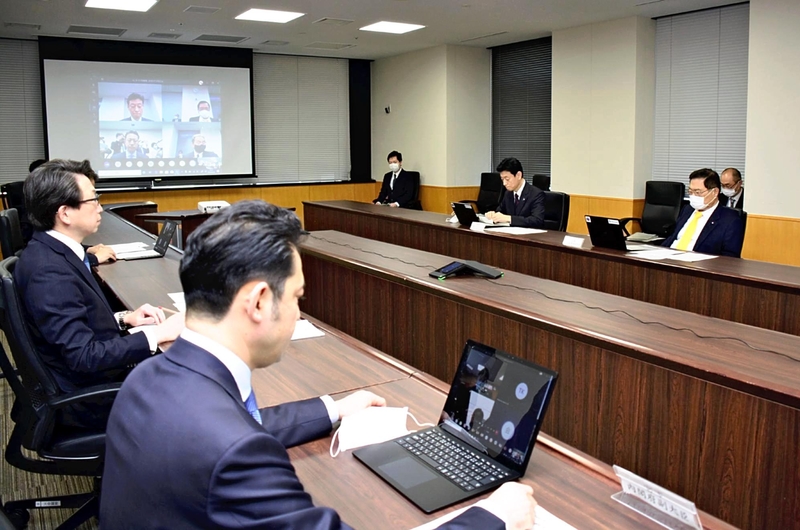
On April 6, the government held the first meeting of the Anti-Covid-19 Tech Team, which considers how to utilize ICT to battle the new coronavirus. Corporate representatives attended via teleconferencing.
During the meeting, members proposed such methods as searching for locations where clusters have occurred by combining the contents of online information searches and location information from smartphones, as well as measures to assist teleworking at home through video apps.
Participants representing the government, including Yasutoshi Nishimura, minister in charge of economic revitalization, took notes with serious expressions on their faces.
"You could see the urgency felt by the government, which had not taken notable action," an ICT specialist said.
Under the strategy to cope with infection clusters, which the government emphasizes as a Japanese-style anti-infection method, primarily officials of public health centers interview people who have been infected and collect information about other people who have had close contact with the infected persons.
Working-level officials are exhausted as the number of infections has rapidly increased, leading to delays in the discovery of infection clusters.
"Utilizing personal information [through ICT] is one option to search for clusters quickly," said Shigeru Omi, former regional director for the Western Pacific Region of the World Health Organization and deputy chair of the government's expert panel.
In other Asian countries, location information and payment records gained through smartphone apps have been used to ascertain the movements of infected people, and the measure has been effective.
Particularly well known is TraceTogether, a free smartphone app developed by the Singapore government that utilizes the Bluetooth wireless communication standard installed in most smartphones. Identification numbers, that are allocated to the telephone numbers of nearby people, are recorded in smartphones carrying the app.
Through this data, the app has helped determine the routes of infected people and search for those who had close contact with infected people.
The system takes users' privacy into consideration and does not use the global positioning system (GPS) through which authorities can trace individuals over an unlimited range. Instead it records only information from smartphones near specific sites.
Moves to develop and introduce similar apps have also begun in the United States, Europe and Japan.
Though Singapore has limited the spread of infections through the app, recently more than 50 new infections have been reported daily. Like Japan, the infection routes for an increasing number of people have not been identifiable, so the app has not been effective lately.
On April 7, the Singapore government switched from its previous policy of avoiding as much as possible measures that could negatively impact economic activities, and adopted the stance of closing all companies and stores except those are essential for daily life.
ICT is not a silver bullet. The technology needs to be used in parallel with restrictions on people's movement and other forcible actions for containing infections.
Concern remains over administrative authorities being allowed to use personal information.
"Japan's Law on the Protection of Personal Information allows as exceptions the use of personal information for purposes other than the original intention, or the provision of the information to third parties, in cases in which doing so is particularly necessary for public health," said Kohei Yoshimine, a lawyer well versed in issues related to personal information and privacy. "Even so, it's necessary to secure transparency and obtain consent from the public."
Read more from The Japan News at https://japannews.yomiuri.co.jp/