Right. That’s it from all of us on the liveblog. Many thanks for your company and comments. We leave you with Liz Ford’s report on a historic day.
To cheers, applause and probably a tinge of relief, the 17 global goals that will provide the blueprint for the world’s development over the next 15 years were ratified by UN member states in New York on Friday.
After speeches from Pope Francis and the Nobel laureate Malala Yousafzai, and songs from Shakira and Angelique Kidjo, the ambitious agenda – which aims to tackle poverty, climate change and inequality for all people in all countries – was signed off by 193 countries at the start of a three-day UN summit on sustainable development …
… The global goals summit continues until Sunday, after when all eyes will be on the UN climate talks in November.
Asked if the goals will be scuppered without a strong deal in Paris, Mogens Lykketoft, the president of the UN general assembly, was hesitant, saying leaders were making more commitments than they were in previous COP meetings. “From what we know and hope for, we will be approaching a better deal.”
Here’s the latest take on the pope’s speech from my colleagues Suzanne Goldenberg and Stephanie Kirchgaessner:
The pope demanded justice for the weak and affirmed the rights of the environment on Friday in a forceful speech to the United Nations that warned against “a selfish and boundless thirst for power and material prosperity”.
A day after making history by becoming the first pope to address Congress, Francis for the first time asserted that nature – as well as humanity – had rights.
“It must be stated that a true ‘right of the environment’ does exist,” Francis said.
An attack on the environment was an assault on the rights and living conditions of the most vulnerable, he said, warning that at its most extreme, environmental degradation threatened humanity’s survival.
“Any harm done to the environment, therefore is harm done to humanity,” Francis said. “The ecological crisis, and the large-scale destruction of biodiversity, can threaten the very existence of the human species,” he concluded.
Updated
The Danish prime minister, Lars Rasmussen, is getting some rather stinging criticism on Twitter for remarking that “history will judge us” on whether we achieve the new goals. (ODA is official development assistance, or foreign aid.)
@LizFordGuardian ...while his Government simultaneously cuts ODA! #Globaldev
— Helle Aagaard (@helleaagaard) September 25, 2015
Like Richard Curtis, the global goals ambassador and vlogger Tanya Burr is all about the sharing. She started the #TBGlobalGoals campaign, to get people to tell others about the goal they support most passionately, and in this YouTube video she calls on her audience to help make the goals a reality.
Kary Stewart spoke to Burr about her mission to spread the word.
Updated
With the agenda for the next 15 years agreed, here’s some heartening news from Nigeria on a landmark in public health: the country is set to be removed from the list of polio endemic countries. More from the BBC here.
Updated
Some late reaction to the pope’s speech:
@Pontifex can turn a phrase: "We must avoid every temptation to fall into a declarationist nominalism which would assuage our consciences."
— Mark Leon Goldberg (@MarkLGoldberg) September 25, 2015
Liz Ford has just been talking to Neven Mimica, the European commissioner for international cooperation and and development, about the next big meeting in what is routinely described as “a crucial year” for development.
Mimica said the Paris climate talks were an ‘indispensable part of the concept of meeting the sustainable development goals … You can’t have a sustainable future without a sustainable environment and planet’.
He added that an agreement among leaders at the financing for development conference in Addis Ababa in July and the adoption of the SDGs had sent a strong message to Paris that leaders need to agree firm commitments.
Updated
In a project inspired by the millennium development goals, photographer Nick Danziger began, in 2005, to create an archive of images documenting the lives of women and children in eight countries around the world. He returned five years later, and again in 2015. Had the goals made a difference to their lives? His exhibition, Revisited, runs at New York’s University of Columbia until 15 October, and at London’s Royal Geographic Society, 2-6 November.

Don’t forget to add your thoughts to our open thread. We’re asking which SDG you think should be on the top of your country’s priority list. So far peace and security comes up trumps.
Also present at the UN general assembly today was a well known member of the British secret service. Well, sort of. Daniel Craig, AKA James Bond, was in New York in his role as the first UN global advocate for the elimination of mines and other explosive hazards.
The actor made a public service announcement entitled Explosive Hazards Prevent Progress to support the UN secretary general and Richard Curtis’ Project Everyone, which aims to make the global goals famous. He said:
The fear that unexploded ordnance that is just littered around after a conflict, what that does to a local population, it stops them from being normal, stops them from having a normal life and getting on and rebuilding.
Still no official word from the UN or the Vatican on what they make of Sam Smith’s theme for the new Bond film …

It’s not only global leaders, UN officials and journalists descending on the UN headquarters in New York, young campaigners are making their mark too. This was the mood last night at Action/2015’s Under One Sky event. Looks like everyone was in high spirits! Thanks to Kary Stewart for capturing the scene.
Updated
Nick Thomson, CEO of the Africa Governance Initiative (AGI), says that leaders will face tough choices when it come to implementing the SDGs:
Strengthening the foundations of Africa’s burgeoning democracies requires governments to deliver change that affects peoples’ lives on a daily basis whether that’s new roads, better health clinics or reliable electricity. But a piecemeal approach to delivering on all 17 of the SDGs is unlikely to deliver the kind of tangible improvements people expect and demand – no one benefits from half a road built, or a power station with no one to invest in the network, or schools with no teachers. Democracy will only take hold if governments are given the space to make the choices this entails, even if the priorities of outsiders get set aside in the process.
This week marks the end of the beginning for a new era of development. The vision is bigger than ever before. As the Global Goals move from paper to practice we need to work with national governments to lead this agenda and to respect the choices they make. Ultimately these countries know best the people who stand to win or lose when politicians get things right or wrong. If the international community is willing to step back and allow national governments to choose the right ‘framework within the framework’, then the SDGs will truly be something to celebrate.
And some reaction from Ben Jackson, CEO of Bond, the UK umbrella network of over 460 international development organisations:
The pope speaking out about climate change 10 years ago would have been unheard of and an unthinkable concept. Now it’s actually happened it shows the centre of gravity on the issues raised within the SDGs have shifted. Inequality is another example of issues coming into the mainstream consciousness.
It will be interesting to see what the reaction will be from other areas of society such as the private sector and world leaders following his speech, when it comes to implementing the goals.
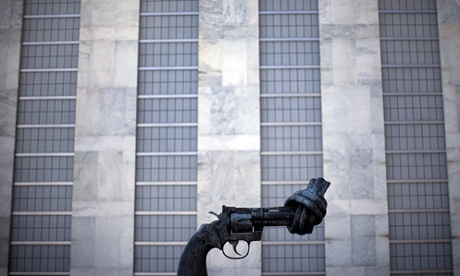
In case you weren’t on the guest list today, here’s a peek inside the UN headquarters (on a much quieter day).
Richard Curtis has been working with the UN as founder of Project Everyone, to help raise awareness of the global goals. He spoke to my colleague Kary Stewart about how people should step up and take part.
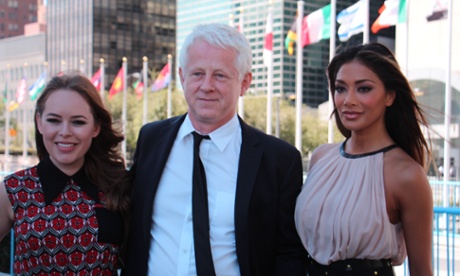
Liz Ford has filed a report on today’s momentous events in New York. Here’s a flavour of it. I’ll link to the full piece soon.
To cheers, applause and probably a tinge of relief, the 17 global goals that will provide the blueprint for the world’s development over the next 15 years were ratified by UN member states in New York on Friday.
After speeches from Pope Francis and the Nobel laureate Malala Yusuf, and songs from Shakira and Angelique Kidjo, the ambitious agenda – which aims to tackle poverty, climate change and inequality for all people in all countries –was signed off by 193 countries at the start of a three-day UN summit on sustainable development.
But beyond the fanfare here was a quieter recognition that without adequate financing, strong data collection and the political will to implement the goals, 2030 will not deliver the transformative agenda desired.
The UN secretary general, Ban Ki-moon, said the true test of commitment to the new global goals will be implementation.
‘We need action from everyone, everywhere. Seventeen sustainable development goals are our guide,’ he told delegates.
‘They are a to-do list for people and planet, and a blueprint for success. To achieve these new global goals, we will need your high-level political commitment. We will need a renewed global partnership.’
He added: ‘The 2030 agenda compels us to look beyond national boundaries and short-term interests and act in solidarity for the long-term.
‘We can no longer afford to think and work in silos. Institutions will have to become fit for purpose, a grand new purpose.’
Gender equality campaigners say the pope’s speech sidelined the rights of women globally, particularly on the issue of reproductive health rights. Shareen Gokal from the Association of Women’s Rights in Development had this to say:
The Pope would do well to take the opportunity in his address in front of the United Nations to ask forgiveness for the death and injury of millions of women, particularity those living in poverty, who have had unsafe abortions because of the lack of mercy of the institution that he represents.
Given his respect of the role of the UN in the “codification and development of international law, the establishment of international norms regarding human rights, advances in humanitarian law”, we ask that the Pope hold to account the Holy See, the entity representing the Vatican at the UN in it’s unwavering opposition to sexual rights and the reproductive health and rights of women at every opportunity they are giving in negotiations to respect and further these norms.
Moreover, the Pope rather than praising the Church in it’s handing of sexual abuse cases, he should respect the findings and recommendations of two of the UN committees that the Holy See was brought in front of — the UN Committee for the Rights of the Child and the UN Committee Against Torture which exposed the role of the Vatican in perpetuating sexual abuse cases, declared clerical sexual abuse as a form of torture and other cruel, inhuman, degrading treatment or punishment and asked the Vatican to open files on sexual assault, hold perpetrators to account and provide redress for victims— none of these recommendations have thus far been followed by the institution he represents.
The length of Modi’s address did not go unnoticed at the UN general assembly, either. As one UN official noted - to much laughter:
I thank Prime Minister Narendra Modi. Representing 1.2 billion people, he had to exceed the time by 13 minutes. That means one minute for every 100 million people.
Modi said he was confident that the world would rise to the challenge of the SDGs and ended his address with a quotation from an ancient Indian text:
May all be happy, may all be healthy, may all see welfare and may there be no sorrow of any kind.
The SDG agenda chimes strongly with India’s own strategies for ensuring sustainable development and empowering the poor, Modi said. He cited bank accounts and insurance for the poor as a concrete example of the government’s commitment to reducing poverty.
The world must look beyond the public and private sector in its development thinking, he added, and think also of the “personal sector”. In India, said Modi, initiatives were already under way to help people lift themselves and their families out of poverty.
The country is also working to empower and educate women - “Save the girl child, educate the girl child!” - and to make its cities “smart and sustainable” engines of progress, said the prime minister.
Updated
Not to be outdone by fellow singer Shakira, Nicole Scherzinger has been explaining to my colleague Kary Stewart why she is in New York to support the global goals.

In a lengthy address, the Indian prime minister, Narendra Modi, has invoked Mahatma Gandhi and praised the UN’s “lofty and comprehensive” agenda for the next 15 years. He said that a “just world, a peaceful world and a world with sustainable development” will never be possible until poverty is eliminated.

Updated
Bill Gates waiting for listening #popeFrancis #PopeInUs #PopeInNYC #PopeInUN pic.twitter.com/VfgGMYzTo3
— Antonio Spadaro SJ (@antoniospadaro) September 25, 2015
More plaudits for the pope’s speech - this time from the president of the International Committee of the Red Cross
Congratulations to @Pontifex for a moving speech at #UNGA. #humanitarian work, just like all religions, is founded on principle of #humanity
— Peter Maurer (@PMaurerICRC) September 25, 2015
Meanwhile - and on a jarringly different note - the BBC has an intriguing piece on how the pope’s visit to the US has sparked a craze for dressing dogs as the pontiff. Yes. Really. It gives a whole new meaning to the phrase petrine ministry ...
As we noted earlier, the pope’s speech to the UN general assembly was very heavy on the importance of protecting the environment. Over at Crux, the Vatican expert and journalist John L Allen Jr explains - with a bit of help from Humphrey Bogart - why the pope sees action on the environment as such a priority:
One of the iconic lines from “Casablanca” comes when Humphrey Bogart tells Ingrid Bergman, “We’ll always have Paris.” Speaking to the United Nations on Friday, Pope Francis effectively served up a negative version of that sentiment, insisting that we won’t always have Paris.
Paris, in this case, is a reference to a looming UN summit on climate change set to run from Nov. 30 to Dec. 11, known in shorthand as Cop21 because it’s the 21st yearly session of the “Conference of the Parties” to a 1992 UN framework convention on climate change.
It’s been clear for some time that Francis sees the Paris summit as a critical turning point …
Updated
My colleague Liz Ford has just sent this from the UN in New York:
I’m hearing disquiet over the amount of time Britain’s prime minister, David Cameron, is spending in New York at the summit, and particularly that he’s not attending the Beijing+20 event on Sunday, which is being organised by UN Women and the Chinese government.
Seventy other heads of state are due to attend, and given the UK’s strong emphasis on empowering women and girls, this has struck ActionAid in particular as odd. The NGO has launched a twitter action to press Cameron to attend on Sunday and lodged a 60,000 signature petition. ActionAid is asking supporters to tweet: @David_Cameron will you stand with #fearless women by attending @UN_women Global Leaders’ Meeting on Sunday? @actionaiduk

Updated
Dr Flavia Bustreo, assistant director-general, family, women’s and children’s health cluster, World Health Organisation, has this reaction to the adoption of the goals:
The new global strategy for women’s, children’s and adolescents’ health puts people at the centre of the sustainable development goals (SDGs) and aims to mobilise everyone, governments, businesses, academia, civil society, in ensuring their success.
Only by putting women, children and adolescents at their heart can the SDGs bring about the transformation needed to attain and sustain the future we want, where women, children and adolescents everywhere have the opportunity to live healthy and prosperous lives.
In 2010, when progress towards the millennium development goals 4 (to reduce child mortality) and 5a (to reduce maternal mortality) stalled, we seized the opportunity to make a course correction and mobilised countries and partners around the global strategy. As a result, investment increased, silos among different sectors were broken, and deaths of mothers and children fell in the targeted countries.
The SDGs recognise that so many aspects of development impact one another and are interrelated and interdependent. Benefits from the MDGs will not be ‘diluted’ as the world moves into the SDGs. Instead, the SDGs will strengthen our focus, helping us create healthier societies and promote wellbeing for everyone, everywhere.
Do you know how many sustainable development goals there are? Or which countries they’ll apply to? Take our SDG quiz and let us know how you go …
Updated
Commenting on the global goals, Phumzile Mlambo-Ngcuka, executive director of UN Women, told Liz Ford that the process had gone much better than she thought it would.
There really were moments when I thought the thing was going to collapse because it was so inclusive, and views were so divergent and everyone felt so strongly about what they wanted to see [in them]. But in the end there a common agenda emerged.
She added that implementation was “really going to be the big, big, big challenge”, but lessons had been learned from the millennium development goals.
If you look back at the MDGs, we didn’t achieve everything, not every country has done as well as we would have liked ... [but] gaps have been identified and we know where are the areas where we have not performed well … Experience has been built.
She added:
We don’t have to convince women’s organisations and civil society, we have that. We have gone out of our way to bring in men and boys. We’ve also been reaching to religious leaders and traditional leaders ... so we’ve invested a lot in this outreach and invested a lot in making sure gender was front-and-centre of the SDGs.
Responding to concerns that the limited targets on women’s rights in the SDGs would supersede the stronger call for action in the Beijing platform for action, adopted 20 years ago, Mlambo-Ngcuka said it was not a case of either-or.
Beijing still stands in its own right but also we have to be practical … for implementation we have to find a way of overlapping, a way forward in implementation of Beijing and implementation of the SDGs. Fortunately, the areas that the two documents focus on do overlap so it should not be too difficult to do that.
UN Women will be hosting an event with the Chinese government on Sunday to specifically look at the gaps in implementation of the Beijing agreement.

Updated
Amnesty International’s Salil Shetty has received a lot of praise for his admirably blunt and passionate speech to the UN general assembly. Here it is in its entirety. Well worth a read:
Secretary General of the United Nations, world leaders:
I speak today both on behalf of the global Amnesty International movement with more than seven million members and activists, and also for many independent civil society organisations around the world.
At the outset, I congratulate you for the remarkable progress the world has seen through the Millennium Development Goals.
But increasingly we hear the question, is our world spinning out of its axis? It can feel that way. Hundreds of millions of people still live in poverty. Too many people, particularly women and girls, routinely suffer violence and multiple human rights violations.
Inequality, injustice, environmental destruction and corruption are a toxic combination. There is declining trust in governments and big corporations and young people across the world are rising in protest. Horrific conflicts are destroying communities and countries and have fuelled the largest global refugee crisis since the Second World War.
The appalling story of the three-year-old Syrian child Alan Kurdi, whose dead body on the beach shocked the world, sums it up. We cannot hide the reality of the world we live in.
And then … there is the world we want, the world represented by the Sustainable Development Goals.
We cannot blame people for being sceptical when they see yet another Summit Declaration.
There is a huge gap between the world we live in, and the world we want.
But these goals represent people’s aspirations and rights and they must and can be realised.
So I suggest four practical tests to realise the goals and prove the sceptics wrong:
1. First, the ownership test. The key to success is for poor and marginalised people to be primary decision makers at every stage. The Sustainable Development Goals must be resourced and integrated in national and local plans and budgets, and they must be implemented in line with the state’s existing human rights obligations.
2. Second, the accountability test. People should know exactly what governments have promised and what they have delivered – the right to information. And if governments don’t deliver, people should be able to hold them to account through independent mechanisms. It is not enough anymore for governments to say that they are legitimate because they were elected or have a mandate. They have to be accountable to the people directly on an ongoing basis.
3. Third, the non-discrimination test. Let us be clear. Leaving no one behind means challenging power structures and enforcing the rule of law. Inequality is largely the direct result of discrimination and exclusion based on gender, race, descent, religion or other status. Inequality is the consequence of the failure to protect the rights of the marginalised, Indigenous peoples, minorities, migrants, persons with disabilities, children and the elderly.
4. Fourth, the coherence test. We are all aware of countries which performed very well on the Millennium Development Goals . But outrage against persistent human rights violations led to revolutions. Why? Because people’s lives are not divided into development, environment, peace and human rights – only bureaucracies are. Coherence and consistency is essential.
You cannot claim to support sustainable development when you are reluctant to reduce the consumption of the rich or transfer technology. You cannot preach about human rights while practising mass surveillance. You cannot lecture about peace while being the world’s largest manufacturers of arms. You cannot allow your corporations to use financial and tax loopholes while railing against corruption. You cannot adopt the Sustainable Development Goals and at the same time attack and arrest peaceful protesters and dissenters. You cannot launch these Sustainable Development Goals and in parallel deny a safe and legal route to refugees, a life with dignity.
Esteemed leaders,
The Sustainable Development Goals present a compass for decent jobs, for justice, for humanity. As civil society, we will stand with the poor and marginalized at all costs. And we will hold governments and businesses to account.
Thousands of people marched last night for the Sustainable Development Goals to light the way. They called for authentic leadership from you, leadership with integrity, leadership from the heart. I know that you can live up to their hopes.
Thank you.
An interesting World Economic Forum piece here from Robert Muggah and John de Boer on how cities fit into the SDG agenda. They argue that the sustainable development fight will be won or lost in our cities:
The United Nations is on the cusp of making history. The much-anticipated Sustainable Development Goals (SDGs) set out a bold and detailed global agenda to guide development for the next fifteen years. And it is arguably the eleventh goal, SDG 11, and its promotion of safer, more inclusive and resilient cities that makes them genuinely revolutionary. After all, two thirds of humanity will reside in urban settings by 2030. By 2050, roughly 6.4 billion people – almost the equivalent of the planet’s current population – will live in a city. The future success of the SDGs resides, in large part, in cities …
Manish Bapna, executive vice president and managing director, World Resources Institute:
The SDGs are a remarkable achievement that set a bold new agenda for international development. Reflecting profound changes in the world, the new SDGs apply to all countries and importantly put environmental sustainability at their core. The SDGs recognise that we cannot eradicate extreme poverty and ensure lasting economic growth without also caring for the planet.
Fortunately, there are a growing number of examples where poverty reduction, economic growth and environmental protection go hand-in-hand. This includes creating compact cities that focus on people, restoring degraded land, expanding access to low-carbon energy, and many more.
Of course, it’s not enough to have good goals. Now, it’s up to governments – and others in the private sector, international organisations, and civil society – to follow through on this vision. By setting smart policies, encouraging sustainable investment, and measuring progress, countries can put us on a path to achieve these goals.
If successful, the SDGs will usher in a radical shift in development. We can move away from today’s imbalanced approach to one that benefits all people and protects the planet at the same time.
Reactions from the Overseas Development Institute (ODI) and the Institute of Development Studies (IDS) here ...
Kevin Watkins, director of the ODI:
We welcome the ambition of new global goals. And individual governments should be held to account for delivering on that ambition. Our research highlights the scale of the challenge. We are not on track for hitting any of the targets. Changing this picture will take a relentless focus on inequality and the poorest who are being left behind.”
Professor Melissa Leach, director of the IDS:
The transformative and universal ambitions of the SDGs are welcome and mark a new era in global development. The process now to hold governments and the international community to account for delivery is critical. Building and sustaining political momentum is key, and can be facilitated by grassroots action and campaigns as well as formal processes.
Equally, developing meaningful international and national indicators to motivate and measure progress is vital, but the process must remain transparent and inclusive, be informed by a broad range of evidence and mutual learning and take account of the views of the poorest and most marginalised if the goals are to be achieved.
But what does the EU make of it all? Step forward EC First Vice-President Frans Timmermans, who is responsible for sustainable development and leading the commission delegation:
This agreement is a historic event, and a significant step forward for global action on sustainable development. I am proud to say that from the start, the EU has been strongly committed to reaching an ambitious outcome, with a universal agenda for all countries, rich and poor alike, fully integrating the economic, social and environmental dimensions of sustainability. The result is a landmark achievement uniting the whole world around common goals for a more sustainable future. We are determined to implement the 2030 agenda which will shape our internal and external policies, ensuring the EU plays its full part.
And now … Christian Aid’s chief executive, Loretta Minghella, who says the goals will be realised only if governments are fully committed to their financing and implementation.
We are not naïve. We know that while we talk about the goals, children are dying from preventable diseases, women and girls are falling victim to violence and exploitation, catastrophic climate change threatens and fences and barbed wire are going up to separate us, one from the other.
So we stand at a crossroads between pain and hope. Only our collective commitment and determination to bring the goals into being will determine the path ahead.
The star-studded events this weekend in New York must be just the start of determined effort in every country – not the point at which we can congratulate ourselves and feel our work is done.
These new goals apply in every country, including the UK. They will need to be translated into detailed and fully-costed action plans, if they are to amount to more than mere words on a page and help to secure the just, sustainable and peaceful world we long for.
Here’s an audio clip from Justin Forsyth, chief executive of Save the Children, talking about the need for world leaders to deliver on the goals.
Dissent alert! Not everyone, it seems, is totally enamoured of the goals. According to the campaign group Global Justice Now, the SDGs miss the point. This from their director, Nick Dearden:
Obviously we all want to get rid of poverty – but we can’t do that by continuing ‘business as usual’ or simply wishing poverty away. Some people are very poor because others are very rich. So challenging poverty also means challenging wealth, challenging power. And the SDGs aren’t up to the job.
The obscene levels of inequality and poverty that we see around the world have been driven by the imposition of a set of economic policies, which have benefited some and been disastrous for many others. The SDGs advocate more of the same.
Development cannot be separated from any conception of politics or power. Poverty isn’t simply the difference between living on $1.20 and $1.40 a day. It’s about lacking power over those resources that you need to live a decent life – food, water, shelter, access to healthcare, education. If one person – or corporation – controls them, that means others don’t. The SDGs stress the need to provide access to resources for the poor, but fail to mention the need to challenge power relations which allow the elite to monopolise global resources.
The sharper-eyed among you will probably have noticed that some people are referring to the global goals. Yes, they do mean the sustainable development goals (SDGs). There seems to be a concerted push to rebrand the SDGs as the slightly snappier global goals (for sustainable development). It will be interesting to see which name sticks …

Updated
Toby Porter, Chief Executive of HelpAge International:
This summit is not business as usual. The Global Goals give us an unparalleled opportunity to bring older people fully into the picture. We can, and must ensure that the international and national development agenda dominating the next 15 years recognises and responds to the global phenomenon of population ageing, supporting women and men as they age.
The sustainable development agenda pledges to ‘leave no-one behind’, and older age or older people are included directly or by implication in 15 of the 17 Global Goals and their targets with key phrases including ‘all ages’, ‘older persons’ and ‘lifelong’. The language of ‘action for all ages’, the life course and intergenerational approaches seem finally to have brought about an appreciation that women and men share the same human rights as they age.
Speaking from New York, Justin Forsyth, chief executive of Save the Children said:
These goals have genuine teeth and substance and we shouldn’t underestimate that nearly 200 world leaders have stood up at the United Nations and publicly committed to doing this.
They build on massive progress over the last decade – including halving child mortality – and pave the way to end extreme poverty and preventable child deaths for good in the next fifteen years. This is a watershed moment we should celebrate.
Barbara Frost, Chief Executive of WaterAid:
This is a moment of transformation for our world – a chance to change the course of history and reach those who are poorest and most vulnerable in our world, so that they can reach their potential. Water, sanitation and hygiene are fundamental– no society ever truly achieved modernity and prosperity while its people were forced to relieve themselves in bushes or walk miles to collect dirty water for their families. By delivering these essential services, the lives of hundreds of millions of people will be transformed, and it is possible with the right political commitment, innovative thinking and new sources of funding.
And now Michael Elliott, president and CEO of the ONE campaign
The adoption of the Global Goals is a truly historic occasion, amounting to the world’s biggest promise to itself since the global settlement at the end of World War II. Ours can be the generation that ends extreme poverty and fights inequality; and the last to be threatened by climate change. That amounts to both an audacious challenge and an incredible opportunity.
The Global Goals will provide a critical set of priorities for global development over the next 15 years. They acknowledge that no person should be forced to live in hunger or die of a preventable disease, and that poverty hits women and girls hardest. The Goals reflect a shared commitment to real partnership — a more sophisticated approach to global development than the world has ever seen. This is a once-in-a-generation moment that the world cannot afford to squander. With the world’s population due to soar in the next few decades — especially in vulnerable regions — failing to achieve the Global Goals will mean that today’s difficult problems will become tomorrow’s impossible ones.
We know that words alone won’t end extreme poverty. It’s what people do with those words that matters, and whether those words are used to hold those same governments to account. It’s going to take hard work to turn these aspirations into reality, as well as an unprecedented global focus on better data and on making sure that leaders are held accountable for what they promise.
When world leaders return to their home countries, they need to make sure that their own people know about the goals. A global system of public national report cards should be developed to allow citizens to monitor progress and make sure that the promises made in the Global Goals are promises kept.
The world can do this. It was Nelson Mandela who said that, ‘sometimes, it falls upon a generation to be great.’ We can be that generation. We can fulfill his dream, and we can make extreme poverty history.”
Here’s ActionAid’s chief executive, Adriano Campolina:
The sustainable development goals are a step forward as they identify the causes of poverty, but unless we change the rules that govern the global system, the same players will keep winning. We need to build a more just future for all people and the planet where it’s no longer just money that talks and the gaps in society are narrower.”
Inequality is increasing in almost every country in the world, leading to high youth unemployment, poorly paid jobs, and leaving many people without access to basic services like health and education.
Attempts by governments to address these problems by encouraging large-scale private sector investment have failed. Large-scale mining and agricultural plantations have instead kicked poor farmers off their land, often with little or no compensation.
Campolina added: “We need to make sure that people living in poverty around the world benefit from these new development goals. Massive corporate investments alone will not guarantee a reduction in poverty and inequality. Governments must change the rules of the game and stop looking to the corporate sector for all the answers. We urgently need to address inequality if these new development goals are to stand a chance of succeeding in the next 15 years.”
Updated
Given this is such a pivotal moment, lots and lots of NGOs, agencies, activists and academics are keen to share their responses and counsels following the adoption of the sustainable development goals. Here’s the first of many:
The new sustainable development goals are ambitious on paper – and they could be historic in their impact. They seek to go beyond band-aid solutions by setting out to eradicate – not just reduce – extreme poverty and hunger in every country,” said Winnie Byanyima, executive director of Oxfam International.
“The key is to welcome the richest people back in touch with the rest of society, rather than allowing them to exist on the margins of privilege.”
Oxfam praised the new focus of “leaving no one behind”, but warned this requires the participation of the most vulnerable and marginalised people so they can hold their governments to account and claim their rights. Women must be central to realising these goals, while at the same time the concentrated power of vested interests must be challenged and those interests held more accountable by governments and citizens.
“With 17 goals and 169 targets, this promise is a necessarily complicated one,” continued Byanyima. “To leave no one behind, we have to understand the many barriers people face, from economic and gender inequality to how the most vulnerable are the most affected by climate change. The goals are achievable, but it cannot be business as usual. Governments – rich and poor – must defy vested interests that seek to maintain the status quo at the expense of people and the planet.”
To meet this shift of power, Oxfam says national and international financing rules must be rewritten, including a clamp down on tax avoidance by multinational companies, and measures by governments to ensure the richest contribute more equally to the rest of society. Additionally, an agreement at the Paris climate talks that delivers for the poorest must be made if “zero hunger” is to ever be achieved.
“We can indeed be the first generation to eradicate extreme poverty and hunger, but we are the last generation that can avert catastrophic climate change. We are all responsible for making this happen,” said Byanyima. “Our political leaders have set the goals. There is a collective responsibility now to achieve them.”
Updated
Now that the sustainable development goals are formally adopted, we want to hear from you. Which of the 17 goals should your country prioritise? Share your thoughts in our open thread.
Here are Ban Ki-Moon’s full remarks from the opening of the summit:
We have reached a defining moment in human history.
The people of the world have asked us to shine a light on a future of promise and opportunity.
Member States have responded with the 2030 Agenda for Sustainable Development.
The new agenda is a promise by leaders to all people everywhere.
It is a universal, integrated and transformative vision for a better world.
It is an agenda for people, to end poverty in all its forms.
An agenda for the planet, our common home.
An agenda for shared prosperity, peace and partnership.
It conveys the urgency of climate action.
It is rooted in gender equality and respect for the rights of all.
Above all, it pledges to leave no one behind.
The true test of commitment to Agenda 2030 will be implementation.
We need action from everyone, everywhere.
Seventeen Sustainable Development Goals are our guide.
They are a to-do list for people and planet, and a blueprint for success.
To achieve these new global goals, we will need your high-level political commitment.
We will need a renewed global partnership.
The Millennium Development Goals showed what is possible when we work together.
The Addis Ababa Action Agenda has given us a solid financing framework.
Let us build on these foundations.
To do better, we must do differently.
The 2030 Agenda compels us to look beyond national boundaries and short-term interests and act in solidarity for the long-term.
We can no longer afford to think and work in silos.
Institutions will have to become fit for purpose, a grand new purpose.
The United Nations system is strongly committed to supporting Member States in this great new endeavour.
We need to start the new era on the right foot.
I call on all governments to adopt a robust universal climate agreement in Paris in December.
I am encouraged that several countries are already working to incorporate the 2030 Agenda into their national development strategies.
But no-one can succeed working alone.
We must engage all actors, as we did in shaping the Agenda.
We must include parliaments and local governments, and work with cities and rural areas.
We must rally businesses and entrepreneurs.
We must involve civil society in defining and implementing policies – and give it the space to hold us to account.
We must listen to scientists and academia.
We will need to embrace a data revolution.
Most important, we must set to work – now.
Seventy years ago, the United Nations rose from the ashes of war.
Governments agreed on a visionary Charter dedicated to ‘We the Peoples’.
The Agenda you are adopting today advances the goals of the Charter.
It embodies the aspirations of people everywhere for lives of peace, security and dignity on a healthy planet.
Let us today pledge to light the path to this transformative vision.
I count on your strong leadership and commitment.
Thank you
UN adopts the sustainable development goals
- The UN has voted to adopt the sustainable development goals, which will set the global development agenda for the next 15 years
- The pope addressed the UN general assembly, asserting that the environment – as well as humanity – has rights, and calling for a dramatic rethink of the relationship between people and the Earth
- Salil Shetty, Amnesty International secretary general, warned the UN general assembly that their pledges would need to be backed by action, accountability and inclusivity if the goals were to succeed
Updated
And after a quick vote, it is done:
And to cheers, flag waving and applause the #globalgoals are adopted! #globaldev
— Liz Ford (@LizFordGuardian) September 25, 2015
Updated
Here’s what my colleague Carla Kweifio-Okai made of the pope’s decision to put the accent on the environment in his opening address:
The shift to a greater emphasis on the environment in the pope’s speech reflects a similar movement at grassroots level. The millennium development goals, introduced in 2000, were criticised by environmental campaigners for failing to prioritise the impacts of climate change on countries’ social and economic development. The goals that will be adopted today move climate change to the top of the priority list, alongside poverty and inequality, acknowledging that the three issues cannot be tackled in isolation.
I attended last night’s Light the Way rally in London, which was part of a global call by campaigners to take the new goals seriously. I was surprised to see just how many environmental activists were at the event, people who once felt they were at the fringes of the anti-poverty movement. One woman I spoke to said that the new agenda’s emphasis on the environment had brought her “back to the fold”, after years of feeling like the environmental and anti-poverty movements were failing to work together. Time will tell whether this new approach yields results.
Next up is Salil Shetty, secretary-general of Amnesty International.
.@SalilShetty, SG of @amnesty at #UNGA - #GlobalGoals represent peoples' aspirations & rights pic.twitter.com/aCWP9fLFOK
— UN Environment (@UNEP) September 25, 2015
He says although there is “a huge gap between the world we live in and the world we want”, there are four ways to achieve it. The sustainable development goals (SDGs) must be inclusive and owned by those they are intended to help, he says. There must be sufficient information to allow people to hold their governments to account. The goals must not discriminate, marginalise, nor leave anyone behind. Finally, he says, they must be coherent and consistent. Countries must live the value they espouse as part of the SDGs, says Shetty. There is no room for hypocrisy and double standards and governments and businesses must be held to account. That means treating refugees well, collecting taxes properly and not basking in the glow of the SDGs while producing large quantities of arms, he concludes.
Updated
The UN secretary-general, Ban Ki-Moon, is now talking to the UN general assembly about the need to cooperate to protect the environment as the world prepares for December’s UN climate change talks in Paris.
“We can no longer afford to work in silos,” he says.
If the pope’s speech has whetted your appetite for complex development agendas, why not try this sustainable development goals quiz by my colleague Carla Kweifio-Okai? There are, we are sorry to say, no prizes. It is commendably educational, though …
Updated
And here’s what the Guardian’s religion correspondent, Harriet Sherwood, made of the speech
While paying fulsome tribute to the United Nations on its 70th birthday, Pope Francis also appeared to be rebuking the global body for too much talk and not enough action.
On the UN’s achievements, he ticked off the development of international law and human rights norms, conflict resolution, peace-keeping and reconciliation. ‘All these achievements are lights which help to dispel the darkness of the disorder caused by unrestrained ambitions and collective forms of selfishness,’ he said.
But later in his speech, Francis also said: ‘Solemn commitments, however, are not enough, even though they are a necessary step toward solutions.’
He made a clear call to action by the UN and its member states on very specific fronts, warning against ‘declarationist nominalism’ – something that is very much a feature of the UN and its myriad agencies.
This is what he said: ‘Our world demands of all government leaders a will which is effective, practical and constant, concrete steps and immediate measures for preserving and improving the natural environment and thus putting an end as quickly as possible to the phenomenon of social and economic exclusion, with its baneful consequences: human trafficking, the marketing of human organs and tissues, the sexual exploitation of boys and girls, slave labour, including prostitution, the drug and weapons trade, terrorism and international organized crime. Such is the magnitude of these situations and their toll in innocent lives, that we must avoid every temptation to fall into a declarationist nominalism which would assuage our consciences. We need to ensure that our institutions are truly effective in the struggle against all these scourges.’
And if that was not enough, Francis later delivered an even more pointed reproach. Citing the preamble of the UN’s charter, he said: ‘The ideal of “saving succeeding generations from the scourge of war”, and “promoting social progress and better standards of life in larger freedom” risks becoming an unattainable illusion, or, even worse, idle chatter which serves as a cover for all kinds of abuse and corruption.’
There’s been plenty of abuse and corruption in the UN’s history. No doubt Ban Ki-moon and others in the hall will have squirmed to hear the pope’s words.
Here’s some quick reaction to the pope’s speech from my colleague Liz Ford, deputy editor of the Guardian’s global development site:
After all the fanfare, the road closures and the excitement, Pope Francis finally gave his speech to the UN general assembly. It was peppered with applause and at times cheers. But did it go far enough to stir people into action? I’m not sure.
There were important words on protecting the environment, people, particularly the poorest, and ending inequality. There was a strong call to fully implement the non-proliferation of arms treaty in “letter and spirit”, which will go down well with many.
And you can’t argue with calls for leaders to work for peace not war. But I’ll admit, I was expecting something stronger - not quite naming and shaming leaders, but giving them a harder slap on the wrists than I feel they got.
And as for women … Well, things aren’t about to get any easier for activists trying to ensure women’s rights are upheld. The fact that it’s international contraception day tomorrow will not be lost on them.
In case you are wondering what Shakira is doing at the UN - besides covering Lennon’s Imagine – here’s a 2009 profile of the singer and her charity work.
Shakira’s Pies Descalzos [Bare Feet] Foundation, which she started at 19, has so far provided education and jobs for over 30,000 Colombians. Wider Latin America now has 54 million children aged five and under, 32 million of whom live in poverty: this she has more recently attempted to address by co-founding Falas (Fundacion América Latina en Acción Solidaria), a broad coalition of artists, writers and musicians attempting to kick-start similar, wider projects over the continent. “It’s the only way out of this awful set of circumstances, where if people are born poor then they die poor, and accept it. I never thought it was fair for an 8-year-old child not to be able to afford shoes, or to wander the streets having to beg for money. To know that child’s joy would end soon, when they realised there was no future. In Colombia, in Latin America, the kids are still very smiley, enjoy music, have very high spirits. And yet you know that society is one day soon going to crush them and any dreams like … cockroaches.”

Updated
Nobel laureate Malala Yousafzai has just addressed a crowd at the UN, standing in front of 193 young people from each of the member states. “Promise us that you will keep your commitments and invest in our future,” she urged.

Updated
Worth a quick look backwards as the UN prepares to sign off the development agenda for the next 15 years. Just how successful were the millennium development goals, which will soon be replaced by the sustainable development goals? Here’s our take on the UN’s own final progress report:
The millennium development goals (MDGs) have driven “the most successful anti-poverty movement in history” and brought more than a billion people out of extreme penury, but their achievements have been mixed and the world remains deeply riven by inequality, the UN’s final report (pdf) on the goals has concluded.
Ban Ki-moon, the UN secretary general, said that while the 15-year push to meet the eight goals – on poverty, education, gender equality, child mortality, maternal health, disease, the environment and global partnership – had yielded some astonishing results, it had left too many people behind.
“The MDGs helped to lift more than one billion people out of extreme poverty, to make inroads against hunger, to enable more girls to attend school than ever before and to protect our planet,” he said.
“Yet for all the remarkable gains, I am keenly aware that inequalities persist and that progress has been uneven.”
Shakira’s Lennon cover gets the thumbs-up from a former first minister of Scotland
Stunning performance of #Imagine by @shakira starts the opening ceremony of #UNGA70 @GlobalGoalsUN #LeaveNoOneBehind pic.twitter.com/chACpLFgnH
— Jack McConnell (@LordMcConnell) September 25, 2015
And this just in from Liz Ford at the UN:
Shakira’s singing Imagine to the UN general assembly while the pope is being serenaded by other singers outside the room
PS A colleague misread Liz’s dispatch and wondered, momentarily, why the pope was singing Imagine ...
Here’s what WaterAid head Barbara Frost had to say about the pope’s speech and his references to the importance of safe drinking water:
Pope Francis has shone a light on the plight of the poorest and most vulnerable, who are most affected by climate change and by the tremendous inequalities that exist in our world today. He has done much to reaffirm access to safe, drinkable water and sanitation as basic and universal rights essential to health and dignity. And he has asked us all to care for everyone on our planet.
Well, that was a thorough and immensely well-received address. Notable that it was as much – if not slightly more – about the environment as about human development. Evidence, perhaps, of the pope’s belief that the two simply cannot be separated.
Updated
Reactions to the pope’s speech are now rolling in. This from Neil Thorns of Catholic aid agency CAFOD:
Pope Francis’ UN speech served as a metaphor for his whole US visit, focusing on power, inequality and climate change. He was unequivocal that today’s social and economic exclusion is a total denial of human brotherhood and a grave attack on human rights and the environment. Which other leaders will now step up, join Francis and leave a legacy of which we can be proud?”
He ends with a blessing of everyone present and is greeted with a long, standing ovation.
He quotes from Pope Paul VI on the dangers of man having ever more powerful instruments to bring about ruin as much as progress. We must care for the unborn, for children, for old people, for the abandoned and for all those reduced to mere statistics, says the pope. To quote Paul VI again, “the edifice of modern civilisation has to be built on spiritual principles because they are the only ones capable of not only supporting it it but also of illuminating it”.
And now a Martín Fierro reference. As an Argentinian, no surprise to hear the pope referencing the classic gaucho poem on the importance of sticking together. Up there with maté and asados in Argentinian culture.
He now turns to the drug trade: another scourge that is often accompanied by money laundering and the trafficking of people and weapons.
The plight of those suffering and dying in Ukraine, Syria, Iraq, Libya, South Sudan and the Great Lakes region of Africa must not be forgotten, says the pope. The international community must do all it can to stop and prevent further violence against religious and ethnic minorities.
He repeats his appeals for the world to focus on the persecution of Christians and other cultural and ethnic groups – including Muslims – in the Middle East and North Africa.
Updated
The pope is now talking about nuclear weapons: we must work for a world free of nuclear weapons, otherwise we will be “nations united in a fear” of destruction.
There must be respect for life in all its stages. Without that respect, the notion of saving future generations from “the scourge of war” and poverty will become “an unattainable illusion”, says the pope. He says war must be avoided between people and nations and the rule of law must be observed. The past 70 years of the UN’s history – and the first 15 years of this millennium – have shown the need to enforce laws and the UN charter.

Updated
The “ecological crisis” can threaten the very existence of the human species, says the pope. There must be a forthright reflection on man: he does not create himself; he is spirit and will but also nature – and creation is “compromised when we ourselves have the final word”.
Updated
If people are to escape from extreme poverty “we must allow them to be dignified agents” of their own development. But government leaders must also make sure everyone has the basic materials to live in dignity and to support a family – “the primary cell of any social development”. The new development agenda must allow easy access to housing, reasonably paid employment, food and water.
Updated
Now he turns to drug and human trafficking, the sexual exploitation of children, slavery and crime. So serious are these issues and “their tolls in innocent lives”, that we must act decisively and ensure that our institutions are truly effective in the fight “against all these scourges”.

Updated
A “selfish and boundless thirst for material prosperity” damages the world and excludes the weak, says the pope.
This social and economic exclusion is a complete denial of human fraternity and a very grave offence against human rights and the environment. The poorest are those who suffer most from such offences for three serious reasons; they are cast off by society, forced to live off what is discarded and suffer unjustly from the the consequences of the abuse of the environment. These phenomena are part of today’s widespread and growing culture of waste.
Updated
The pope urges humankind to understand its relationship with the natural world:
Any harm done to the environment is harm to humanity.
“We must forcefully affirm our rights by working to protect the environment and to put an end to exclusion,” says the pope. “We are part of the environment and we live in communion with it.”
Law and justice, too, are essential to achieving universal fraternity, says the pope. No humans or groups can consider themselves omnipotent and more important than others.
He urges international financial bodies to care about sustainable development and says they must not inflict oppressive lending systems on the developing world.
He pays tribute to all those UN workers who have given their lives for peace and reconciliation.

Updated
He praises the UN’s role in establishing international law, strengthening human rights and bringing an end to wars:
All these achievements are lights that help to dispel the darkness caused by the disorder of unrestrained ambitions and collective forms of selfishness.
The pope notes that it’s the fifth time a pontiff has visited the UN, and reiterates his predecessors’ appreciation and esteem for the UN as a global organisation.
Updated
The pope thanks the secretary general for his kind words and greets those assembled before him, all those in the UN family, and the citizens of all the countries represented in the hall. He thanks them for their service.
Updated
The pope begins his opening address
The pope is speaking in his native tongue - Spanish.
Updated
The secretary general says the UN is “here to listen” to Pope Francis. Let’s see what he has to say …
Updated
Ban Ki-moon notes the pope’s identification of climate change as a principal challenge to humanity and calls him “a resounding voice of conscience” on fighting poverty and modern-day slavery.
The UN secretary general Ban Ki-moon is now speaking – in Spanish. Now he’s switched back to English. He says the UN assembly is a “sacred space” where leaders can speak to nations. But never has a pope addressed such an opening session or such a groups of world leaders. He praises the pope for his humility, charity and embracing of “selfies with young people”.
Updated
Pope Francis about to speak at the UN. pic.twitter.com/7q33RqCYPd
— Jeffrey D. Sachs (@JeffDSachs) September 25, 2015
The pope is now being introduced to the UN general assembly.

Updated
Here he is
.@Pontifex entering @UN general assembly room. Seems quite subdued after all the cheering elsewhere #globaldev
— Liz Ford (@LizFordGuardian) September 25, 2015
As the cardinals and the papal security detail confer and we wait for the pope’s much-anticipated address, here’s a piece looking at the overall success of the millennium development goals - and their impact in Ghana in particular:
In 2000, the UN adopted theMillennium Declaration, vowing to “spare no effort to free our fellow men, women and children from the abject and dehumanising conditions of extreme poverty, to which more than a billion of them are currently subjected”.
It went on to agree the eightmillennium development goals aimed at narrowing the gulf between the developed and developing world over the course of 15 years. Although the goals were only fixed in the aftermath of the declaration and designed to expire in 2015, many of them used 1990 statistics for their baseline targets, meaning they, in effect, measured progress over a 25-year period.
Ban ki-moon, the UN secretary general, called the initiative “the most successful anti-poverty movement in history”.
But was it?
Ghana was, in many senses, a bellwether country for the MDGs: the turn of the century found the west African nation basking in its newfound stability after four decades of coups, violence and authoritarian rule. The future glowed more brightly still in 2007, when oil was discovered off the coast and there was excited talk of Ghana becoming “the African tiger”.
But as the UN prepares for a final reckoning this weekend at a New York summit to draw a line under the MDGs, the picture in Ghana – as elsewhere – is at best mixed.
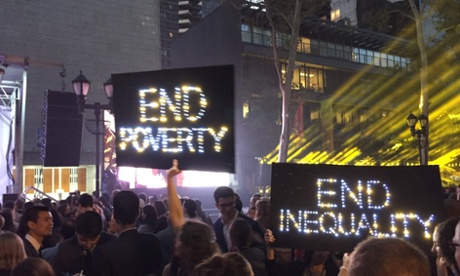
While the spotlight is on global leaders today, last night it was on campaigners who took to the streets in more than 100 countries. The Light the Way rallies aimed to shine a light on the sustainable development goals and call on leaders to make them a reality — which is the tricky part. Take a look at the photos we received from readers who took part.
Updated
Here’s Shakira arriving a little earlier today
#Shakira arriving at UN to sing. Waiting for #PopeFrancis pic.twitter.com/JGIsffhsiR
— Trisha Thomas (@TrishaThomasAP) September 25, 2015
Meanwhile, elsewhere at the UN
Malala speaking to the UN youth delegation #globalgoals #ONEYA2015 pic.twitter.com/mB99CL7ony
— Phil Reed (@philreeduk) September 25, 2015
Also worth a look as we prepare for the papal address is this take from the Guardian’s environment editor, John Vidal, on the pope’s recent climate change encyclical:
It’s more than 150 pages long with lots of commentary on climate, water scarcity, waste, the state of humanity, poverty, consumption, justice, morality and technology. But for all the papal encyclical’s reliance on peer-reviewed science and state of the art environmental analysis, there is only one brief mention byPope Francis of the massive population growth that has overwhelmed many countries in the past 50 years as a direct result of Catholic teaching. And there are just 11 mentions of women.
These two whopping elephants in the Basilica of St Peter throw some doubt on whether the encyclical is really a radical analysis of the state of the world intended to speak to everyone, as Francis has said he wants it to be, or is aimed at the upper echelons of a divided church in need of fresh teachings ...
While we wait for the pope to address the UN, it’s worth reading this handy guide to the summit by my colleague Clár Ní Chonghaile:
For three days this week, New York will be the centre of the world when the pope, presidents and pop stars descend on the city to ratify the sustainable development goals and celebrate the start of a new era.
The summit will adopt a new set of priorities and pledges meant to end poverty and huger, fight inequality and injustice, and achieve gender equality by 2030.Those are some of the broad aims of the 17 sustainable development goals due to be ratified by the UN’s 193 members on Friday.
But the men and women gathered in New York will be acutely aware that this defining moment is taking place against the backdrop of multiple global challenges – from the worst refugee crisis since the second world war to the threat of dramatic climate change ...
As you can see from the reaction at the UN, Pope Francis’s visit to the US is something of a triumph. Here’s a bit of what my US colleagues had to say about his appearances yesterday:
Even beneath the soaring arches and columns of St Patrick’s cathedral, the atmosphere was one of frenzied adulation rather than solemn reverence. Bishops held up their smartphones to record the historic moment; the cheers, applause and whistles almost drowned out the choir
After a day in which he became the first pope to address a joint session of Congress in Washington DC, exhorting US lawmakers to open their hearts to immigrants and build a country capable of rising above partisan politics, Pope Francis took New York by storm on Thursday evening.
The city responded with a welcome more befitting royalty or a rock star than religious leader. From early afternoon, the faithful and the curious began massing behind barriers on Fifth Avenue, some crowding into the upper display windows of stores to catch a glimpse of the Holy Father. Donald Trump occupied a prime position on a terrace of Trump Tower ...
Children sing "Light a candle" as pope rides by in airport-style electric car pic.twitter.com/Fn4MuZ6Rx9
— Catholic News Svc (@CatholicNewsSvc) September 25, 2015
Pics of the mini-popemobile from CNS ...
The pope is now making his way along a UN corridor in a buggy. Lots of waving, lots of mobile phones be held aloft to capture the visit.
That address went down very well - more shouts of Viva el Papa!
“My friends, I bless each one of you from my heart,” says the pope and asks them to pray for him. If they aren’t believers, he adds, can they wish him well.
The pope calls UN staff “microcosms of the people the UN represents and seeks to serve”. Like others, he adds, they worry about their children, the fate of the planet and the future. He asks them to “care [for] one another; be close to one another; respect one another”.
“Long live the pope!” a member of the UN staff has just shouted in Spanish. Not a member of the press. Sorry.
Updated
UN secretary general Ban Ki-moon gets a rapturous round of applause from welcoming the pope in Spanish. He also praises the pope’s call to action on climate change and tackling poverty.
Updated
But what exactly is today all about? What are the new sustainable development goals? And what were the millennium development goals? My colleague Liz Ford, who’s at the summit on New York, has written this handy overview. Here’s a taste:
On Friday, three years after the idea was first mooted at a summit in Rio, 193 countries are expected to ratify a new set of ambitious global goals that aim to end extreme poverty and hunger, address the impact of climate change and reduce inequality by 2030.
At the UN general assembly in New York, member states will formally adopt the 17 sustainable development goals (SDGs) and 169 accompanying targets resulting from the largest consultation process the UN has conducted in its 70-year history.
Podium @UN stands empty, waiting for one and only @Pontifex #PopeinNYC pic.twitter.com/xSNaT26Ozh
— Joshua McElwee (@joshjmac) September 25, 2015
Joshua McElwee of the National Catholic Reporter has tweeted this scene-setting pic
@Pontifex signs @UN guest book upon arrival as #UNSG Ban Ki-moon looks on #UNGA pic.twitter.com/D8MZjfkW0J
— UN Spokesperson (@UN_Spokesperson) September 25, 2015
My colleague Kary Stewart was outside the UN headquarters in New York last night, where hundreds of people gathered for a rally in support of the sustainable development goals. Among them was Amina J Mohammed, the secretary general’s special adviser on post-2015 development planning. Kary spoke to her about the long road to the SDGs:
And Pope Francis has arrived at the UN’s headquarters
Secretary-General of the UN Ban Ki-moon greets Pope Francis upon his arrival: http://t.co/JG90G9Uw0K pic.twitter.com/1NeVio9mMH
— ABC News (@ABC) September 25, 2015
Welcome
Good afternoon/morning/evening (depending on where you are) and welcome to the Guardian’s live coverage of the Sustainable Development Summit.
Today, the world’s political leaders – not to mention the pope and a fair few pop stars - are gathering in New York for the adoption of the sustainable development goals (SDGs), which will set the global development agenda for the next 15 years.
The UN secretary general, Ban Ki-moon, has described the new goals as “a universal, transformative and integrated agenda that heralds an historic turning point for our world”. The summit, he added, is intended to “chart a new era of sustainable development in which poverty will be eradicated, prosperity shared and the core drivers of climate change tackled”.
Updated