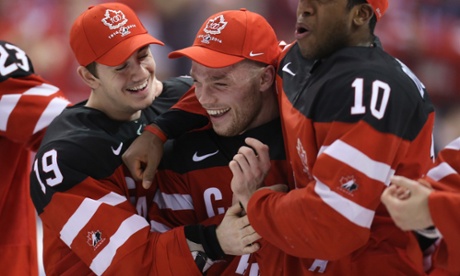
Suffice to say: that was close. You might not have known it by walking the streets of Toronto after the final buzzer, but it was close. Canada pulled out to an early 2-0 lead in the first period of the gold medal game of the 2014-15 IIHF World Junior Championship in Toronto against Russia, and then watched their lead gradually fall away, in fits and starts, over the course of three periods, to end in a 5-4 nail-biter. The Canadians almost faltered, almost lost – embarrassingly.
In the end, though, the crowd at the Air Canada Centre – along with those watching across the country at home – was mollified. The lead held, only just, and the gold returned to Canada, its first medal at the tournament in two years, and its first gold in six.
But with the winning and losing out of the way, perhaps we should ask: What did we learn from this tournament about the crop of (possible) future NHL-ers?
Denmark: emerging hockey superpower?
Perhaps not a superpower, but the team Denmark sent to Montreal and Toronto this year impressed.
Perhaps they didn’t impress by conventional standards, given they finished fourth in Group B with only a 0-1-2-1 record (that is, no wins, one loss and a few overtime finishes), but elements of their game were worth watching. Specifically: Halifax Mooseheads prospect, Nikolaj Ehlers, who was drafted to the Winnipeg Jets ninth overall in 2014 and his linemate, Oliver Bjorkstrand, drafted one year earlier to Columbus.
They were particularly effective in Denmark’s game against the Czech Republic in the waning hours of 2014, which they pushed to a shootout. Ehlers, a speedy winger, who spends his time right now with the Halifax Mooseheads, nabbed two assists, and Bjorkstrand – of the Portland Winterhawks – walked away with a goal in the effort. That doesn’t tell the entire story, though. Together, sharing a line, they dominated virtually every shift.
There were moments of beauty from them both in Denmark’s 4-3 win against Switzerland, too. Moments such as this:
Is there more where that came from? Er, perhaps. Mads Eller, son of Danish U-20 coach Olaf Eller, and brother of Montreal Canadiens forward Lars Eller, is an option, for instance. He’s not been stellar in Edmonton for the WHL’s Oil Kings (as a left wing only posting 11 goals in 80 games, but to watch him on the WJC stage was to accept that there’s potential). Niagara Ice Dogs left wing Mikkel Aagaard, who’s managed five goals and 15 points in 28 games this year in the OHL was another standout, though perhaps not enough to garner him a spot yet in the NHL.
Nobody’s going to argue that Denmark is the new heart of hockey, but when they were in a few tough situations this tournament (the Czech game is the most pertinent example), the Danes held their own – and then some. And while they may not be the future of the sport – only two of their 23 players have been drafted – the little things hint at a good future. Watching goaltender Georg Sorensen, for instance, gradually emerge from essentially behind his own goal line at the start of the first period on 29 December, into a reasonably confident butterfly position, and turn away 43 of 47 shots the Czech’s fired at him was enough to bring some hope.
Keep your eyes on the Danes. Things are happening.
Connor McDavid and Max Domi
Back in November, Connor McDavid broke his wrist during an on-ice fight, and instantly prompted minor turmoil, both for those who wanted to continue the conversation about whether (and how much) fighting belongs in the sport, and also for those who worried he might not be able to play in this year’s WJC. The first question remains, for some, unanswerable (though it is). The second, happily, had an easier answer: McDavid played for Canada – and he played well.
In fact, he excelled as the tournament progressed, going into the final with six points in the previous two games. To be fair, he had plenty of opportunity, as the Canadians trounced Denmark 8-0 and Slovakia 5-1. To Kevin McGran at the Toronto Star, McDavid is the heir to the current New York Islanders captain, John Tavares, whose WJC showing as an underage, yet-to-be drafted scorer, in 2009 was particularly memorable. High, and arguably fair, praise.
But we expected that. The McDavid jerseys were hanging from windows in advance of the tournament, as they were when Tavares played, as they were when Crosby played. We’ve been waiting for McDavid.
I’m not sure we were all waiting for Max Domi.
The son of known, retired, agitator, Tie (someone for whom the answer to the first question prompted by McDavid’s broken wrist would likely have been a “Yes, it does.”), Max, took the opportunity to show Canada this winter why he was selected 12th overall in 2013. In his first three seasons with the OHL’s London Knights, he averaged roughly a goal every two games, and is keeping about the same pace through 27 games so far this year.
Through the first round of the WJC, he overshadowed McDavid, anchoring what proved to be an explosive secondary scoring line between Anthony Duclair and Sam Reinhart – a line on which he told reporters he is simply “along for the ride,” which, as Scott Stinson at Postmedia rightly declared to be “modest and absolutely untrue”.
Oh, one more thing about Domi’s year: he wasn’t necessarily supposed to play another season in London. He was drafted to an Arizona Coyotes squad that some figured could use a youthful spark at center, but was ultimately sent back down to improve.
For McDavid and Domi, one undrafted, one already picked up, perhaps the motivation was ultimately the same: proving a point. Consider it done.
The unexpected (overlooked) hero: Denis Godla
The short story with Slovakia goaltender Denis Godla in this year’s WJC is this: After being pulled against Canada at the group stage in an 8-0 loss, he re-emerged to prove the unexpected star of the entire tournament.
Case in point: When Slovakia again drew Canada for the semifinal, it was Godla – practically alone – who stood in their way to the gold medal game. The Canadians scored early (just four minutes into the first period) but it took until the end of the second before they couldn’t expand on their 1-0 lead. In the end, Godla turned away 39 of 44 Canadian shots.
For his efforts, he wasn’t awarded with a player of the match award, but instead an ovation from the Canadian fans:
He shone again in the bronze medal game against Sweden, backstopping Slovakia to its medal win, and ultimately walked away from the tournament with 198 saves in 214 shots (more than any other goalie had to face). What will happen to him? Godla is eligible for the 2015 draft, so remember his name in late June.