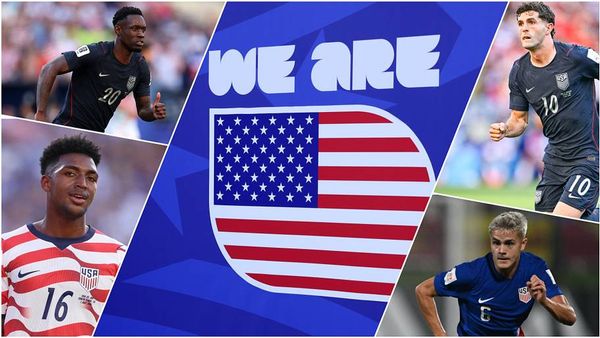
The day after Belgium knocked the United States out of the 2026 World Cup, the post-mortems began. There were the tired snickers, the familiar quip that soccer is "the sport of the future and always will be," and the usual banter about how America's men can't compete because our best athletes are claimed by more established sports, or because our flawed "pay to play" youth system doesn't develop talented players whose families can't afford access to pro academies.
This is all outdated nonsense. It's time to get a grip and change the way we understand and talk about America's relationship with global football. This 2026 Fifa men's World Cup has showcased how integrated America now is in the global sporting community and, conversely, how integrated the world's sport has already become in American life.
This has been the gradual achievement, dating back at least to the first 1994 men's World Cup, of three distinct protagonists who've pulled the world's pop culture superpower and its top sport closer together: immigrants, girls and women who took up the game post-Title IX, and US-based companies whose global aspirations required them to embrace a sport with global reach. (That list includes Coca-Cola, McDonald's, EA Sports, Nike, Apple TV and the owners of the LA Rams and LA Dodgers who have each acquired an English Premier League club.)
We can still pretend this soccer thing is a niche import with uncertain prospects in this country, but numbers don't lie. The opening US game against Paraguay on June 12 was watched by 27.5 million people on television, 3 million more than the NBA Finals game that clinched a title for the New York Knicks earlier that week. By the time Belgium knocked out the US four matches later, the combined US audience on Fox and Telemundo had swelled to 50.1 million viewers, outperforming any non-NFL sporting event this century, and the NFL's own conference championships earlier this year. Perhaps more remarkably, the epic showdown between Mexico and England at Mexico City's Aztec Stadium the night before drew an audience of 46.7 million viewers across the two networks.
International soccer's power to outdraw all sports other than the NFL's biggest games is not new. The US audience for the 2022 Qatar World Cup final was also larger than any of that year's World Series or NBA Finals games.
The columnist Candace Buckner wrote in The New York Times that we "kid ourselves that the United States of America … could become a soccer nation". She explained: "This sport belongs to the world. We borrow it every few years," and that we should just admit, once and for all, "that professional soccer will never rise to the level of the four titan leagues in this country."
Buckner is correct that this sport belongs to the world. But concluding that therefore it can't be ours is to miss precisely what's so revolutionary about the transformation we're witnessing and celebrating with this World Cup. For much of our history, sports have set America apart. We invented our own games in the late 19th century to decouple ourselves from a British-dominated sporting ecosystem and proclaimed the winners of our domestic leagues "world champions." To this day, our most celebrated athletes in our most-followed sport never get to represent their country -- Tom Brady never wore a Team USA uniform -- because there's essentially no one to play against.
But over the past generation, sport has gone from a reinforcer of American insularity to a powerful vehicle for global engagement. The US has succeeded in exporting our homegrown sports, to the point where we now have a World Baseball Classic, numerous international NBA players landing the MVP title, and the NFL taking regular season games to Sao Paulo, Madrid and Berlin (and flag football is coming to the LA Olympics!).
But the biggest story in how sport came to connect us to the world has been the rise of soccer within the US, and of the US within the world of soccer. Depending on your perspective, losing to Belgium in the Round of 16 may or may not be a catastrophe for the US men's national team, but there is no debating the tournament itself has been a wild success. In addition to record TV ratings, we've seen record attendance at sold-out stadiums with electric atmospheres; classic matches featuring marquee stars like Messi, Mbappe and Haaland.
But mostly, it's been the vibes. International visitors relishing the discovery of American quirks such as free refills, Buc-ee's, Chipotle and seemingly nuclear-powered air-conditioning. And re-discovering that regardless of what goes on between governments, Americans are welcoming, friendly and eager to soak up other fan cultures. I've heard people compare this World Cup to a fun sleepover or a study abroad term. We all were Cape Verdeans. Boston became the capital of Scotland, and New Yorkers and Texans rowed alongside those zany Norwegians. The University of Kansas marching band learned Algeria's national anthem, and in Kansas City -- which four teams chose as base camp -- residents got to hop from left to right with a sea of orange Dutch, dance cumbias with Colombians and jump to anti-English chants along with Argentineans (despite many homes featuring yard signs welcoming the English team). KC is going to have quite a World Cup hangover.
In Los Angeles, I attended Iran's match against Belgium and witnessed an additional ingredient that makes World Cups in the US so intoxicating: the passion of our diasporas. There are no away teams in the United States. Iranian expats easily outnumbered Belgian fans and neutrals wearing Mexico jerseys on the day, and those around me vociferously booed their nation's current anthem, waved its pre-revolutionary flag, and then joyously rooted on their team, chanting "I-ran, I-ran..." throughout the match.
The full North American dimensionality of the tournament was another case of sport triumphing over politics. The structure of this World Cup -- with England having to play matches in Atlanta, Mexico City, then Miami; or Belgium going from Los Angeles to Vancouver, then Seattle -- subtly reinforced that this is one region.
Of course, politics made an unwelcome intrusion. I don't know if US President Donald Trump's spectacularly ill-advised lobbying of Fifa President Gianni Infantino to suspend Folarin Balogun's red card proved an insuperable distraction for the American team, which overnight went from globally admired underdogs to vilified prima donnas. His meddling certainly didn't help, and the last thing the tournament needed was a reminder of Fifa's weak governance.
And if I were to force a silver lining from the one scandal to have emerged from this riveting World Cup, it's the very fact that an "America First" president, whose political project and base traditionally would have made him one of the sport's haters in this country, has been such an enthusiastic supporter of the tournament, and so invested (to a fault, indeed) in it.
Clearly, there are now two American footballs. Zocalo Public Square
Andrés Martinez is co-director of the Great Game Lab at Arizona State University, and the author of 'The Great Game: A Tale of Two Footballs and America's Quest to Conquer Global Sport'. This was written for Zocalo Public Square.