Twenty-six years have passed since a tragic fire broke out at a doll factory in Nakhom Pathom killing almost 200 workers. The accident, which is now known as the "Kader Toy Factory Inferno", is still remembered by many factory workers as one of the country's worst workplace accidents.
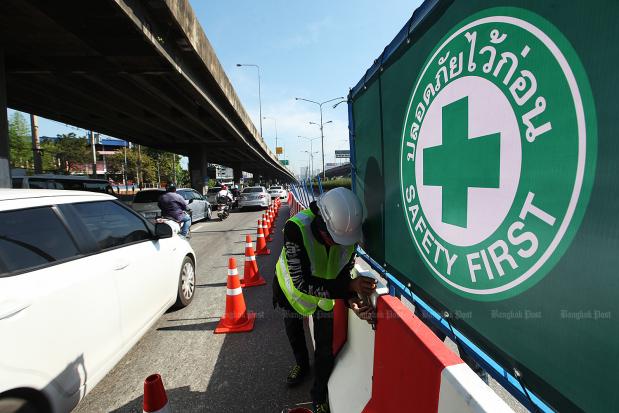
While more than a quarter of a century has passed, workers and labour rights advocates said no significant progress has been made in terms of making workplaces safer for its workers. Many factories and workshops are still fraught with dangers, and "zero-accident" labels are put up simply to prop up a company's image.
The blaze that broke out on May 10, 1993 happened at a factory run by Kader Industrial (Thailand) Co, which exported dolls to the United States and Europe.
The fire, which claimed the lives of 188 workers -- 174 of the victims were women -- also injured as many as 469 employees.
Many workers failed to escape in time from the burning building because the factory's emergency exit was blocked.
Subsequent investigations found the factory had experienced three major fires prior to that fateful day.
Moo, a factory worker who used to work for Kader, said she can still vividly remember what transpired during the inferno.
Now 48-years-old, Moo said she was working on the fourth floor of the factory when the fire broke out on the first floor. She managed to escape the burning building by sprinting through the fire to an adjoining building. About 20 minutes later, the factory collapsed to the ground.
Despite the incident, Moo still works as a factory worker in Samut Sakhon's Krathum Baen district.
However, she said that she has yet to see any meaningful improvements, in terms of workplace safety.
"These days, companies often boast of their 'zero accident' campaigns," she said. "All employees know that these are just lies."
"Employers don't care about our lives -- all these 'zero accident' labels were simply aimed at making sure that companies can sell their products at higher prices," said Moo, who spoke at a seminar organised by the Thai Labour Solidarity Committee (TLSC) to mark Work Safety Day on May 10.
Moo is not alone -- other labour union representatives who attended the event also expressed their concern about the employers' lack of concern for their workers welfare.
Several labour activists said that many employers still force their employees to seek treatment at hospitals which will cover the cost of treatment under the Social Security Fund (SSF) -- even in emergency cases that require urgent attention.
Others say that employers are often reluctant to cover the cost of medical treatment when their workers had to be admitted to private hospitals which are better equipped to deal with certain injuries -- simply because the costs are usually higher.
Worse still, in cases where employees become permanently disabled because of workplace accidents, many companies will still only shell out the bare minimum as compensation, the seminar was told.
As such, union representatives are calling on the government to roll out a law that guarantees the rights of workers to medical assistance and adequate compensation for those who become permanently disabled due to workplace accidents.
A leader of a union at a company in tambon Omnoi said he had received numerous complaints from families of injured workers, who claimed to have been pressured to move their sick or injured relatives to cheaper hospitals.
"This is demoralising for both the family and the worker," said the union representative, who spoke on the condition of anonymity.
Another issue that was brought up during the seminar was the fact that some companies "mislead" their employees by saying that no toxic chemicals are used by in the factories' assembly lines.
"However, when their workers eventually become sick due to the continued exposure to the toxic fumes, these companies would simply refuse to recognise the issue," said a labour representative who works for a firm in Rangsit, before adding that illnesses from continuous chemical exposure can take a long time to manifest.
A key labour union leader in an industrial estate on the Eastern Seaboard, which is known as a hub for petrochemical and heavy industries, admitted that many factories have adopted "zero accident" label.
"But in reality, they tend to sweep accidents under the rug because if they reported the accidents to the Social Security Office (SSO), they are obliged to contribute more to the Workmen's Compensation Fund," he said.
Wiwat Tanghong, chief of the Department of Labour Protection and Welfare, stressed occupational health and safety is a priority of the Labour Ministry.
"We will make sure that all labour laws are enforced, and we will launch campaigns to raise public awareness about the importance of workplace safety," Mr Wiwat said.
Last year, the rate of severe workplace incidents -- which includes deaths, disabilities, and accidents that require a worker to rest for three or more days -- fell to 2.59 per 1,000 employees, as opposed to 2.88 a year before, he said.