May 16--The National Transportation Safety Board has asked the FBI to examine window damage to determine whether an Amtrak train was hit by an object before it derailed in Philadelphia, the latest step after investigators on Friday questioned the engineer, who said he could not recall details of the crash.
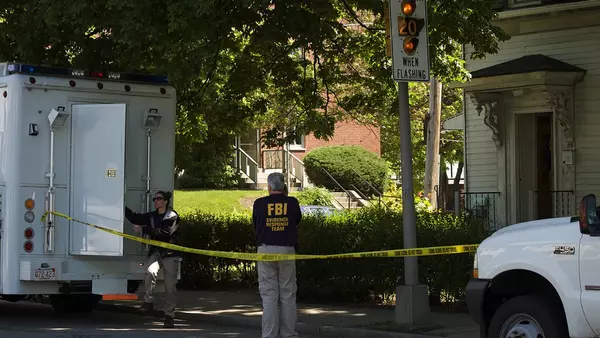
Safety board member Robert Sumwalt said investigators asked the FBI to examine what appears to be circular damage in the left-hand lower portion of the Amtrak train's windshield. No projectile was found inside the locomotive, he said.
An unnamed assistant conductor in the cafe car told investigators of a radio conversation she heard between Brandon Bostian, the engineer of the Amtrak train, and another engineer in a regional commuter train. The local engineer said the train had been "hit by a rock or shot at," Sumwalt said. The unidentified assistant conductor told investigators that she thought she heard Bostian say his train had also been struck.
According to Andrew Busch, a spokesman for the Southeastern Pennsylvania Transportation Authority, which operates the local trains, there was an incident involving a damaged windshield to one of its trains on Tuesday night.
"A SEPTA train was damaged by a projectile in a separate incident, but all of our indications is that this is not connected to the Amtrak incident," said Busch, who described it as an act of vandalism. "Unfortunately it does happen occasionally that we get juveniles throwing rocks."
There were no injuries and the 80 passengers were transferred to buses. The incident is being investigated, he said.
SEPTA will make the engineer of its train available to NTSB investigators, he added.
Bostian, 32, was interviewed Friday, and though he was cooperative, he said he could not recall anything after ringing the train's bell as it left the Philadelphia station, Sumwalt said. Bostian said he had no recollection of any discussion with another engineer or of Tuesday's derailment, which killed eight people and injured more than 200.
Investigators are continuing to look for answers about the cause of the crash and especially why the Amtrak train increased speed in the last minute before it derailed. It left Philadelphia on time heading for New York on Tuesday night when it began to pick up speed to more 100 mph as it headed into a the curve with a 50-mph speed limit in the area known as Frankford Junction.
The interview with Bostian, of Queens, N.Y., was an important step in the investigation because he was the only person in the locomotive cab as the train accelerated. Robert Goggin, Bostain's lawyer, also attended the interview. He said earlier this week that the engineer had been injured in the crash and had limited memory of the accident.
"We've interviewed three crew members," Sumwalt said, adding they were traumatized by the accident and they may not have completely recovered. The train's conductor remains hospitalized, Sumwalt said.
Bostian tried to be helpful, even offering to meet again. "Investigators found the engineer to be extremely cooperative," Sumwalt said.
Bostian said he was not tired or ill on the day of the derailment. "He felt fully qualified and comfortable with his equipment," Sumwalt said. "He demonstrated good working knowledge of the territory."
Sumwalt said the interviews with the crew were important steps, but noted that investigators were still gathering evidence.
"We do not draw conclusions at this stage of the investigation," Sumwalt said. "We will draw conclusions later."
Officials have focused on the train's acceleration leaving Philadelphia. An analysis of the train data recorder and a camera set up in the locomotive showed the train rapidly and steadily increased its speed in the last 65 seconds before the crash.
Sumwalt said Thursday that the train was traveling above 70 mph for 65 seconds before impact. At 43 seconds before impact it exceeded 80 mph. At 31 seconds it had increased to 90 mph. Sixteen seconds before impact it topped 100.
The speed limit before the curve is 80 mph, but drops down to 50 going into the turn.
Train 188, carrying 243 passengers and crew, originated in Washington and was traveling on the Northeast Corridor, Amtrak's busiest.
All aboard have been accounted for. Six people remain in critical condition, hospital officials said Friday, and all are expected to recover.
Meanwhile, the last of the wrecked cars were removed from the scene Friday and a funeral was held in Long Island for one of the passengers killed in the crash.
Midshipman Justin Zemser, 20, who was traveling from the U.S. Naval Academy to his home in Rockaway Beach in Queens, was described as "a phenomenal young man" who "had this quiet strength about him," by Capt. Brandy Soublet, the academy's commandant of midshipmen.
Amtrak has taken responsibility for the crash. In a letter posted on the rail line's website, Joseph Boardman, Amtrak's president and chief executive, said the railroad was cooperating fully in the investigation.
"With truly heavy hearts, we mourn those who died. Their loss leaves holes in the lives of their families and communities," Boardman wrote. "Amtrak takes full responsibility and deeply apologizes for our role in this tragic event."
He said the railroad's goal was "to fully understand what happened and how we can prevent a similar tragedy from occurring in the future."
Amtrak is hoping to resume partial service on Monday and full service by Tuesday.
At the site, the crashed train ripped up rails and knocked down power lines. Workers on Friday were beginning to drill holes for new utility poles and preparing to pour concrete. The last of the seven passenger cars was hauled away on a flatbed truck to an Amtrak facility in Delaware for further study.
Litigation stemming from the wreck began on Thursday.
Bruce Phillips, an Amtrak employee who was heading to New York City as a passenger in one of the rear cars, sued the railroad, claiming he sustained injuries including trauma to the brain. The suit seeks more than $150,000 in damages.
Bostian has been an Amtrak engineer for four years and six months, and before that was an Amtrak passenger conductor from 2006 to 2010, according to a LinkedIn profile under his name.
A few hours after the crash, Bostian changed his Facebook profile picture to a black rectangle as friends swarmed to his side and posted messages of support. The engineer's hometown was listed as Memphis, Tenn.
Bostian attended the University of Missouri in Columbia, Mo., where his LinkedIn profile said he attained a bachelor's in business administration and management. Bostian was also a member of Acacia, a service fraternity, and in recent years was lesbian, gay, bisexual and transgender rights advocate while living in San Francisco and New York City, according to a news article.
Goggin said he believed part of Bostian's memory loss was due to his concussion.
"I can tell you he was distraught when he learned of the devastation," Goggin said. "He was distraught."
UPDATE
3:33 p.m.: This post was updated with new information.
3:04 p.m.: This post was updated with new information about the investigation.
This post was originally published at 10:04 a.m.