The degree of freedom in choosing a workplace has risen with the prevalence of working remotely from home and elsewhere thanks to information technology. The following are companies making the most of their employees' choices to work in regional areas, away from head offices, bringing the merits of ensuring staffing and the ability to respond to a crisis.
--Preparations prove successful
Tokyo-based Plat Ease Corp., which does video production and other business entrusted by TV broadcasters, has overcome the crisis it initially faced amid the spread of the novel coronavirus. Its second office in the town of Kamiyama, Tokushima Prefecture, more than 500 kilometers away from its head office, is in active use.
When the state of emergency was declared by the central government in April, all the company's employees at the Tokyo head office worked from home. There were some work, however, that was contracted on the condition the "work is done at the company's office to ensure the standards of information management are met." The company hurriedly decided to undertake these jobs at its second office in Tokushima Prefecture, where there were fewer cases of coronavirus infections and there are fewer infection risks due to the use of cars for commuting.
"We could continue business because there was another office," said company Chairman Tetsu Sumita, 58. "The risk-avoidance we had prepared proved effective."
The second office was set up in 2013. Learning from the experience of the 2011 Great East Japan Earthquake, the company considered it essential to make arrangements to be able to continue business even if widespread power outages occurred.
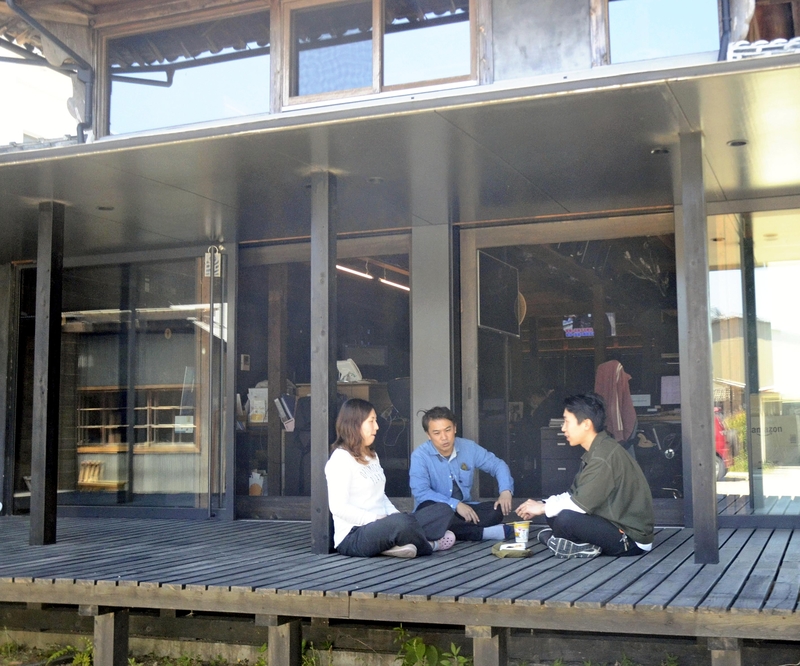
An about 100-year-old house located in a mountainous area that takes 40 minutes by car to reach from JR Tokushima Station was renovated into the second office. Of the about 110 employees of the Plat Ease group, 13 work at this office. The latest video equipment and personal computers are lined up on the glass-walled first floor.
"It was very busy, but I am pleased to hear this office is a strong point when the company undertakes jobs," said Rie Oshita, 32, who temporarily took charge of some head office tasks.
Work styles also changed.
"While being liberated from commuting on packed trains, I can work in an open atmosphere," said Taizo Tamagawa, 43, who moved to Plat Ease after quitting a company in Tokyo and returning to his hometown of Tokushima five years ago. "I could secure important hours that I can spend with my parents here."
Tamagawa is one of 11 employees from Tokushima Prefecture in the second office.
"It is hard to secure manpower in Tokyo, where there are many rival companies," Sumita said. "If companies are capable of employing people who want to work in their hometown, that could become a strong selling point."
--Dual dreams realized
Remote work can broaden the range of options for workers.
Yu Nakamura, 23, who is in charge of systems development at Tokyo-based Gaiax Co., has been working in his hometown of Hiroshima since he was recruited by the IT company in spring 2019. He reports to the head office once every several months. The company's employees include those who work while traveling and living overseas.
There are times when he works with colleagues while sharing his computer screen online.
"After working at a Tokyo IT firm on an internship program, I really wanted a speedy way of working," Nakamura said. "At the same time I wanted to cherish connections with the people of my hometown."
He worried about his career path, but he decided to accept the company's offer to work while living in Hiroshima.
While he was a student at a technical college, he had the experience of tackling renovation projects for vacant houses in collaboration with adults from Hiroshima Prefecture as part of their regional revitalization efforts. The experience sparked his desire to contribute to his hometown. While currently working at a shared office, where many people outside the company work, he is building his network and tackling the development of apps in collaboration with students.
"I could achieve two dreams," Nakamura said living in the countryside and working for a Tokyo company," .
--Able to be anywhere
Natsumi Yamauchi, 27, of Tokyo-based carecolLabo Inc. ― which sells software systems that help manage nursing care facilities ― has taken charge of nationwide sales while based in Akashi, Hyogo Prefecture, which is her hometown.
She communicates with her customers via a screen with the use of a videoconferencing system. She can hold sales negotiations with nursing care centers in prefectures such as Aomori, Chiba, Kyoto and Oita, communicating with them the same day should any problems arise after the company's nursing care management system is introduced.
Yamauchi moved to the current firm after quitting a banking institution because she wanted to continue working even if she had to move for the sake of her husband.
"I can handle my jobs anywhere now, so I can make appointments to meet with friends living outside Hyogo Prefecture after work," she said.
"Because remote work can be done anywhere, capable people from across the country apply whenever job offers are advertised," said Takuya Okabe, 30, who is in charge of recruitment at carecolLabo. "Such a working style has a lot of merit."
--Creating jobs
The town of Kamiyama established a fiber-optic network to facilitate TV viewing for residents in fiscal 2004. This network and the town's favorable natural environment have been popular among companies. Currently, 14 businesses that include IT firms have set up offices by renovating traditional old houses and vacant facilities.
The Tokushima prefectural government has provided assistance since 2012, including subsidizing rental and communication fees. As a result, it could attract 66 companies from outside the prefecture as of April this year. About 90 locals were also recruited to the firms. Moves have also been spreading to develop new products in cooperation with local residents.
"We tried to create jobs and promote the migration of the people from other prefectures," said a prefectural government official in charge. "Our work has started to create employment in a semi-mountainous area."
The central government, for its part, has been promoting a Furusato Telework program since five years ago to facilitate working in regional areas as part of measures to alleviate the concentration of the population in major cities. Through the program, the government provides subsidies to help cover the expenses for setting up offices in regional areas.
Read more from The Japan News at https://japannews.yomiuri.co.jp/