I'm spending the weekend in the city in order to speak at the Edinburgh International Science Festival, where I'll be appearing on a panel talking about journalism in a digital age. My contribution is to look at how developments in publishing technology have changed journalism, and one of the main sections of my talk is inspired by a collection of crumbling sheets of paper held here in Edinburgh.
I've opted to take a long historical view of technical change, and so my talk will start with Trajan's Column in Rome. The council newspaper of its day, it was a propaganda exercise set in stone, built at great expense to the state. Since then news storytelling has evolved from the hand-written manuscripts of the Anglo-Saxon Chronicle, through the early era of the printing press, to the development of first the newspaper, and then radio, television and internet news. I'll finish my talk with a look at how digital tools like blogging and social media are affecting the production, consumption and ethics of news reporting.
For around 300 years, though, before the abolition of a punitive tax saw a rise in newspapers' sales and popularity, the most common way for news to be distributed to the general public was the broadside. These consisted of one-sided printed pamphlets which contained everything from serious news of war and politics, to story-telling ballads, to 'news' of the fantastical and outlandish. My favourite is from around the 1760s, entitled The Wonder of Wonders, which tells of a mermaid encountered off the coast of Inverness
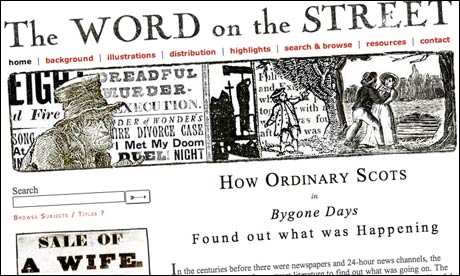
I was first exposed to it on a previous trip to Edinburgh, when I got to visit the National Library of Scotland. They have a large collection of broadsides which have been preserved and made digitally available on a site called The Word on the Street. The broadsides aren't the only news content that the library holds, and they also have a large collection of regional and national newspapers.
Among the broadside highlights picked out are publications about the trial of Burke and Hare, a rather violent football match between the Swifts and the Macalvenny Wallopers, a spoof act of Parliament and an 1880 tribute ballad to victims of the Tay Bridge Disaster.
The fact that a couple of hundred years later we are still able to read these stories, originally published in such a disposable format, is astonishing on many levels, and probably says more about the changing impact of technology on the art of storytelling than anything I can say in my presentation on Sunday.
Journalism in the digital age: trends, tools and technologies is at the Informatics Forum on Sunday April 11th at 16:00.
Martin Belam is Information Architect for guardian.co.uk, and blogs about information architecture and the media at currybetdotnet. You can follow him on Twitter as @currybet.