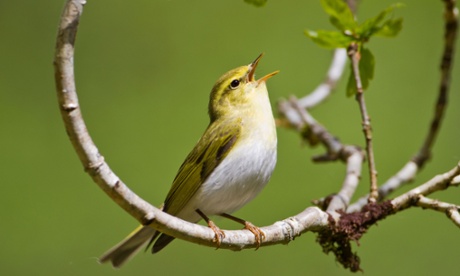
What a world it must have been! In their book on Britain’s prehistoric bird population, the late Derek Yalden and Umberto Albarella speculated that our islands’ first forest blanket after the end of the last ice age held 16m wood warblers every spring. Now there are fewer than 50,000 – since 1995 they have declined nationally by 65%.
These woods are one of their last strongholds and it emphasises how the creature’s world is always in green: either the emerald of rainforest, where they spend our winter or, as it is here, the astonishing chromatic patchwork of lichen, fern, moss, holly and fresh-licked leaves of beech and oak.
The steep-sided place was so immersed in green that at times it felt as if we were under water. The warbler sealed the impression because as it sang it flew in short slow-wafted flurries from tree to tree.
In each momentary shift, the wings were rowing so deeply through the tidal pools of sunlight that they looked like fins and the displaying birds like fish. If the visual impact was aquatic then the music was stone.
Wood warblers grind out their notes from some mysterious Pleistocene hoard and – with head back and wings quivering – spray them as flakes of sound in an ecstatic downward trill.
The tempo builds steadily. The lapidary notes are granular and individual at first, then they blur to the human ear, and as they accelerate they are like a burst of light in that green place.
Actually this song seems like light and it is truly made from light. Think this: the light in the red spectrum is swallowed by all the chloroplasts that make Tan-y-Bwlch so green, then the leaf becomes moth larva and the caterpillar turns to muscle and surplus energy in a bird. Wood warbler and wood and song are all just light.
We too come from light. In this spot and at that moment we all felt it.
How strange to think that this tiny bird comes out of Africa to make these woods so completely Welsh. What a world we still own!