
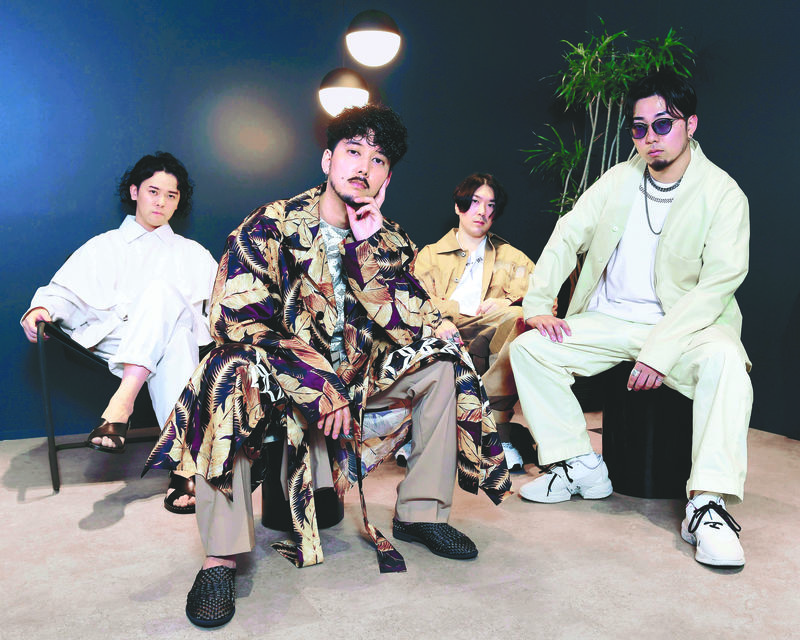
How should I describe this music? Absorbing soul, jazz, rock, hip-hop and every other kind of music, the four-man band Wonk sets new trends, with their eyes always fixed toward the world, even writing their lyrics in English.
What's more, each member of the band has another facet, such as a chef and a sound engineer. Let me tell you about the band members' extraordinary new album, "Eyes."
Wonk's four members are vocalist Kento Nagatsuka, keyboardist Ayatake Ezaki, bassist Kan Inoue and drummer and leader Hikaru Arata. The band's official website defines Wonk as an experimental soul band -- asked what that means, Inoue said with a subtle smile, "We do experimental and cool music."
The band was formed in 2013 when Arata invited members of a university club that he was part of to join him. At first the band aimed to create a sound Arata described as "something like beat music." Yet Wonk was sometimes noted as a promising new act in the jazz scene, as well as a new leader of R&B music in Japan. The band has been engaged in a variety of activities; it also provided a song to singer-actor Shingo Katori.
"I don't like saying our music is such and such because we're working hard to get rid of the walls between genres," Inoue said when I asked how I should explain Wonk's music. But Arata simply said, "J-Pop will do."
Other specialties
What's particularly special about Wonk is that each member has another facet. Nagatsuka, for example, is a cook who has worked as the head chef of a bistro.
"When you cook, you pay respect to the history and philosophy of food, and at the same time refine the elements inside you and dish them out, which I think is similar to what you do with music," he said.
Ezaki performed in support of King Gnu, a popular band that appeared in NHK's Red and White Year-end Song Festival last year. "It's not that [King Gnu] officially appointed me as a studio musician," he said. "More like we're friends making music together since our student days."
From coming up with ideas to recording, mixing and mastering, Wonk regards all these tasks together as composition. As a sound engineer, Inoue plays a pivotal role in that respect.
"Deciding what kind of beats or tone colors we'll use for what started as humming -- it's the engineer's job to take control of all such things," he said.
Arata keeps Wonk together as the leader and the president of Epistroph, the music label the band established.
"Sometimes the music we want to introduce to Japan doesn't sell very well, like some Afro-American music," he said. "I feel an obligation to do that."
The band's music production methods are quite up-to-date. According to Ezaki, first they send the original data to the cloud. Then each member downloads the data, adds his sound to the data and returns it to the cloud. They repeat the process again and again. The members do in a studio what needs to be done there, and do at home what they can at home, such as the bass and keyboards. Sometimes they check their ideas with other members via videoconference.
Due to the spread of the novel coronavirus, many companies have started introducing telecommuting.
"We've been working that way for several years now," Ezaki said with a chuckle.
Many bands produce temporary sounds for sharing among the members at home and do the real recording in a studio. Wonk members start making the real sounds for recording at home; that's why they can produce high-quality sounds quickly from the beginning.
"I think that's the norm for our generation," Ezaki said.
Their lyrics are basically in English. Apparently, that's been the group's policy from the beginning, with a strong motivation to venture overseas.
"The vast majority of the people in the world speak English, so more people will understand our songs. It's as simple as that," Nagatsuka said.
Depending on the song, however, it may be difficult to get across 100% of the lyrics' meaning to Japanese listeners. Referring to YouTube's subtitle function, which shows lyrics in Chinese and Korean, Ezaki said, "Language is becoming irrelevant." He said he sees language as an acoustic material.
"If we write in Chinese, maybe we can make cooler songs," he said.
Wonk released its latest album, "Eyes," via streaming in June on the Caroline International label. The 75-minute album contains 22 songs, including several skits. It is the band's first concept album, created for the contemporary world where various values meet each other.
"In the beginning, we wanted to make something like a film," Arata said. True to his words, the album is like a movie soundtrack, with its dramatic structure and songs that evoke a magnificent scale. The theme is "diversity of values and the universe in a highly advanced information society." People only collect information they want, which means they can obtain only one-sided information. The album uses music to tell a story about the kind of social division that causes.
"Everyone is too preoccupied by information, which is wrong -- that was the starting point," Arata said. "I wanted to speak out, in a sci-fi like setting, about the fact that it's important to always think."
Based on this idea from Arata, the four held discussions and created a script, which Nagatsuka adopted into English lyrics.
Ezaki said he tried to remove the gaps between genres from the music in the album.
"Even within one song, the first part is like rock, the middle section is jazzy, and the ending is like a film score, for example," he said.
There is a limited edition of the album, a CD that comes with an art book containing film-like scenes from each song to tell its story from a visual perspective as well.
Through the album, one can see that it raises a question: What should we do next after the internet?
"We've become able to get hold of every kind of information," Inoue said. "As a result, some of us have forgotten how to deal with other people outside [our comfort zone] and become too defensive, which is particularly common on social media. First we must recognize the problems and then think what we should do now. That is the point of this work."
To the end of the album, Ezaki added the hope to dream about the future once again. Since he belongs to a generation of people who can't believe that technology brings happiness, he said, "I think it's valuable to work on feeling a bright future and designing the way to live."
Read more from The Japan News at https://japannews.yomiuri.co.jp/













