The rising sun casts a golden glow above the dark ramparts of the ancient hillfort, but the rest of the sky is still a deep blue-black. I clamber up the steep slope, passing the silhouettes of trees, and leave the hum of the morning traffic behind in the valley below.
The resident birds of prey are already up – a sparrowhawk flaps past at head height and a kestrel is hovering over a ditch, its gaze fixed on a point in the grass below. I walk round the dense thickets of hawthorn that grow on the south-western side of the hilltop and listen.
Then I hear them – the deep chack and whistling calls of ring ouzels from deep within the bushes. Each October, they arrive from their upland breeding grounds and stop by the coast – sometimes in large numbers swelled by Scandinavian birds – to feed on the berry-rich trees and bushes, before continuing south for the winter.
Although little is known about them – ring ouzels are elusive birds – surveys have indicated that British populations have declined rapidly in recent years, by 27% in the past 20 years alone. There are now about 7,000 pairs, possibly because of changes to their moorland and upland habitats.
The birds in the hawthorns are proving characteristically difficult to see. I walk around the bushes quietly, patiently, all the time watching my steps around the deep pits that were created thousands of years ago by ancient flint mining.
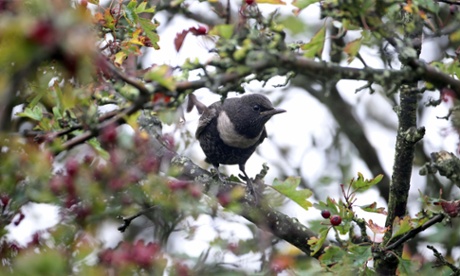
Then three birds fly out of a bush. Very similar to blackbirds, they are mostly black but slightly larger, with a longer tail and wings, and a heavier bill.
A bird perches at the top of a branch and I can see the broad, white crescent band on its breast – a male. It flies off, but another lands at the top of the same hawthorn, “chacking” loudly.
This one is a female – the band is buff-brown and the bill dark. The sun shines on her, and I can make out the pale grey, “scaly” edging to the feathers.
Then the sky darkens again. I look up to see large, black clouds gathering overhead.