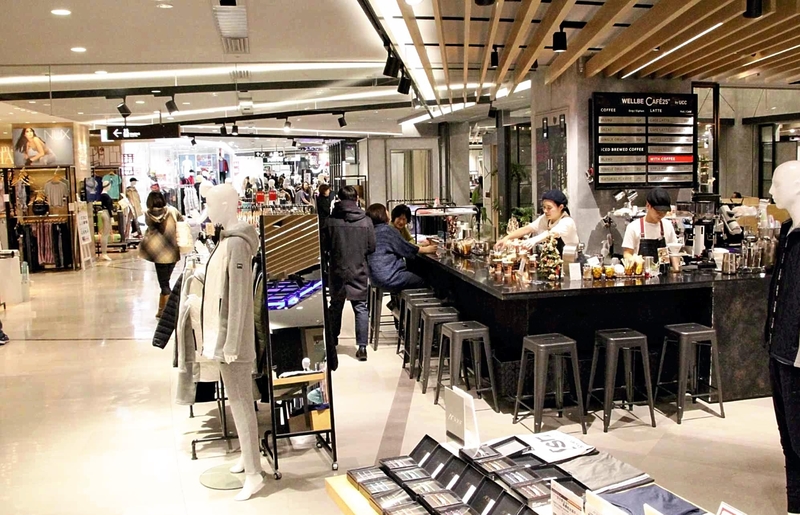
Department stores are cutting back on the floor area allocated for womens wear sections, which had long been considered one of their main attractions. The vacated areas are increasingly being converted into sections specializing in cosmetics and beauty care goods, which are popular among foreign visitors, and cafes.
Efforts to stem a decline in sales of women's apparel caused by the rise of fast fashion and online shopping are behind such conversions.
Daimaru Matsuzakaya Department Stores Co., which operates 17 stores across the country, is proceeding with a plan to scale back floor space for womens wear by 30 percent over five years starting in 2017.
At Daimaru's Sapporo store, the women's clothing section on the 3rd floor was reduced in size by 30 percent in spring 2018. The vacated space is now occupied by accessories and cosmetics stores, as well as a restaurant, among other businesses.
Over the four months following the renovation, sales on the 3rd floor rose nearly 20 percent compared to the same period in the previous year, so the change proved to be effective in attracting customers, a store official said.
At Takashimaya Co.'s Shinjuku store in Tokyo, part of the womens wear section was converted into a yoga studio and event space in spring 2017.
At Hakata Hankyu department store in Fukuoka, space for women's apparel has been scaled down by 20 percent through three rounds of renovations over the past three years. Kintetsu department store's Nara shop also plans to convert part of its womens wear floor space into a beauty care and health goods corner, including aromatherapy products, in March.
For many years, womens wear was often found near the entrances of department stores. This was considered key to attracting customers because of an expectation that female shoppers visiting stores with their families would first look around stores selling cosmetics and accessories, then move on to those for men's clothes on the upper floors. Department stores could count on a ripple effect of such customers' behavioral patterns.
However, sales of women's clothes and accessories at the country's department stores stood at 1.13 trillion yen in 2018, down as much as 35 percent from 10 years earlier. Considering that total department stores sales dropped by only 20 percent over the same period, sales for women's clothes and accessories have declined at a much faster pace.
Lying behind such a trend is the fact that sales of high-priced products have declined as consumers have become more budget-minded, while such fast fashion brands as Uniqlo and Zara have increased their numbers of outlets quickly. The popularity of online shopping has also hit department store customer numbers.
These developments could be attributed to women's increased participation in the workforce, according to Teketo Yamate, a senior analyst at Frontier Management Inc. "Women have less and less time to shop at department stores."
Ryoichi Yamamoto, president of J. Front Retailing Co., which has Daimaru Matsuzakaya under its arm, points out that "while the consumption environment is changing, there have been mismatches occurring [between demand and the makeup of sales floors], making it necessary [for us] to make quick corrections."
But the sales of women's clothes and accessories still account for 19.2 percent of department stores' total sales -- down 4.7 percentage points from 10 years ago -- leaving store operators at present unable to find revenue sources to cover the declines.
"For the time being, many of those department stores have no choice but to treat women's apparel floor space as sacred," an industry source said.
Read more from The Japan News at https://japannews.yomiuri.co.jp/