It has been 25 years since the 1995 Fourth World Conference on Women in Beijing. In the Beijing conference, the term "gender" (social and cultural gender difference) was officially used for the first time and such themes as violence against women and poverty among them were discussed.
Over the 25 years, moves toward promoting women's active participation in society have progressed in Japan, while serious issues still remain, such as domestic violence against women from their spouses and partners. Ahead of International Women's Day on March 8, what does it mean to be a woman today?
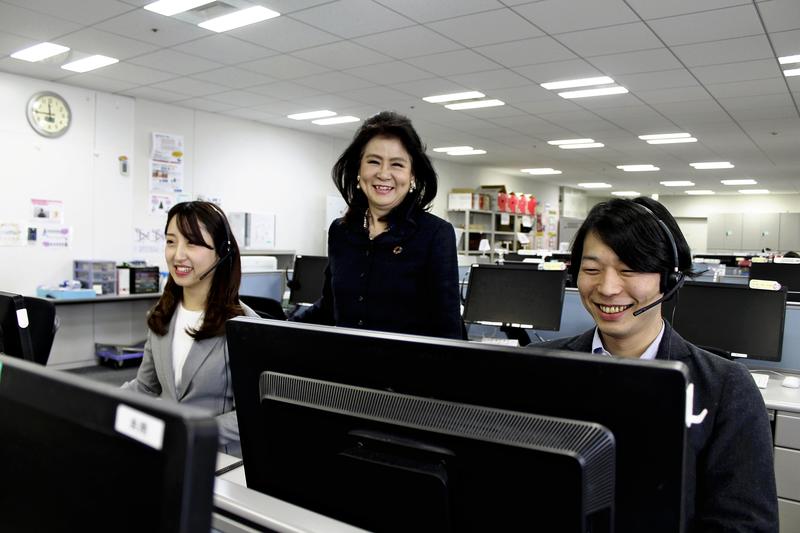
"For me, 1995 was a milestone year when I switched from an administrative position to a management-track position. Around that time, Japanese companies began creating an environment where more women were hired or promoted, and I was supported and encouraged during those times. I remember the Beijing conference well," said Sanae Suyama, 62, the president of Sompo Communications, the call center arm of the Sompo Holdings Group.
Suyama was hired by Yasuda Fire and Marine Insurance Co. in 1979, she got married and had a child in her 20s and switched to the management-track position at age 38. When she was 41 years old, she was promoted to the assistant chief position of her organization. However, she was frustrated as three male junior colleagues were promoted to section chiefs ahead of her.
She became the first female department head at age 54. Suyama attended a meeting with other department heads and branch managers to decide on important policies, and this one meeting changed the way she saw how the company operates. Of the 300 attendees, she was the only woman.
"I understood how heavy my responsibility was when I actually looked around the room," Suyama said.
She became the first female corporate officer of the company at age 56 and the first female president in the group's history at age 60.
The Sompo Holdings Group set a goal of raising the percentage of women in managerial positions to 30% by the end of fiscal 2020, and as of July 2019, that figure was at 22.5%. "Over the past 25 years, various systems such as reduced work hours have been established, and they have created a more female-friendly work environment. However, women are still not on an equal footing with men in some aspects. I hope women don't hesitate to take on challenges if they have the opportunity," Suyama said.
According to a preliminary Labor Force Survey by the Internal Affairs and Communications Ministry, the rate of employment among women aged 15-64 reached a record high of 71% in 2019. Over the past decade, the employment rate among women aged 25-34 rose from 67% to 79% and among those aged 35-44 increased from 65% to 77%.
The so-called "M curve" refers to graphics showing the rate of employment for women by age form an "M" as women's employment declines around 30 because they stop working to have and raise children. And this tendency is now being eliminated thanks to the new environment that enables women to be mothers and continue working.
However, 54% of working women aged 15-64 are part-time employees. Some wives want to work below the upper limit of the spouse tax deduction, while many women cannot become full-time employees and suffer from unstable positions and a low salary.
According to a survey conducted by the Yokohama Association for Promotion of Gender Equality and others in 2015, 82% of unmarried, female part-time employees aged 35-54 said they were concerned about low income. The council holds seminars and meetings for unmarried, female part-time employees worrying about income and treatment to help them mitigate their concerns and make friends.
Machiko Osawa, a professor of women's labor and career-building issues at Japan Women's University, said: "Over the past 25 years, the way women choose to live their lives have become more varied and they have become more career-focused. Companies are now giving more opportunities to women who display a certain aptitude.
"However, societal attitudes are still stuck in the past. Companies and society cannot keep up with the changes women are trying to make," Osawa added. "Since some women can only work part-time, many of them fall into poverty following a divorce. Society needs to take note of these issues and create a place for these now impoverished women."
Read more from The Japan News at https://japannews.yomiuri.co.jp/