Two hundred and sixty years ago this month a swashbuckling Yorkshireman known as Lieutenant Colonel Robert Monckton led a fleet of warships containing 270 English troops across Atlantic waters and into the mouth of the Missaguash river.
Monckton’s men ended up in a heavily forested region now known as the eastern Canadian province of New Brunswick where, following a two-week siege, they captured an area previously controlled by French Acadian settlers.
At its heart lay a habitation soon to be named “Moncton”. More than two-and-a-half centuries on it has grown into a small, thriving, officially bilingual city, currently bracing itself for another fierce battle between French and English invaders. And once again England are led by a bright, ambitious young man. At 32 Mark Sampson is four years older than Monckton was when he first set foot in a region known as “The Maritimes”, but his challenge is arguably even greater.
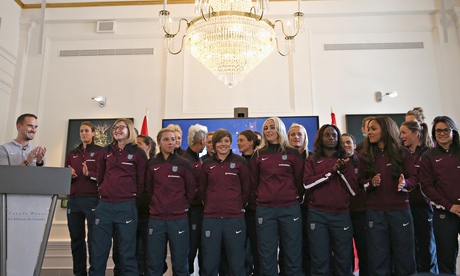
Sampson’s Lionesses, the England women’s football team, checked into their downtown hotel on Friday for a World Cup campaign kicking-off with a match against a formidable looking France side in Moncton on Tuesday. Further Group F games against Mexico, next Saturday, and Colombia, in Montreal on Wednesday week, follow as England aim to progress beyond the World Cup quarter-finals for the first time.
Ranked sixth in the world, England are fast improving but face daunting competition in the shape of not only France but fellow tournament favourites, Germany and the United States. While Japan, the holders, should also be in contention, and Sweden cannot be underestimated.
The Football Association has invested considerable sums of money in the domestic women’s game but crowds for the Women’s Super League have risen slower than was hoped, meaning there is a certain pressure on the squad to complement off-field advances with on-pitch success.
The greater investment can be traced through mattresses, airline seats and medical facilities. When Hope Powell was winning her 66 international caps playing for the Lionesses during the 1990s, England’s former coach – and Sampson’s predecessor – often slept on gymnasium floors before internationals and routinely washed her own kit. Two decades on, things are radically different.
Largely thanks to Powell’s readiness to, quite brilliantly, stand up to the suits at FA headquarters, the current squad flew to Canada in business class, with flat beds available at the touch of a button. During their stay they are being housed in five-star hotels equipped with fully ergonomic mattresses.
Similarly, the squad are accompanied by a high-calibre medical team possessing direct lines to the finest orthopaedic surgeons. The days when Powell and her peers either paid for private surgery on misbehaving knees or ankles or faced often lengthy waits before NHS operations are over.
“There’s definitely a sense of responsibility,” says Claire Rafferty, England’s left-back and a part-time financial analyst at Deutsche Bank, who can look back nine years and recall her parents digging deep to finance career-saving knee surgery. “If we do well in Canada it will increase, and hopefully sustain, interest in the WSL.”

In 2014, the average figure for a crowd at a WSL game stood at 728 – up 30% from the previous year – with Manchester City attracting the biggest gates, which sometimes topped the 1,000-mark. Encouragingly, international fixtures generally capture the public’s imagination; almost 46,000 watched England lose to Germany at Wembley last November.
With women’s football an appreciably bigger draw in North America, Scandinavia and parts of east Asia, Canada 2015 is being billed as the most high-profile Women’s World Cup in the history of a tournament which began in China in 1991. Yet while a healthy 23,000 turned out in Hamilton, Ontario, to watch Sampson’s side lose a warm-up game against Canada 1-0 late last month, the game attracted relatively little attention in the UK.
This low-key response had much to do with the match kicking-off at midnight British Summer time. It prompts concerns that, despite the excellent Jacqui Oatley fronting comprehensive coverage of the tournament on BBC television, domestic interest could be affected by the significant time differences which dictate some games, the final included, are scheduled late at night in western Europe.
Matters are further complicated by this international showpiece being, contentiously, staged on artificial surfaces. Quite apart from most players detesting such pitches, a handful of key England performers, including Steph Houghton, the influential captain, are still working their way back to match fitness following lengthy lay-offs and would have much preferred the rather more forgiving feel of grass beneath their feet. Should the coming month produce a rash of non-impact injuries, surface tensions will become the hottest of topics.
A Canadian side coached by John Herdman, a Newcastle United supporting-Englishman from Consett, outclassed England in that warm-up game, but Sampson insists not too much should be read into that. “We’re in a good place,” says the Welsh-born coach, who led the team to 10 straight qualifying wins but has lost friendlies to Germany and the United States in recent months. “We’ll be sharp and firing by Tuesday. I want 23 players ready to put their feet flat to the floor against a very good France.”
The atmosphere in the camp is said to be excellent, with the Lionesses relishing Sampson’s comparatively relaxed management style after Powell’s more authoritarian and, sometimes, downright confrontational approach. A big believer in rotation, he tends to pick horses for courses while alternating between a fluid 4-3-3 formation and a 4-4-2 based diamond. “The great thing is we don’t really have a starting XI,” says a coach once mentored by Roberto Martínez. “We’ve got a group of 23 players who at any given time can slot in and do a job.”

Unlike Rafferty, a majority of Sampson’s squad are fully professional. A typical combined salary for a WSL player also on one of 27 “central” England contracts is around £45,000 per annum – peanuts compared to their male peers but an infinite improvement on the £5 match fees commonly paid by leading clubs only a couple of decades ago.
Back then, women’s “soccer” was frequently depicted as a joke – or even something slightly shameful. “Women’s football should only be played by consenting adults in private,” wrote Brian Glanville, the then eminent Sunday Times football correspondent, in 1990. Depressingly, he was merely reflecting a consensus among his sportswriting contemporaries.
Several might be shocked to learn that on Boxing Day 1921, a crowd of 53,000 at Goodison Park watched the famous Dick, Kerr’s Ladies team in action. Women’s football had reached such a zenith that panic was provoked in the FA’s corridors of power and an emergency edict duly issued. “The game is not to be encouraged for females,” it stated. The governing body proceeded to ban women’s football from being played on any pitches belonging to FA affiliated clubs until 1971.
Now, 44 years on, a glorious velvet revolution is unfolding. Upwards of 150,000 girls and women play football every week in England alone, while Prince William, the FA president, is an enthusiastic supporter of Sampson’s Lionesses.
Should they somehow confound all available odds and end “49 years of hurt” by becoming the first England side since Sir Alf Ramsey’s class of 1966 to win a World Cup, participation figures would sky-rocket and the WSL could surely afford to look confidently towards the future.
No wonder Marieanne Spacey, the former England striker turned national assistant coach, is urging everyone to seize the moment. “The important thing for these girls is to create some memories,” she says. “It’s vital they enjoy the experience, that they embrace it – and make the very most of it.”