If you accept, as I do, the notion that feminism is by nature anti-war, then the increased presence of women in warmongering action blockbusters like Man Of Steel (which was used by the National Guard as a recruitment drive) and Battleship should not be applauded.
This “feminising” of traditionally boys-own pop culture ties into the ongoing debate about whether or not it is a “feminist issue” to have women on the front line. On the one hand, there’s a school of thought that says equality is reached when female soldiers are considered as capable as their male counterparts. The logical conclusion to be drawn, however, is that they are then just as capable of being blown to smithereens or crippled with PTSD. Is this true liberation? Or is it capitulation to the ultimate patriarchal nightmare of war?
It is often said that women have been written out of history, since the writing of history itself is so often a concern of powerful men. This is true of science, art, cinema and, perhaps most notably, upon this centenary of the first world war, in the telling of the history of “the Great War”.
The stories of the unprecedented number of women who volunteered and served, some at the front, during the first world war have traditionally taken a back seat to the tales of male bravery and derring-do. That is in part due to the fact, it almost needn’t be mentioned, that tens of millions of men died, a loss of life at a level of senselessness that borders on the incomprehensible.
But where art is concerned, and specifically the myth-making possibilities of cinema, women have been largely absent from the stories we are told about the first world war with scant exceptions. The classics of the genre, like Gallipoli and All Quiet On The Western Front, are almost exclusively populated by men.
A number of filmmakers, working in both cinema and television, have attempted to counter this in the past year, with mixed results. ABC1’s Anzac Girls, a six-part exploration of the true stories that befell women working with the Australian army nursing service at Gallipoli and the Western Front, offered melodrama that felt ultimately soapy.
While its intention – to tell the tales of women who have been in essence forgotten in favour of the men they worked alongside – was noble, in its execution (zeroing in on moonlit walks with handsome soldiers; even the “Girls” of the title), for all the hospital gore on show, Anzac Girls still felt undeniably concerned with the romantic. It was, in this sense, conservative both artistically and politically.
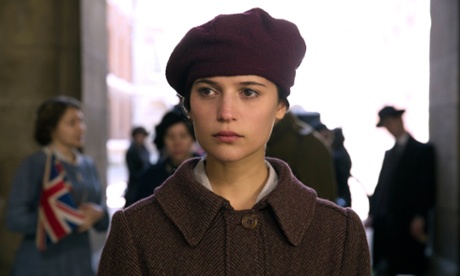
More compelling is Testament Of Youth, James Kent’s fine big screen adaptation (it previously received the telemovie treatment from BBC2 in 1979) of Vera Brittain’s acclaimed war memoir, which opens nationally on 23 April. Brittain worked as a voluntary aid detachment nurse during the war that claimed the lives of her fiancé, brother, and two close friends; she later became one of the 20th century’s most prominent pacifists. And while love and its loss plays a role in the film, Testament of Youth is most concerned with Brittain’s experience of war, from afar and at the front, as her pacifism begins to crystallise.
What makes the film a compelling entry into the war movie canon, from a feminist perspective, is that Brittain was never concerned with marriage: her dream was to attend Oxford University (more than once during the film she is decried by the men in her life as a potential bluestocking and suffragette). She admires her suitor’s mother, a writer whose literary pursuits supports the entire family, and spars with her Oxford tutor (Miranda Richardson in a small but rewarding role).
All this is, of course, waylaid by the terrible news of 1915. The anti-war stance that Brittain would later champion informs Testament’s mournful quality even before the first battle has been fought. Far from the frenetic nature of Joe Wright’s Atonement, this film teeters quietly on the precipice of an unknowable grief, so much so that you dread the inevitable human tragedy as much as you do the paroxysms of tears you know will come to you, the viewer.
But this is not a 10-hankie weepie concerned solely with dashed romantic hopes; the tears roll because of the witlessness of war and the waste of life. When we eventually see Vera (played with quicksilver wit and deep empathy by the Swedish actress Alicia Vikander) standing dumfounded among a field of dead and dying soldiers, the false meaning of wartime heroism – and the meaninglessness of the deaths of millions – that Brittain campaigned against is clear.
There are another three years left of the centenary of the first world war, and there will likely be many more films, television series and plays that explore those four dreadful years. The centenary, and the oncoming tide of sentimentalised commemorative narratives, should give us pause to consider whether the presence of “women’s stories” about the first world war assists in righting the wrongs that a male-centric cultural “history” of the war have done the women who served, or whether is it just another way to make the whole debacle seem hopelessly romantic rather than simply hopeless.
“I shall never be afraid to confront the real,” Vikander’s Brittain assures her fiancé, via voiceover, as war begins in Testament Of Youth. If women are to enter this particular part of history by way of cinema, let us hope that they do so in the model Brittain envisioned: free of the dangerous notion that war is in any way heroic or romantic.