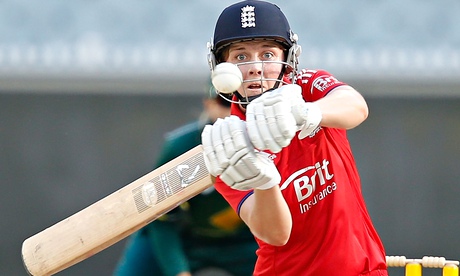
The England and Wales Cricket Board has announced the creation of a six-team Women’s Cricket Super League which will launch with a condensed Twenty20 competition next year before a 50-over tournament is added in 2017. Charlotte Edwards, the England captain who experienced a similar if considerably more established event when she spent last winter playing for Western Fury in Australia’s seven-team Women’s National Cricket League, described the proposals as “what we’ve been crying out for for a number of years”.
The announcement reflects the increasing popularity and success of women’s cricket, a year after the advent of central contracts and in the buildup to an eagerly anticipated Ashes series. “In terms of impact and scale I think it’s the most significant development in the women’s game in this country for a very, very long time,” said Clare Connor, the ECB director of England women’s cricket and former national captain. “I think this is the game changer, in terms of driving standards up towards the England team, for as many talented players to be as good as they can be.”
The competition, created following discussions not only with Cricket Australia but with the Football Association and the England Netball Association, which is seen as being particularly successful at attracting and involving women, remains shrouded in a considerable degree of uncertainty. The identity of the six “hosts” will be decided over the next six months following a bidding process which will not be limited to existing counties. The ECB is hoping to have identified locations spread across the country. It will also rank the top 80 women cricketers in the country and map their existing addresses to see where they are currently clustered.
“What’s exciting about this process for me is to see what comes back,” said Connor. “So will Yorkshire submit an application, and will they submit it as Yorkshire Cricket Club or as the Bradford Belles? The fact this is open to absolutely creative suggestions is what really excites me. Some counties might bid on their own, some might submit joint bids. But I would be so excited if we got a bid from, say, Arsenal. Anything’s possible. We need to break the shackles of traditional women’s cricket.”
Among other criteria, aspiring teams will have to prove their ability to attract and develop players from their communities, as well as commercial partners. “Looking at the potential impact from a participation perspective, the strategy is that 51% of the population are female and there’s huge low-hanging fruit there in terms of growing our game and putting cricket into the home of every family,” added Connor. “I think we’ve got to be really ambitious with this project in terms of the impact it can have on sporting communities, on the opportunities for girls in schools, clubs and universities.”
The WCSL will supersede the existing 38-team Women’s County Championship, the aim being to create a smaller competition of greater quality. The 18 centrally-contract players – currently spread around the top two divisions – will all be involved, while each team will also be allowed two overseas players. Its impact in the first year will be limited – the 2016 T20 competition is likely to be played over less than three weeks in August, allowing the England players to regularly represent their counties for what is likely to be the last time – while there is also a possibility it will be shortened in 2017, when the calendar will be cluttered because of England hosting the Women’s World Cup.
The announcement could also preface the return of cricket to terrestrial television after a decade’s absence. “Sky have obviously been phenomenal in their support for the women’s game,” said Connor. “But I think this probably gives us the opportunity to speak to every broadcaster, whether it’s free-to-air or subscription. Obviously we want some or all of the games to be on TV.”
Once the six teams are identified the ECB will also be involved in squad selection, with the aim of guaranteeing fierce and fair competition. The centrally-contracted players – and possibly the rising stars in the national side’s academy – will be allocated to teams who are also likely to be restrained by salary caps.
The ECB has pledged £3m in funding over the next four years, which will cover its own staffing and infrastructure costs, grants to help fund the establishment of the six chosen hosts and – for the first time – prize money.