The United Nations has designated March 8 as International Women's Day.
Otekomachi -- a Yomiuri Shimbun website that aims to support working women -- and the paper's Tohoku General Headquarters held a symposium on Feb. 11 titled "SDGs from the perspective of disaster-stricken areas" at a Sendai hotel.
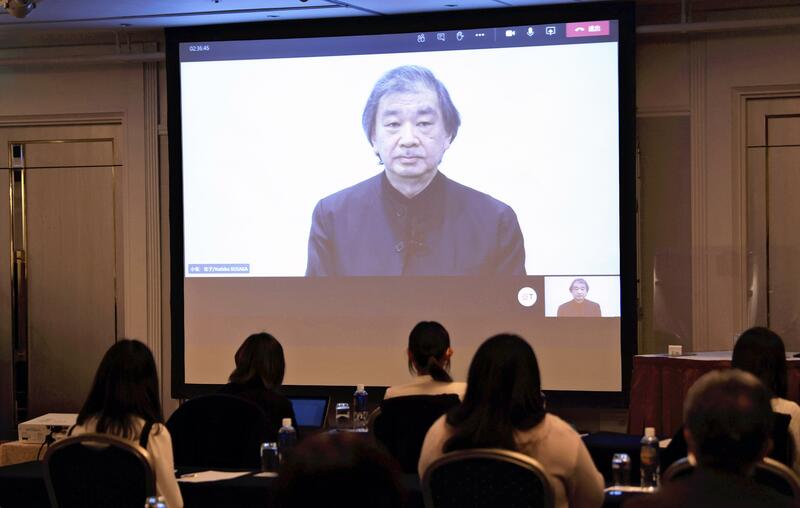
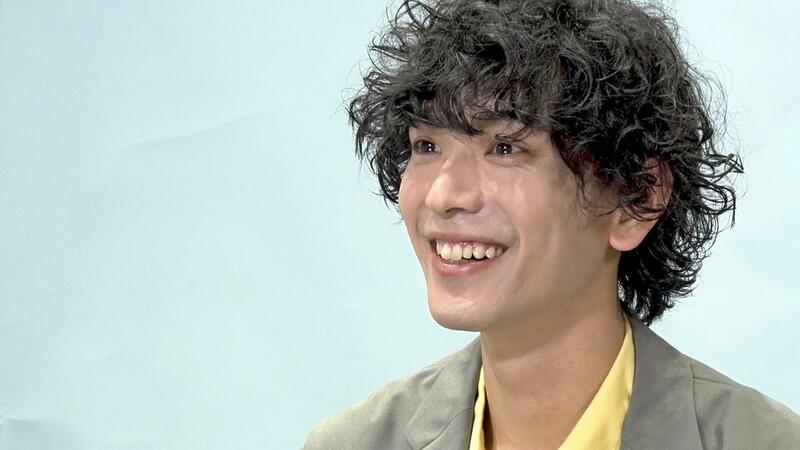
Architect Shigeru Ban, noted for his disaster relief work, gave a keynote speech online from Tokyo. Actor Mario Kuroba, a native of Miyagi Prefecture, shared his disaster experience.
In a panel discussion, four people working in Miyagi, Iwate and Fukushima prefectures talked about the potential of the disaster-stricken areas. The symposium was broadcast live and shown at venues in Sendai and Morioka.
This feature presents highlights of the speakers' remarks at the symposium.
-- Architect Shigeru Ban: Paper buildings, privacy walls after disasters
I've supported disaster-stricken areas around the world for more than 25 years, creating buildings made of paper tubes. Earthquakes themselves do not kill people, but they destroy buildings -- and that kills people. Architects are responsible for disasters.
When the Great Hanshin Earthquake struck in 1995, I learned that a large number of Vietnamese were gathering at Takatori Church in Kobe, and I created 50 temporary houses for them, using beer crates filled with sandbags as the foundation.
I also created a temporary paper church on the site of a former church where only a Christian statue remained, and the paper structure became a local symbol, where weddings and concerts were held. I thought it would be good enough if it would last for three years or so, but the church actually was kept for 10 years and then relocated to a Taiwan village that had also been hit by a big earthquake, and it's still in use. Even a church made of paper can become a permanent building if it's beloved.
When the Chuetsu Earthquake struck in 2004, I proposed that shelters be partitioned as evacuees had no privacy, but I was turned down by municipalities as the idea was "unprecedented." At the time of the Great East Japan Earthquake, I was able to make partitions at 50 shelters in Otsuchi, Iwate Prefecture.
Since then, partitions for use at shelters have been stockpiled for the future. They are now recognized as highly useful in preventing the spread of airborne droplets amid the coronavirus pandemic.
-- Actor Mario Kuroba: Promoting hometown cheers me up
I was 17 years old at the time of the Great East Japan Earthquake, and it was the day of the closing ceremony of my second year in high school. One thing I remember is the cold.
Electricity had been cut off, and there was no heat. So, I couldn't take a bath and had to wipe down my body with a wet towel. I waited in line for five hours at a convenience store to buy food for my whole family.
At present, I serve as an ambassador of Miyagi and am promoting the prefecture's specialties on my blog. My dream of engaging in jobs related to my hometown came true.
It now seems to be long after the disaster. But the time also passed quickly, before I knew it. Over the past 10 years, I felt people's deep strength. For the next 10 years, we will be able to see the future after reconstruction, and I want to keep on going.
The panel discussion, moderated by Yomiuri Shimbun Tohoku General Headquarters Chief Yuki Hasegawa, addressed future work styles and the possibility of the disaster-hit area in two parts.
-- Part 1: Reconstruction and women's roles
Two women took the stage: Kyoko Watanabe, the representative of Makigumi LLC, which provides vacant houses to people who move into Ishinomaki, Miyagi Prefecture, and Kyoko Washiya, the representative of a company in Koriyama, Fukushima Prefecture, called 2hours that offers jobs that allow flexible working styles including shorter working hours and working with children.
The 2hours concept is that teams of several people undertake work for companies under the motto of "Let's work two hours." Work styles have diversified amid the pandemic, and Washiya said, "If the diversification becomes widespread in regional cities, mothers will become more involved in labor."
Watanabe, meanwhile, set up Makigumi in 2015 after learning that people who came to disaster-hit areas for volunteer work are struggling with finding places to live, even if they decided to settle down there.
"There are business opportunities in places, like rural areas, with many problems," she said.
She emphasized that it was important to identify demand by interacting with many people and create businesses based on free thinking.
-- Part 2: Job creation and work style
Two panelists shared their knowledge about industries in the disaster-hit areas: Yukinori Shitautsubo, the president of processed food maker Hironoya Co. in Hirono, Iwate Prefecture, and Nozomi Hiramatsu, who runs Hiramatsu Farm in Sendai.
Over the past 10 years, Shitautsubo has worked to revise an image of the fishing industry and created a brand for local products. For example, he has sold top-quality sea urchin around the world as a premium food that excites gourmets, like caviar.
On sea urchin farming, he said, "We keep creating jobs for fishermen even during the off-season through shipping our products, and this would lead to sustainable fisheries."
Fellow panelist Hiramatsu started farming in 2017 after studying at Tohoku University's agriculture department and then worked as a disaster relief volunteer after the Great East Japan Earthquake. Her farm is growing vegetables in the Arahama district of Wakabayashi Ward in Sendai. A group of people in the district moved out after tsunami. The farm also supports new farmers and gives food and agriculture classes at elementary schools.
Hiramatsu said, "We want to promote community-supported agriculture in which producers and consumers know each other and support each other."
-- International Women's Day
In the International Women's Year of 1975, the United Nations designated March 8 as a commemorative day to improve women's rights and eliminate discrimination.
-- SDGs
Abbreviation for the Sustainable Development Goals that were adopted at a U.N. meeting in 2015 where 17 goals were set, including "no poverty" and "gender equality."
Organizers: Otekomachi, Yomiuri Shimbun Tohoku General Headquarters
Sponsors: McDonald's Company (Japan), Ltd.; Tohoku Electric Power Co.; Sendai Terminal Building Co.
Cooperation: NTT Urban Development; The Japan News; German Embassy; Romanian Embassy
Read more from The Japan News at https://japannews.yomiuri.co.jp/