A date night at the movies in Berlin this Valentine’s Day promises an alternative perspective on love. As the city’s film festival reaches its climax next weekend, the desires of the female audience will have come into sharp focus. And it is erotica, rather than traditional romance, that is taking centre stage, as a succession of directors unveil films that offer a woman’s viewpoint.
The festival’s opening film, Nobody Wants the Night, starring Juliette Binoche, set the scene last week for a lineup saucily laced with a revisionist approach to the conventions of presenting physical love and lust on screen. Binoche trudges through Greenland’s frozen wastes and befriends her husband’s Inuit mistress in an unsentimental film loosely based on the true story of Josephine Peary, wife of the American polar adventurer Robert Peary, played by Gabriel Byrne.
The film was followed up on Saturday by a remake of the 1946 Jean Renoir classic The Diary of a Chambermaid, a story also tackled by Luis Buñuel in 1964 and based on Octave Mirbeau’s 1900 novel. This time directed by Benoît Jacquot, it stars Léa Seydoux, the latest Bond Girl, as Célestine, the chambermaid who becomes entangled with both her master and the gardener.
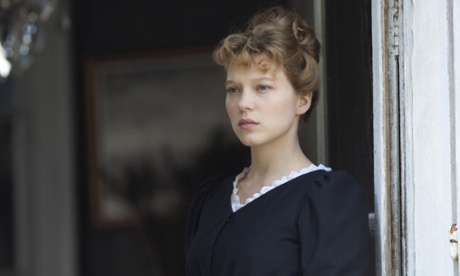
In Jacquot’s version, which is running in the main competition for the Golden Bear in Berlin and claims to be the closest so far to Mirbeau’s book, the seductive Célestine is placed at the heart of intrigue in a wealthy French family. And while a beautiful chambermaid might not sound like a character destined to rewrite erotic stereotypes, the screenplay claims to adopt a feminine, and possibly even a feminist, approach. Producer Kristina Larsen, of Les Films du Lendemain, has described the film as having “an intimist edge, because the story is told from Célestine’s point of view”.
Jacquot believes he has made a film that addresses gender politics and not just sex. “Octave Mirbeau was an anarchist and, although his novel takes place at the turn of the 20th century, it still says something about the world we live in, the condition of many women today,” he said.
“Buñuel’s and Renoir’s films are so different, and mine will be as well. I emphasised the feminist aspect of the novel. The central character, Célestine, is a young woman who wants to be someone and has to go through extreme things to achieve that status because for her it’s a question of life or death: she must free herself from ‘slavery’. At the end of the 19th century, French maids working for affluent families were treated like slaves. The story is told through her eyes and comments on what happens to her.”
The sexual allure of Célestine, the director argues, is important simply because it is “her best weapon”.
While directors such as Jacquot and Isabel Coixet, who made Nobody Wants the Night, may strive for artistic impact, there is strong evidence that the commercial end of the film business has found new confidence in the appeal of sex for a female audience.

The big international premiere at this year’s festival is British director Sam Taylor-Johnson’s $40m adaption of the bestseller Fifty Shades of Grey. Since E L James wrote the e-book in 2011, the title of the first of her steamy trilogy has become synonymous with the profit to be made from providing erotica for the modern woman. Producers of Taylor-Johnson’s film, which stars Jamie Dornan as the mysterious alpha male, Christian Grey, have based its publicity campaign on the assumption that it is chiefly women who will want to see it – in spite of a growing boycott campaign this weekend by feminists, who argue that James’s story glamorises abuse.
Fifty Shades of Grey has been promoted via the 71% female userbase of the social media site Pinterest and one marketing analyst told the trade journal Variety that 86% of the retweets from the film’s promotional Twitter account are from women. The expectation is that women will see the film in large groups, much as they did in great numbers for the opening of the first Sex and the City film in the spring of 2008. But trailers and posters for the film have steered a careful path, avoiding images that might look like soft porn.
A stronger kind of meat will be on show at Berlin in 54, a rerelease of the explicit film about Studio 54, a fabled New York disco of the 1970s. Director Mark Christopher first ran into trouble with the German poster put out for its release in 1998. The image of a woman receiving oral sex on the dance floor was one of many elements regarded as scandalous then. Christopher is now presenting a director’s cut of his star-studded film, featuring Salma Hayek, Ryan Phillippe and Mark Ruffalo, for the first time.

In the late 90s it was heavily edited by the studio that released it, eventually losing 30 minutes of original material and then proving a failure at the box office. Whether this longer incarnation of 54 will give more space to women’s sexuality is less clear. Many of the scenes that originally offended producers at Miramax, who first released the film, are thought to have contained male gay sex rather than female sex.
When Coixet’s Nobody Wants the Night launched the festival last week, earning a tepid, if not icy, response from critics, the director became only the second woman to hold the festival’s coveted opening-night spot. She clearly saw the film as a way to represent female marital emotions without the cliches of a domestic setting.
“Nobody has told the story of the north pole from the point of view of the woman,” she said. Binoche, her star, said she saw the film as a kind of woman’s western. This year Coixet is one of three female directors in competition at the Berlinale, but it is questionable whether the gender of a director is necessarily an indicator of whether a film will depict a female sensibility.
Apart from Kathryn Bigelow, who won Oscars for best director and best film for The Hurt Locker, her brutal look at modern warfare, there are plenty of examples of women who succeed in making films that appeal to men. Amy Heckerling made mainstream American teenage comic hits such as Fast Times at Ridgemont High in 1982, while shock-jock Howard Stern’s deliberately reactionary Private Parts was directed by Betty Thomas.
If you want to know where you are with gender politics and sensuality, reports suggest there is only one place in Berlin to go: Kenneth Branagh’s Cinderella. This live-action Disney film, which opened at the festival on Friday night and stars Downton Abbey’s Lily James, is still happily set in a land far, far away and makes little attempt at a revisionary rewriting of the myth. Cinders suffers, as we expect, under the evil rule of her wicked stepmother, portrayed by Cate Blanchett, and must wait for Helena Bonham Carter’s fairy godmother beneficence to release her.
The trailer features a flashback in which Cinderella’s late mother passes on the wisdom that, if a woman can just stay lovely and kind for as long as possible, everything will work out for the best. Yet Branagh has noted “how all-pervasive this Cinderella myth is” and seems to know that its doctrine of passivity is just as loathed by some feminists as the sado-masochistic fantasies of Fifty Shades.
“The first time we meet the grown-up Cinderella, she’s reading a book; she isn’t just scrubbing the steps,” said Branagh. “She’s already intellectually stimulated. And she makes a decision to try and understand the cruelty and the ignorance of her stepmother and stepsisters. We see a strength of character that is sort of a form of nonviolent resistance. And she meets the prince way ahead of the ball, before she decides to fall for him. The seeds of a romance are sown in terms of equality. It’s not about a man rescuing a woman.”
The message from Branagh and the rest of the lineup at Berlin is as clear as a crystal slipper: this year it is not just the prince who comes.