Just six months ago, counterterrorism officials announced their next initiative for preventing young Britons enlisting to fight in Syria: recruiting Muslim women as amateur detectives. At this point, it was estimated, between 200 and 366 British nationals had volunteered for Islamist duties. Deputy assistant commissioner Helen Ball, the senior national co-ordinator for counterterrorism, told the Guardian what her chosen anti-militarists would be urged to look out for. “Women might see their family members spending more time on the internet,” she said. “They might get very angry about what’s going on in Syria.”
Wouldn’t it make sense to involve the Muslim men, too? Or was there evidence that, unlike their womenfolk, they might take umbrage? Although academics had already set out the dangers of taking Muslim women for granted as protection against radicalisation, and one Muslim mother, Najma Hafeez, promptly told reporters that she considered this advice “very patronising”, Ball’s assumptions about women as preeminently benevolent bystanders, possibly a rather eccentric one for a top police officer, were delivered as if self-evident. Maybe she was right. For, strikingly, this confident depiction of women as biddable nurturers of the warrior sex – perhaps based on still-undisclosed triumphs in maternal policing – did not provoke the level of public indignation (as in the Let Shoes Be Shoes campaign) that is now routine when manufacturers make gendered assumptions about, say, children’s shoes.
No Let Artillery be Artillery campaign challenged a statement by one distinguished speaker, Sajda Mughal, at the Manchester launch of the initiative. “Women are the agents of change, particularly mums in the home,” she said. “They are the ones who can nurture and safeguard their children.” Samantha Lewthwaite, mother of four and, incidentally, the Islamist “white widow”, has presumably, according to this essentialist view of things, undergone the same unsexing programme as Lady Macbeth .
While the anti-pinkification movement gathered strength, any doubts about Ball’s scheme were more likely to focus on its alleged provocations to spying and disloyalty than its faith, still more enduring than Disney’s, and greater even than the housewife-friendly Better Together campaign’s, in the power of sex difference.
To be fair to the counterterrorism officers, a conviction that women are naturally averse to conflict is still shared by many distinguished politicians and thinkers, and also by our own Austin Mitchell. He recently worried, in public, about the risk posed by female niceness to the national interest – and, by implication, the risk that political power poses to female niceness. Women, he’s concluded, are “less inclined to discuss big issues, like should we invade Iraq?”.
Often, it’s true, the ratio in media comment pages of male armchair generals to female advocates of “boots on the ground” could be interpreted as supporting Mr Mitchell’s theory, which is itself, I imagine, indebted to Sara Ruddick, the influential feminist philosopher, who posited the restraining impact of mothering on militarism.
Others might see the disparity in comment bellicosity as – assuming we can rule out discrimination – confirming Prof Simon Baron-Cohen’s analysis, whereby a shortage of female bombers could be attributable to women being “hard wired for empathy”. Unlike men, who are programmed, if I have this right, to dote on tanks.
So perhaps it is unscientific to read too much into exceptions, such as Aqsa Mahmood, the runaway Isis supporter and issuer of ambitious threats to David Cameron and his descendants: “Worry not, somewhere along the line your blood will be spilled by our cubs.” Or there’s Khadijah Dare: “I wna b da 1st UK woman 2 kill a UK or US terrorist!” And the 45-year-old former musician, another mother of two, who tweeted under the name Umm Hussain al-Britani: “You Christians all need beheading with a blunt knife and stuck on the railings at Raqqa.”
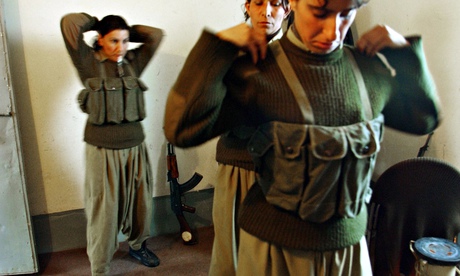
There must be a perfectly good explanation, too, for these women’s more active female opponents, present both in the allied military and much more so in the Kurdish YPJ, a force that is around 35% female, now fighting to the death in the besieged town of Kobani. One soldier, known as Rehana, is reputed to have killed more than 100 Isis fighters. Her commander, a woman called Narin Afrin, is quoted as saying: “In order to enter Kobani the Isis gangs will have to pass over our corpses.” In a fascinating piece for New Republic, Sophie Cousins meets a young Kurdish soldier in north-eastern Syria, half a mile away from Isis forces. Wearing a hijab, armed with a Kalashnikov, the soldier tells her: “The woman has been suppressed for more than 50,000 years and now we have the possibility of having our own will, our own power and our own personality.”
But over here, the counterterrorism police still incline more to Kofi Annan’s position. “For generations,” he has said, “women have served as peace educators, both in their families and in their societies.” It may be partly because such tributes show women in, you might think, a distinctly appealing light, that critics of innate sex difference have been almost as slow to confront myths about female pacifism as they have those that present risk-averse womankind as the potential saviour of the financial markets or as the natural opponents of beastly Ukip.
There’s no denying that killing, unlike maths, is something most of us would prefer – at least in peacetime – to be bad at. Equally, there is no avoiding the evidence that European women, even women who have given birth, are now endorsing the most barbaric of war crimes by their Islamist husbands and protectors, whom they seek out in ever greater numbers. In his new study, Professor Kamaldeep Bhui finds that, even with their relations patrolling the house on behalf of deputy assistant commissioner Ball, young British women and girls are as likely to be radicalised as men; they are estimated to number up to 60 out of around 500 local recruits to Isis.
Women, said Kofi Annan, “have proved instrumental in building bridges rather than walls”. Even before nicely brought-up schoolgirls, well-versed in the precepts of anti-bullying week, began tweeting genocide from a war zone, it was surely more complicated than that.
True, women are always vulnerable as civilians, and rightly prioritised for protection by the UN. But they have also handed out white feathers, enforced FGM, betrayed their neighbours, committed atrocities in every terrorist enterprise, where their perceived harmlessness makes them especially effective. Meanwhile, innumerable male conscripts have deserted, feigned injury and risked death to avoid the heights of victory aspired to by Khadijah Dare, even if the reality, in the embryonic caliphate, is eking out the Nutella.
The greatest glory, for these would-be top jihadis, appears to be promotion to the al-Khansa battalion, a vicious little body tasked with enforcing women’s second-class status in conquered territory, for instance by beating the inadequately veiled. As unspeakably deluded as this might appear, they are not the first women to collude in their own marginalisation. Biological determinism, of the kind that reduces women to helpless nurturers, is sharia’s unlikely best friend.
• Comments will be opened in the morning