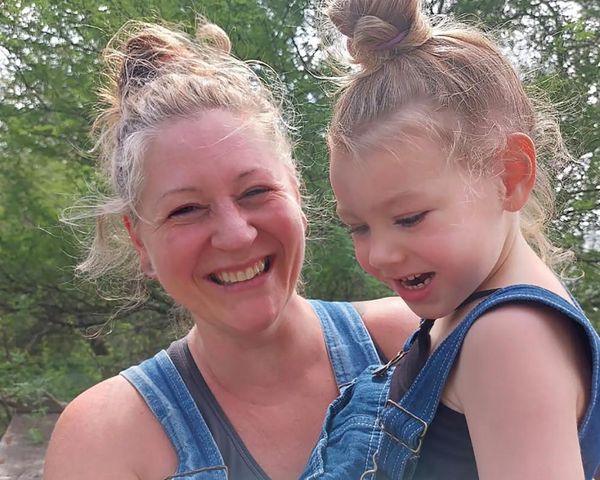
A woman who suffered a stroke at just 36 thought she was kidnapped after more than 20 years of her memories were wiped out.
Stevie Carver was given just a two per cent chance of survival after she suffered a stroke on her way home from work and was placed in an induced coma in hospital.
She was in a coma for a week as she fought for her life, and when she came round she had no idea where she was and thought it was 1998.
It was a traumatic time for Stevie, now 38, and her family, as she was hallucinating and thought she was being experimented on, and screamed at her son: "You're not my son, I don't know you". She had to learn how to walk, talk and read again.
Stevie, who suffered the stroke and brain haemorrhage in February 2018, told Metro: "I thought it was 1998, I had been kidnapped and I was being held hostage. I had no idea what was going on. It meant I wasn’t very cooperative.
"I was hallucinating and was sure I was being experimented on. I recognised my daughter but I was shouting at my son saying, 'you’re not my son, I don’t know you'."
She was born with a previously undetected arteriovenous malformation, an abnormal and rare tangle of blood vessels connecting arteries and veins.
It disrupts blood blow and oxygen circulation, and affects just one per cent of the population.
A rupture caused Stevie's brain haemorrhage and stroke as her then-partner drove her home from work at a nursing home.
She started feeling a stabbing pain in her head and was screaming because the pain was so severe.
Stevie, from Norfolk, collapsed when she got home and lost consciousness.
Paramedics rushed her to hospital and she was transferred to a specialist neurology ward at Addenbrookes in Cambridge after brain damage was discovered in a scan.
Stevie underwent emergency brain surgery, which was a success, and spent a week in a coma until she was stable enough to be brought out of it.
But it was a distressing and "terrifying" time when she regained consciousness and didn't know where she was or who many of the people around her were, including her son.
She had weakness down the right side of her body.
Stevie said she was a "very difficult" patient to deal with and due to her memory loss she would ask the same questions over and over again.
One of the youngest people on the ward, she had a lengthy stay in hospital and had three months of physiotherapy to learn how to walk, talk and read again.
Her mental health suffered being away form her family for so long, and she felt isolated in hospital.
Stevie continues to recover two years on, and is sharing her experience to raise awareness about strokes.
She said: "When people think of strokes, they associate them with older people. Before this happened to me, that’s what I thought too. But it can happen to younger people, as this shows."
She is still off work, has weakness and problems with and memory, fatigue and other cognitive functions. She is still undergoing physiotherapy while volunteering for the Stroke Association.
Last month, she walked a marathon distance of 26.2 miles on a treadmill in two weeks.
She will offer counselling over the phone and hopes to volunteer on a ward to help stroke patients once coronavirus restrictions are no longer an obstacle to that.
Stevie set up a JustGiving page to raise money for the Stroke Association during her 26.2-mile walk.
There are more than 100,000 strokes in the UK each year, or about one every five minutes, and strokes can strike people of any age at any time, according to the charity.
One in four strokes happen to people of working age, according to research.
No two strokes are the same, meaning every person's recovery is different.
"Making sure that you receive treatment quickly will give you the best possible chance of making a good recovery," the Stroke Association said.
Game of Thrones actor Emilia Clarke, who had a life-threatening stroke in 2011, has launched a charity called SameYou, which aims to improve recovery care for young adults following hospital treatment for brain injury and stroke.