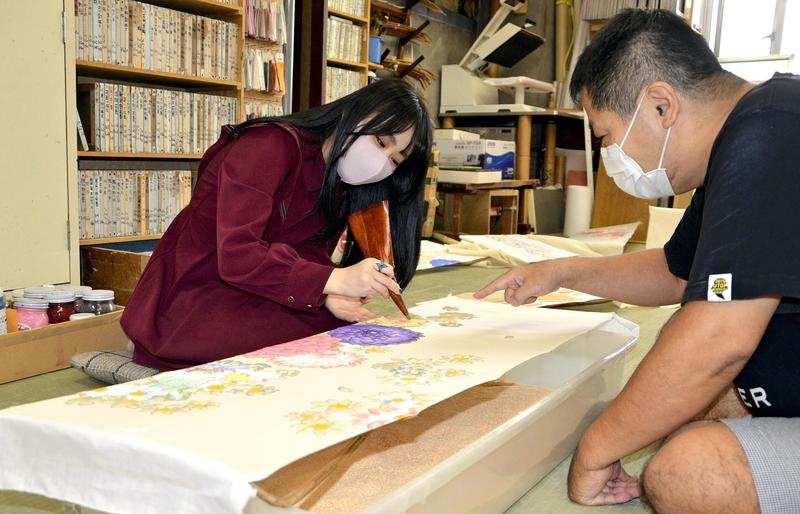
A yuzen traditional hand-painter helped a young woman create her own long-sleeved kimono, called furisode, to wear at her coming-of-age ceremony next year. The woman is undaunted it might be cancelled due to the spread of the coronavirus.
The painter, Takayuki Kato, 57 and of Sumida Ward, Tokyo, specializes in Tokyo yuzen, which is as famous as Kyo-yuzen in Kyoto. Yuzen motifs and dyeing techniques adorn many fabrics for kimono, including furisode, which many women wear at coming-of-age ceremonies due to its formal, extravagant style.
"Because we are all facing a difficult time, I want people to enjoy beautiful kimono and feel better," Kato said.
Kato, himself, has suffered from fewer work orders due to the pandemic. Nevertheless, he kindly taught his skills to the woman and provided the necessary support.
"You need to apply enough glue that the patterns underneath aren't seen through," Kato said to the woman, Miu Manaka, 20, at a studio called Ishiyama Senko, which is a costume manufacturer in Sumida Ward, Tokyo, on Oct. 12.
Manaka, a resident in Sumida Ward, was learning one of the yuzen processes called noribuse. It involves applying glue to brightly colored floral patterns previously depicted on a kimono fabric by using a piping bag containing glue. Using this method can prevent the patterns covered with the glue from disappearing when the fabric's empty areas are colored in. Uneven application of the glue can result in making the patterns unclear.
Manaka's quest to make her own furisode started when her father and custom-made furniture maker, Haruyuki Manaka, 52, got acquainted with Kato last year at an exhibition of craftworks held by craftspeople, including the father. One of the craftspeople, on hearing that Manaka would attend a coming-of-age ceremony in 18 months, suggested she learn the yuzen technique from Kato. Kato readily accepted her request.
Kato is usually busy making kabuki and stage costumes, but he had received almost no orders since March after many events were cancelled. As he felt he had been given plenty of time to teach the yuzen culture, Kato started to work with Manaka in mid-September.
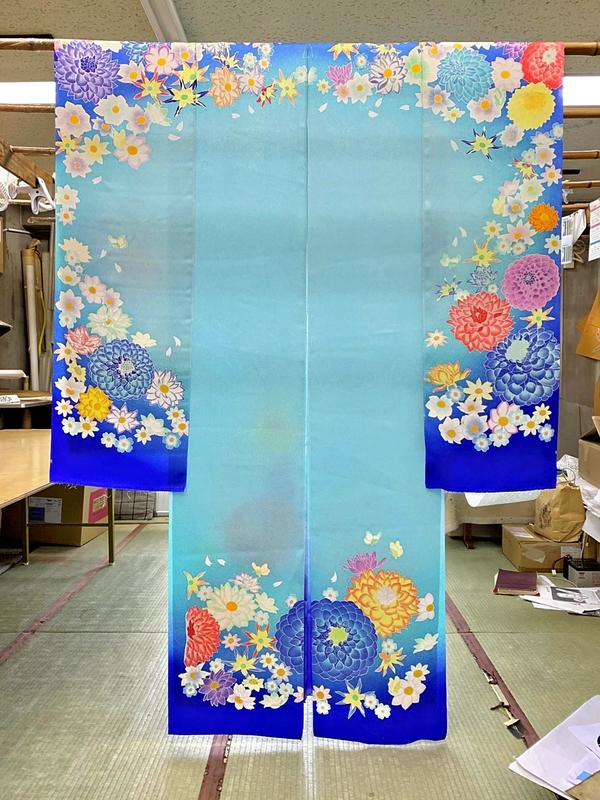
Kato designed the pattern after listening to Manaka's input. He used dahlia, which symbolizes "gratitude," as the main motif. He also arranged forget-me-nots and butterflies, which are Manaka's favorite motifs, to complete the beautiful design for her furisode.
To mark her coming-of-age celebration taking place amid the pandemic, the lining of the kimono's bottom is decorated with the motif of Amabie, a yokai supernatural being said to ward off epidemics.
Beginning in October, Manaka went to the studio every day to work on her celebration kimono. Each time, she spent three hours working on coloring the entire fabric with a brush and decorating the outline of the patterns with gold powder.
Manaka showed the finished work at an exhibition of craftworks produced in the ward held at the Industrial tourism plaza Tokyo Sumida City Point (Sumida Machidokoro). The event ran from Nov. 13-18.
The coming-of-age ceremony for Sumida Ward is scheduled to take place in January of next year. Depending on the spread of coronavirus infections, however, it may be held online or even cancelled in the worst-case scenario.
Manaka nevertheless said with a smile, "Even if the ceremony is cancelled, I want to wear the furisode I made and say, 'Thank you,' to my parents."
Kato said: "I hope this will get young people interested in the beauty of the craftwork pieces produced in their area."
-- Two workshops a month
To help expand the yuzen culture, Kato has continued giving yuzen workshops twice a month at Sasaya Cafe in Sumida Ward, Tokyo. Painting on tenugui cloth costs 1,500 yen and yukata summer kimono costs from 8,000 yen to 20,000, yen for example. Kato will accept people who want to make furisode for their own coming-of-age ceremonies the year after next or later.
Tokyo-yuzen developed during the Edo period (1603-1867) in Edo, which is present-day Tokyo, when kimono shops were opened in the Nihonbashi district. It is said there were more than 600 artisans of Tokyo-yuzen about 50 years ago, but the figure is said to have declined to no more than 60 at present.
Read more from The Japan News at https://japannews.yomiuri.co.jp/