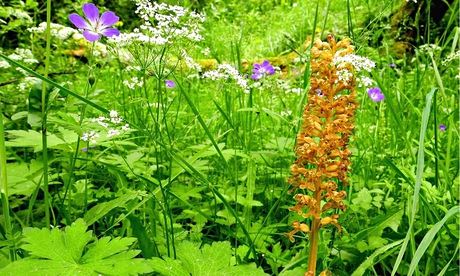
It is 15 years since we last discovered a bird’s-nest orchid. It was hidden among dog’s mercury in an old hazel coppice. The withered brown flower spike was well past its best but its botanical charisma more than compensated for a lack of beauty.
This is an orchid that challenges preconceptions of how a plant can be defined. With no leaves and no chlorophyll, its survival depends on a single species of fungus that also forms a symbiotic association with nearby trees. The trees supply the fungus with sugars and extract minerals from it.
The orchid roots, shaped like a bird’s nest, link to the fungal mycelium and take its nutrients. The complexity of this ménage à trois may explain the freeloading orchid’s rarity.
Over the years we have passed the location scores of times, willing the orchid to reappear, a forlorn hope it seemed. The seedling must germinate alongside the fungus; it takes 10 years to reach maturity, blooms once, then dies. Finding this elusive plant in its prime can be a once-in-a-lifetime experience. Orchids cast a spell, not just for being the most complex and exotic wild flowers in our flora list, but also for being so capricious.
Recently we heard a rumour that strange brown flowers had been spotted near our original sighting. We searched the coppice all afternoon. No luck. Then on our way home, beside the footpath in a patch of sunlit grassland among trees, we found them: two magnificent flower spikes surrounded by speedwells, pignut and meadow cranesbill, an association almost as unlikely as the orchid itself.
Having dispensed with photosynthesis bird’s-nest orchids need no sunlight. Their habitat is the deep shade of a forest floor. There are even anecdotal accounts of their blooming underground when unable to break through to the surface.
But here in bright sunshine flower spikes that might have been sculpted from translucent caramel, at first glance dead but actually flowering to perfection, flaunted their weird attractions; strange alien interlopers among the wild flowers of the hay meadow.
Twitter: @seymourdaily