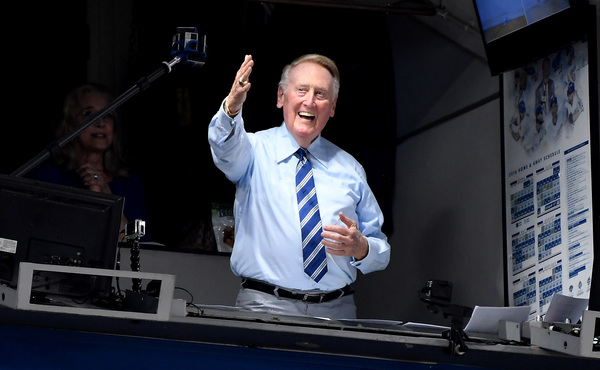
LOS ANGELES_The plane lands at Los Angeles International Airport, the shuttle stops at your car, the long trip is over, but everything feels a little strange until you turn on the radio and hear the voice that wraps you in a welcome.
"Hi everybody, and a very pleasant good evening to you, wherever you may be."
Now that Vin Scully is leaving, how will we know we are home?
The easy chair creaks, the TV is turned up, the Dodgers are playing, and you are bobbing to the rhythm of a man describing a baseball play as if it's set to music, whole notes followed by quarter notes, punchy lyrics flowing into a grand finish.
"High drive into left-center field and deep ... back goes Pederson ... a-way back ... it's gone!"
Now that Vin Scully is leaving, who will sing to us?
The batter and third baseman each have extraordinary beards. In the middle of an ordinary game, the two are looking at each other and everything slows and you're about to change the channel when a voice starts telling a story between pitches, a story that will last only as long as the batter stays alive, a wondrous story about those beards.
"One ball and one strike the count ... then, of course, you come to Abraham Lincoln, who was clean-shaven, and a little 11-year-old girl named Grace Bedell. She said to Mr. Lincoln: 'If you would grow a beard, my daddy has a beard and my mother will tease him to vote for you.' So Abraham Lincoln grew a beard."
Now that Vin Scully is leaving, we'll never again cheer so hard for foul balls.
Scully, who is retiring after 67 years as the radio and television voice of the Dodgers, is the greatest announcer in the history of broadcasting. But he doesn't belong to the Dodgers or to broadcasting.
What makes this farewell so poignant is that Scully, 88, is that rare Los Angeles sports monument who actually belongs to us.
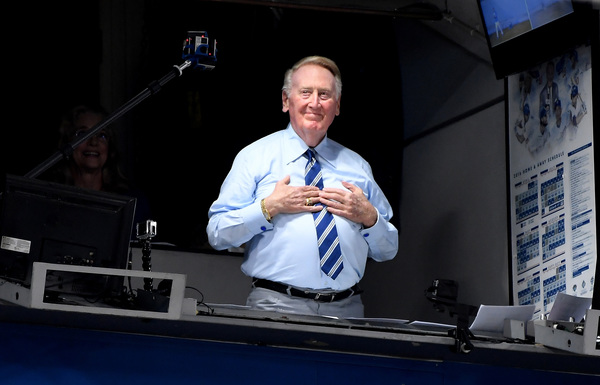
The players don't hear him on the field, the big shots rarely hear him from their box seats, and the rest of the country hears him only through their wireless. Since the Dodgers arrived here 58 years ago, Scully has spoken almost strictly to us, Angelenos in our cars and in our homes, millions who grew up with his voice in their kitchens and have grown old with it at their bedsides. He is the teacher of our children, the bleacher buddy of our teens, the wise neighbor on our cul-de-sac, and the dear companion of our aging and infirm.
For the people of Los Angeles, he is not merely the announcer of baseball games, he is the soundtrack of our lives, the dignified and graceful accompaniment of endless sandy summers, a daily harmonic reminder of the Southern California dream.
"It's tiiiime for Dodger baseball!"
Now that Vin Scully is leaving, will that ever feel so true again?
It is our last interview before he retires. It takes place in the middle of a week when the Dodgers are on the road, when Scully can relax at his San Fernando Valley home without being swarmed by the multitudes of fans who crowd outside the press box each night in this final season, hoping for a glimpse of his red hair and ruddy smile, straining to hear a smattering of his farewell words.
Scully and I have spoken for 30 years in dugouts and press box dining rooms and golf course restaurants, and there is seemingly little he can say that I haven't heard, but I just want to be around him a little while longer. I can't help it.
For this final chat, I ask for 15 minutes. He gives me nearly an hour.
"I don't have any doubts, I know this is the time to retire," he says. "I'm going to be 89 in November and I thought, 'Gee whiz, how can I be doing the games next year, looking forward to my 90th birthday?' Something just doesn't sound right there."
We wouldn't care. We wouldn't notice. But Scully, who missed last year's postseason with an illness, is weary of tempting time and fate. He wants to spend as many moments as possible with a family that includes wife Sandi, five children, 16 grandchildren and three great-grandchildren.
"God has been so generous to allow me all this time, when I look back and I think, 'I've had so many yesterdays, but I'm not sure how many tomorrows,'" he says. "I feel it's best to see if I can enjoy whatever tomorrows are left."
He is still so sharp that this week he was describing the pendant on the chain around the neck of San Francisco reliever Will Smith. He's still so engaged that his description of the shouting match between Yasiel Puig and Madison Bumgarner went viral. He's not leaving because he's lost anything. He's leaving because he knows there are greater joys remaining in his life, and he wants to find them while he still can.
"I'll miss it, I'll miss it a great deal," he says. "But they're precious, whatever tomorrows are left."