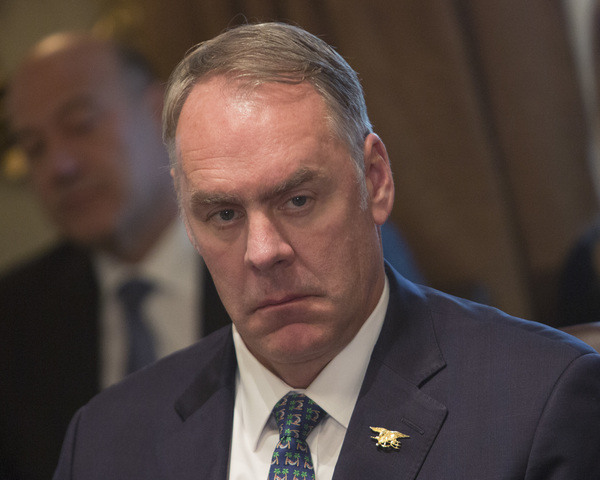
On Saturday, hours after the start of the partial government shutdown, dozens of national parks nationwide closed their gates and turned visitors away. Others have partial services with limited staff as part of a plan worked out in recent days by Interior Secretary Ryan Zinke.
The National Parks Conservation Association, a nonpartisan group that works to strengthen and protect federal parks, estimated that about a third of the more than 400 national park sites across the country are completely closed.
In addition, the group projects about 21,000 park service employees are being furloughed with the shutdown, leaving about 3,200 "essential staff" to manage 80 million acres of national park lands.
"Keeping parks open with virtually no staff is a risky situation, and the guidance park staff is being given is vague at best," Theresa Pierno, the group's president, said in a statement. "The only way to fix this situation is for Congress to come together, do its job and fund the federal government _ including our national parks and all who work in them."
In New York, the Statue of Liberty and Ellis Island were completely closed. Visitors were met with the same message on signs at the entrance to the parks and on social media: "Effective immediately and until further notice, the Statue of Liberty National Monument and Ellis Island are closed due to a lapse in appropriations." Nearly 4.5 million tourists visited Liberty and Ellis islands in 2016, according to Statue Cruises, the excursion company that ferries visitors to the sites.
In southwest Colorado, Mesa Verde National Park remained open on Saturday, and so too did other parks in the state, such as Rocky Mountain National Park and Black Canyon of the Gunnison National Park. But while the gates were open, all visitor facilities were shuttered.
And in Arizona, Grand Canyon National Park, which in 2016 saw a record 6 million visitors, remained fully open _ with the state's parks and tourism departments stepping in to provide services.
The closure and partial closure of national parks due to the government shutdown ignited bipartisan anger from governors in some of these states.
"If Washington, DC won't function. Arizona WILL. Don't change your travel plans. Count on it," Arizona's Republican Gov. Doug Ducey said on social media.
Colorado's Democratic Gov. John Hickenlooper said it's "unnecessary political drama."
"It used to be unimaginable that we would even consider shutting down our federal government. Coloradans know that our state government doesn't shut down," he said.
In 2013, during the federal government shutdown that lasted 16 days, all of the roughly 400 national park sites were completely closed.
On Saturday, Zinke tweeted several photos with National Park Services employees on the National Mall in Washington.
"Not all parks are fully open but we are all working hard to make as many areas as accessible to the public as possible," he said.