K.J. Deepthy’s first tryst with coir, known as golden fibre, at a professional level came after she moved to Vayalar, near Cherthala, in Alappuzha 19 years ago. After becoming a member of a coir society, she set up a small production unit on the premises of the family home. Traditional coir doormats made on handlooms at her unit reached far and wide. However, her fortunes started to plummet in recent years due to poor demand for traditional products.
That said, Ms. Deepthy is among the first batch of 50 people, including members of coir societies and workers, who are undergoing a three-month training programme organised under the aegis of State-owned Coir Corporation in Alappuzha. As the training draws to a close on February 6, they are now ready to move away from traditional products and make innovative and market-oriented coir products. “We have been given training to manufacture in-demand as well as new products. We are hoping for a revival of fortunes once we start making mats such as LKR Natural and LKR Fancy,” says Ms. Deepthy.
Declining demand
There are hundreds of small-scale coir units under 78 societies associated with the corporation engaged in the making of traditional handloom mats and mattings. Thousands of people associated with these units are currently unemployed due to the declining demand for products especially in overseas market.
Pratheesh G. Panicker, managing director, Kerala State Coir Corporation, says that to sustain, the coir sector in the State needs to keep up with the times by making products that are high in demand, launching new products, redesigning existing ones and introducing product diversification.
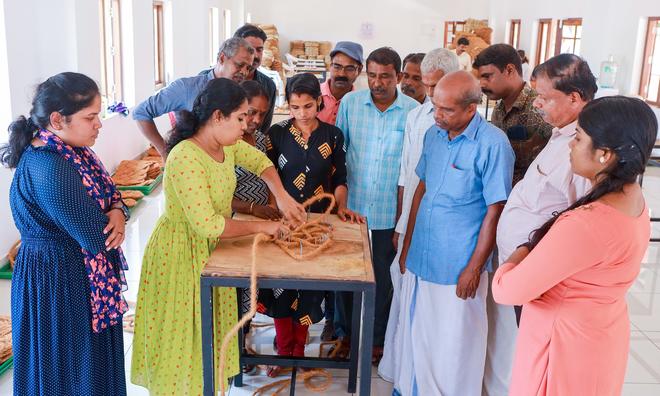
“Despite a declining demand in the export market, majority of the units continue to make things like fibre mat, BC1 and so on. The workforce lacks the expertise to make products that are in demand. Traditional coir products are piled up in godowns with no takers. The coir industry in the State, however, is set for a significant transformation. By providing training, we aim to upskill coir workers in manufacturing products having good market potential,” says Mr. Panicker.
To 500 people initially
In the initial phase, the corporation will provide training to 500 people. “Those who received training will impart the knowledge to other people in their societies. Once the units start producing market-oriented products, it will generate jobs and revive the sector. The corporation will procure all these products,” adds Mr. Panicker.
The corporation has recently signed a memorandum of understanding with the National Institute of Design (NID), Bhopal, to create new designs and products. The training, provided by the experts at Coir Corporation based on a curriculum prepared with the help of NID, is given to manufacture six existing products — two each LKR Natural and LKR Fancy (different sizes), MRA Fancy and WC 3 Fancy, all coir doormats — identified as having “demand in the market right now”. Besides, training is imparted to make two newly designed products, LKR Round Carpet and Mesh Rope Mat.
Coir with natural fibres
“Training will help redeploy the workforce currently engaged in the making of traditional products to new ones. These products are made on frames without using looms,” says Lalji P., coordinator of the training programme. As part of product diversification, the corporation has also come up with some innovative products by blending coir with other natural fibres. Trainees are given ₹600 as stipend daily.