The England and Wales Cricket Board has found itself in the crosshairs of the 2015 edition of Wisden following a year in which results dwindled and the governing body “repeatedly lost touch with the basic idea that the national team belongs to us all”.
The 152nd edition of Wisden Cricketers’ Almanack, the primrose-coloured annual that has long-been considered the touchstone of the sport, holds the governing body to account for its controversial handling of the decision to cut ties with Kevin Pietersen last February, Alastair Cook’s removal as one-day captain on the eve of the World Cup, a decline in Test match attendances and recreational participation,and a “head-in-the-sand” approach to the one-day format.
Its editor, Lawrence Booth, examines a “nexus of self-preservation” among the ECB’s cricketing hierarchy at a time when results for the men’s side have been desperate, with eight series defeats out of 11 across the three formats in 2014. Wisden notes that, of the top-eight nations in the world, only the ‘dysfunctional’ Pakistan side in 2010 suffered more defeats than England’s 28 in a calendar year.
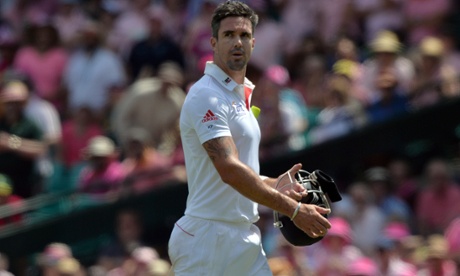
On the failure to properly explain the cancellation of Pietersen’s central contract, Booth writes: “[England] botched the PR battle. They hinted that some darker truth about his behaviour would emerge once a confidentiality agreement expired in October. Yet the lull merely prolonged the fiasco.And, when the dirt failed to materialise, the ECB looked rudderless; worse, in the eyes of those agitating for an explanation, they looked indifferent.
“It was typical of a story beyond the ECB’s control that their best moment was not of their own making. Having searched in vain for the words that justified his sacking, they were gifted a 324-page solution: an autobiography so full of rancour that the BBC chat-show host Graham Norton suggested to Pietersen: ‘Maybe, just maybe, team sport’s not for you …’
“Thereafter, the ECB simply had to sit back and watch him display the lack of self-awareness that had contributed to his downfall in the first place … All the while, he kept insisting how happy he was in the land of Twenty20 franchises – and agitating for an international recall. The whole thing would have been sad if it hadn’t been so absurd.” Wisden notes that results on the pitchmade matters worse and that those accountable at the ECB offices at Lord’s remained in the cosiest of alliances during the final year of Giles Clarke’s chairmanship. “National selector James Whitaker had called Cook ‘our exceptional leader’; Paul Downton, the ECB’s new managing director, hailed [Peter] Moores as the ‘outstanding coach of his generation’; chairman Giles Clarke trumpeted Downton as a ‘man of great judgment’. It was a nexus of self-preservation – yet, as the wagons circled, the wheels kept threatening to come off.”
Wisden added: “To leave the sacking of Cook so late made little sense. Had he stepped down in August after the 3–1 Test win over India, he could have done so with his post-Ashes reputation partly restored. Trouble was, Cook had become more than just a cricketer: cast by his employers in the role of latter-day saint to Pietersen’s fallen angel, he was now an article of faith.
“Clarke even suggested the Cooks were ‘very much the sort of people we want the England captain and his family to be’, which was all well and good but couldn’t stop him edging behind. Downton, Whitaker and Moores were all bound up with his fate: Cook had to succeed, as much for others as for himself. It was an intolerable position.” The notes go on to lament the ascension of Indian cricket and the cement magnate Narayanaswami Srinivasan to the position of chairman at the International Cricket Council, highlight cricket’s move to the peripheries of the national sporting conversation in England and call on the ECB to redouble its efforts in engaging with the country’s south Asian population.On a more positive note for English cricket, the international pair of Moeen Ali and Gary Ballance have been named among Wisden’s five cricketers of the year while Australia’s captain Meg Lanning has become the inaugural winner of its leading woman cricketer in the world award.
Ballance’s county team-mate Adam Lyth is also among the five along with the Sri Lanka captain Angelo Mathews, whose side won four series against England in 2014, and Warwickshire’s New Zealand off-spinner Jeetan Patel, the leading wicket-taker in domestic cricket last summer. The Sri Lanka batsman Kumar Sangakkara was named as the leading men’s cricketer in the world with Wisden also issuing its equivalent in the women’s game for the first time in the annual’s 152nd edition.