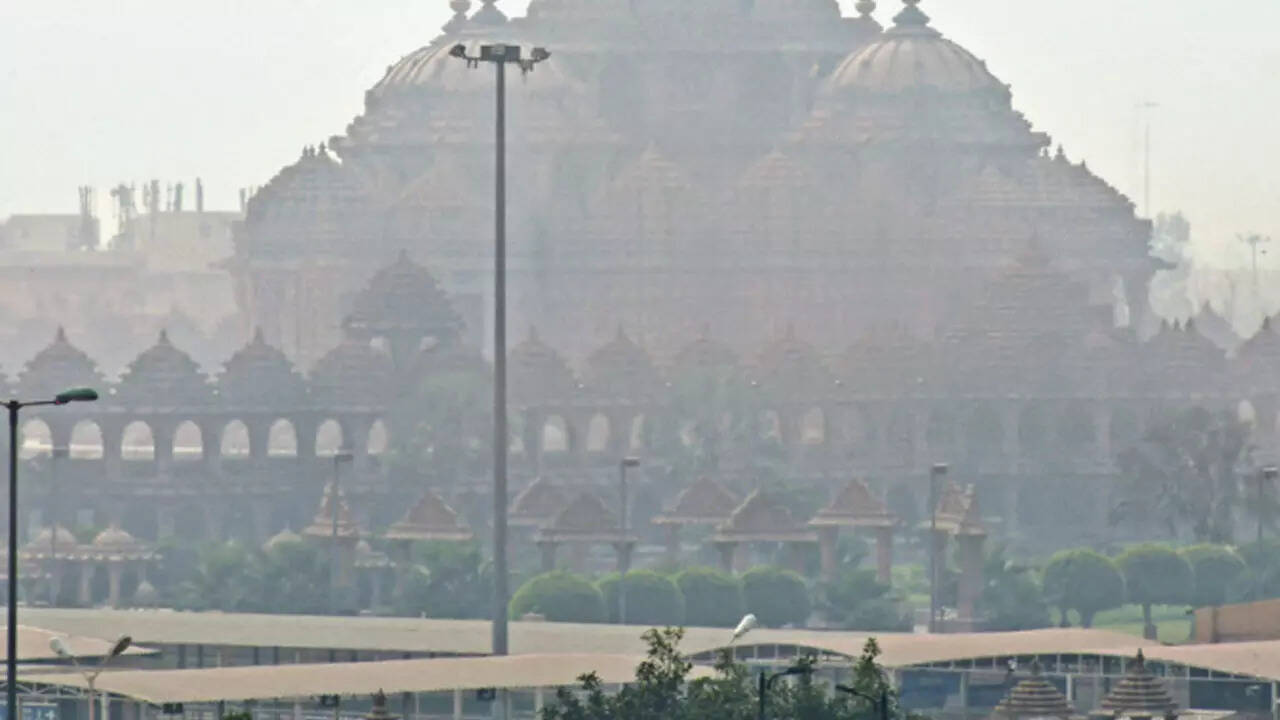
NEW DELHI: Delhi’s air quality entered the “poor” category on Saturday, with the AQI touching 284, the highest so far this winter season.
Track the pollution level in your city
The overall AQI of the capital was 198 on Friday. After the wind speed dropped to almost nil, a “haze” also appeared over the city during the afternoon.
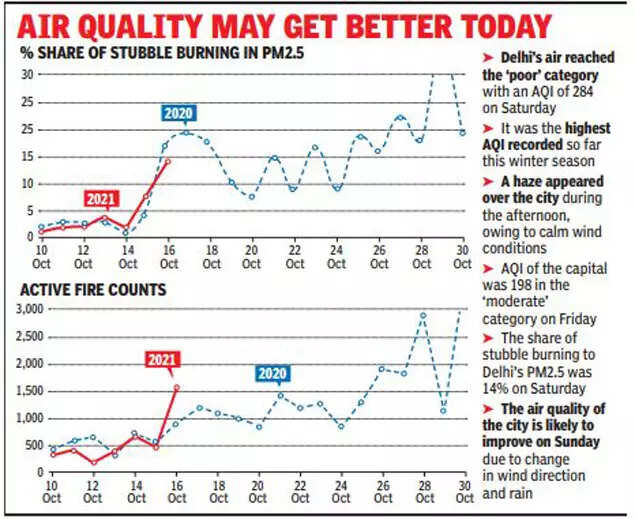
However, 18 monitoring stations recorded “very poor” air quality on Saturday evening. System of Air Quality and Weather Forecasting and Research (SAFAR), the forecasting body under the Union ministry of earth sciences, said fire counts were gradually increasing and the share of stubble burning to PM2.5 was 14%.
CPCB’s central control room data showed that 24-hour average PM10 concentration for Delhi-NCR was 283.6 micrograms per cubic metre at 7 pm as against the standard 100 micrograms per cubic metre. The 24-hour average PM2.5 concentration was 143.2 micrograms per cubic metre at 7 pm. The standard for PM2.5 is 60 micrograms per cubic metre.
Experts said stubble burning and meteorological factors played a key role in deterioration of air quality. Despite the ban, firecrackers were burned in a few parts of the city on Friday on Dussehra.
SAFAR said, “PM2.5 has returned as the lead pollutant in Delhi’s air. Favourable meteorological conditions led to intrusion of stubble burning-related air mass. With 1,572 effective fire counts as per SAFAR harmonised methodology, which includes data of two ISRO satellites, the stubble burning contribution in Delhi’s air has suddenly increased to 14%. Fire counts are gradually increasing and wind direction is favourable and coming from north-west direction at transport level (900 mb) for intrusion.”
V K Soni, head, environment and research centre, India Meteorological Department, said, “The fire counts in Punjab, Haryana and Pakistan are on the rise and the current wind direction is favourable for transport of pollutants from biomass burning to Delhi. Calm wind was recorded during the night and the wind speed again dipped to nil during the afternoon and evening, affecting dispersion of pollutants.”
Anumita Roychowdhury, executive director research and advocacy, Centre for Science and Environment, said, “With the winter conditions setting in, pollution buildup is going to rise. Under these circumstances, polluting activities like crackers or any form of open burning that will impact air quality require strong vigilance and early action.”
As the Met department has predicted north-westerly winds to change to easterly on Saturday night and light to moderate rain on Sunday, the air quality is expected to improve. Rain helps in washing out the pollutants.
SAFAR said, “AQI will remain in the ‘poor’ on Sunday but thereafter it is likely to be ‘moderate’ for the next three days.”
While an AQI reading of 50 or below is classified as “good”, readings between 51 and 100 fall in the “satisfactory” category and those between 101 and 200 are classified as “moderate”. “Poor” air ranges from 201 to 300, “very poor” from 301 to 400 and “severe” from 401 to 500.