Britain’s war leader and generally well regarded former prime minister Sir Winston Churchill’s reputation and legacy has been vigorously defended after Jeremy Paxman labelled him an unelectable, ruthless egotist.
Paxman’s comments came ahead of a BBC documentary he is presenting marking the 50th anniversary of Churchill’s death. “Any rounded assessment of Winston Churchill’s life has to acknowledge that he was a ruthless egotist, a chancer, and a charlatan at times,” Paxman told the Radio Times. “Would he be electable now? I fear not.”
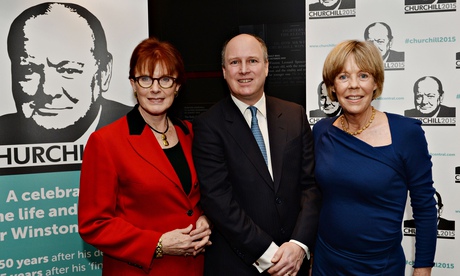
There was little enthusiasm for Paxman’s remarks at the official launch of Churchill 2015, an international celebration of Churchill’s life and legacy, on Tuesday.
Asked about Paxman’s remarks the historian Sir David Cannadine said: “Well it is interesting for Jeremy to compare somebody to that... I think I’ll stop there.
“I am rather a fan of Jeremy’s and I’m quite a fan of Churchill but I don’t feel that it advances discussion of Churchill. It seems to me not helpful. I look forward to telling Jeremy that.”
Churchill’s granddaughter Emma Soames said Paxman was wrong to say Churchill would be unelectable today. “I just don’t think that’s true,” she said. “Churchill’s virtues were so great. In the same way that Boris Johnson is very popular I think Churchill would be popular because he had an amazing gift of the gab and a genuine commitment to ordinary people. “He came from this very ducal background but he felt himself to be very connected to ordinary people. That was genuine. I don’t think his understanding of them was so great but his consideration for them was immense.”
Paxman was supported by Jonathan Dimbleby, whose father Richard provided the TV commentary for the documentary. He said: “I’m not sure whether a Churchill would be appropriate for the complexities of peace-time politics. The greatness of Churchill was that he was, effectively, a democratic dictator.
“He ruled Britain. That was an extraordinary power in the hands of one man. I don’t think that would work very well today.”
Churchill’s legacy will be the subject of much debate this year – positive and negative – and that is fine, say organisers of the Churchill 2015 as it is important to reflect on the man, warts and all.
“He would have felt he failed if he hadn’t been controversial,” said Cannadine. “Most great figures are controversial ... I can’t think of any for whom that’s not true. He certainly made mistakes.”
Cannadine announced a series of events and initiatives including the formal commemoration of Churchill’s funeral which took place on a freezing cold day in January 1965.
On 30 January this year the Havengore, the vessel which carried Churchill’s coffin down the Thames 50 years ago, will retrace its route from Tower Bridge to Westminster before an event at Westminster Abbey.
Also announced on Tuesday was the creation of a new Churchill Central website to advance ‘his living legacy for future generations;’ and the launch of a global leadership programme for the leaders of tomorrow.
The Science Museum, meanwhile, will stage an exhibition devoted to ‘Churchill’s scientists; his family home Chartwell, looked after by the National Trust, will have a display called Death of a Hero and there will be a reinvigorated Churchill exhibition at his birthplace Blenheim Palace.
As well as it being 50 years since Churchill’s death, it is 60 years after his final resignation as prime minister and 75 years after his ‘finest hour’ speech in 1940.
David Cameron sent his good wishes to the launch in a statement read by his chief of staff Ed Llewellyn. He said: “Half a century after his death, Winston Churchill’s legacy continues to inspire not only the nation whose liberty he saved, but the entire world. His words and his actions reverberate through our national life today.
“2015 is a year to remember Winston Churchill’s extraordinary life of achievement, to admire and to celebrate it anew and to give thanks for his service not only to the country he loved, but to humanity as a whole.”