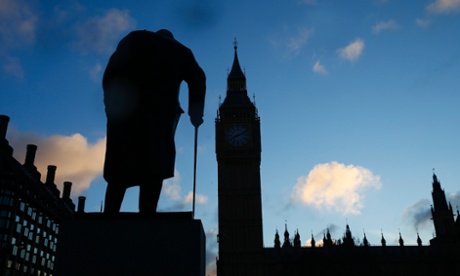
Only the raw bleak January day and the great dome of St Paul’s Cathedral appeared unchanged since the funeral half a century ago today of Sir Winston Churchill, the leader regularly voted the greatest Briton.
The anniversary of the funeral on 30 January 1965, which brought the capital to a standstill and took place a week after his death aged 90 on 24 January, is being marked by scores of events, including a service and wreath laying at the Houses of Parliament, a memorial service at Westminster Abbey, and the rebroadcast by BBC Parliament of the original live coverage.
In a tribute to his most famous predecessor, the prime minister, David Cameron, said: “Half a century after his death, Winston Churchill’s legacy continues to inspire not only the nation whose liberty he saved, but the entire world. His words and his actions reverberate through our national life today.”
Churchill’s granddaughter, the author Emma Soames, said the family was touched that he is still so vividly remembered: “To me growing up he was a grandfather, but I came to realise at his death that he was so much more than that. The family are absolutely delighted that his life is being celebrated and his legacy expanded.”
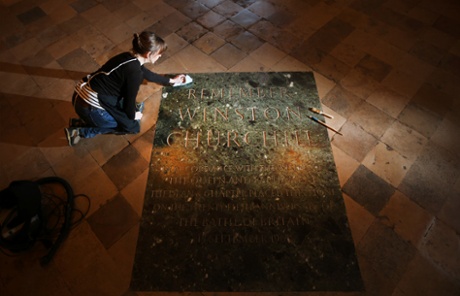
In the small hours of 30 January 1965 the great medieval Westminster Hall was finally cleared of the last of an estimated million people, who came to pay their respects as his body lay in state for three days: a brass plaque on the floor marks the spot where his coffin stood. By then the route to St Paul’s was already lined 10-deep with people, many having camped out overnight to secure the best places.
The Havengore, the sleek motor vessel that carried his coffin on part of the funeral procession, is also recreating its role, accompanied up the Thames by a flotilla of boats. Expensively restored to shining perfection, and this time carrying members of Churchill’s family to Westminster, the Havengore looks exactly as it did in 1965, but the cranes along the great industrial waterway which dipped in tribute have vanished, along with much of the urban landscape of the funeral.
Tower Bridge will be raised at 12.45pm as the flotilla passes, and the service at the Palace of Westminster will begin when it arrives there.
The service across the road at the Abbey will begin at 6pm, with flowers laid on the green marble memorial stone. Churchill was actually buried in a private ceremony in the family plot in the small village churchyard at Bladon, just outside the walls of the park of Bleinheim Palace in Oxfordshire, where he was born. A new stained-glass window is being installed in the church to mark the anniversary.
The National Railway Museum in York is putting on display the locomotive, which was renamed the Winston Churchill, and the carriages that carried his family and other mourners from Waterloo station in London to Oxfordshire. The engine and carriages have been specially restored for their first public display. Russell Hollowood, a curator at the museum, has been researching the years of preparation that went into organising the funeral, in which Churchill himself took a keen interest. The normal London station for a journey to Oxford would be Paddington, but Churchill insisted that the train should leave from Waterloo – apparently entertained at the idea that the French president Charles de Gaulle would have to pass bareheaded under the Waterloo Arch commemorating Wellington’s great victory over Napoleon.
The BBC has specially restored the film of the funeral, which was watched in 1965 by 350 million people across the world. As so often the broadcaster Richard Dimbleby became the sonorous voice of the nation, and gazing down from a viewing platform in the dome of St Paul’s, he described a city where the spires of the churches were still the tallest objects piercing the skyline, and Bankside power station, now Tate Modern which the flotilla will pass today, was still belching out smoke into the sooty London air.