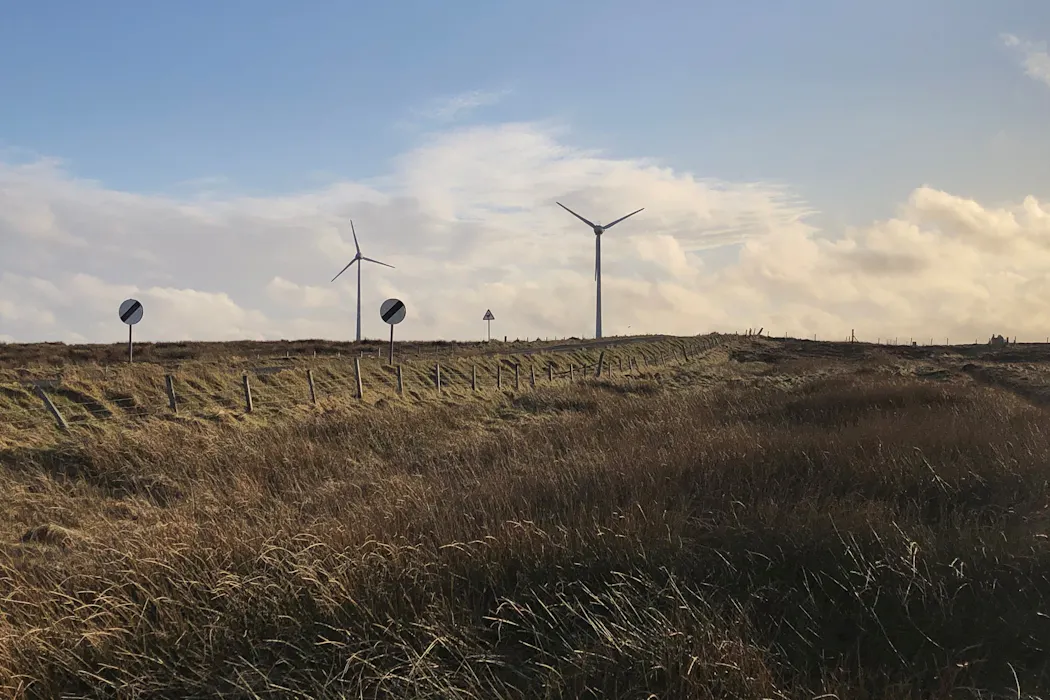
The landscape on the remote Isle of Lewis is striking: a mix of rugged terrain, peatlands, moorlands, lochs, sandy beaches and cliffs.
This island at the northern end of the Outer Hebrides, Scotland, has one of the UK’s highest levels of fuel poverty and a declining population of fewer than 20,000 people. Encircled by the Atlantic and exposed to powerful, persistent winds, it is an ideal location for wind energy.
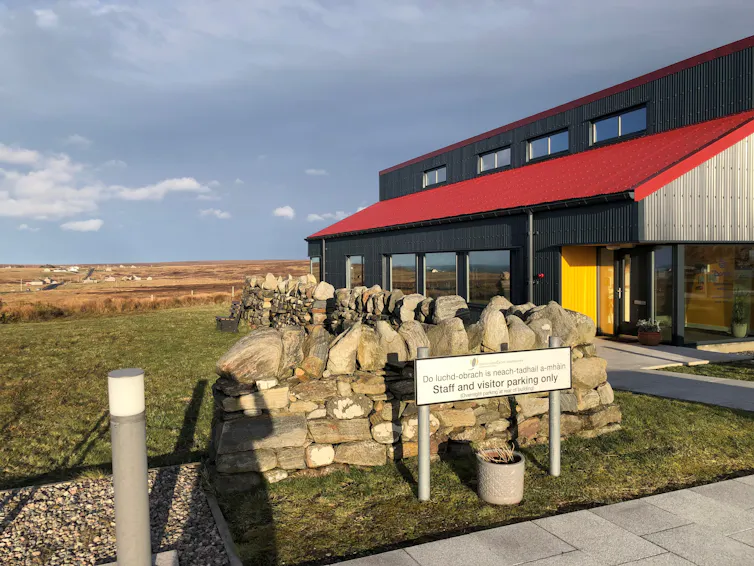
The Galson Estate, a group of 22 villages covering 56,000 acres in the north-west corner of the island, recognised this potential early on. It transitioned to community ownership in 2007 by forming a community land trust. Between 2013 and 2015, the trust installed three wind turbines. The revenue from renewable energy generation could then be reinvested in the estate.
Over a decade, these assets generated £4.35 million in surpluses for the community land trust. Of this, £600,000 has been used to support local projects through grants (with the remainder used for operational costs). This includes initiatives that alleviate poverty, encourage environmental stewardship and cultural heritage plus the sustainable development of this local economy.
But our ongoing research on the island shows that the future of community-owned energy is in peril. These projects are facing persistent barriers to grid access. They include limited capacity of the interconnector (a subsea cable linking Lewis to the mainland grid), alongside an application process that favours large-scale projects and ageing turbines.
As Neil MacKinnon, development manager at the Galson Estate Trust, told us: “Out of the interconnector cable’s 1.8 gigawatts, about 1.4 are for offshore wind, and the rest for onshore wind. Communities have been completely ignored and squeezed out of this.”
Community ownership of wind farms on Lewis delivers real results. Consider the Point and Sandwick Trust’s three-turbine 9 megawatt project – the largest community-owned windfarm in the UK. This generates 34 times more revenue than what the locals would receive in community benefit payment if a company owned the turbines.
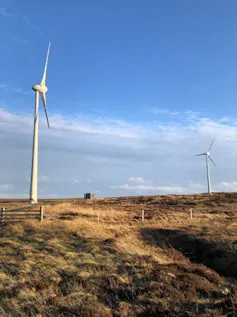
But despite these proven social and economic contributions, many turbines across the Scottish Isles are approaching the end of their operational lifespan, which is around 20 years. Most of these projects started 15 years ago, when supportive government policies empowered local people to develop their own windfarms and reinvest revenue directly in island economies.
There is now an urgent need to repower ageing, first-generation wind turbines by replacing them with more efficient models. But new infrastructure planning is ignoring community-owned projects and making it more difficult for local residents to benefit.
In 2022, energy regulator Ofgem approved a new Western Isles interconnector cable to increase electricity transmission capacity between Lewis and the mainland.
But available cable capacity was rapidly allocated to large corporate energy developers, especially for offshore wind. Community-owned initiatives were left without the grid access needed to expand generation or make a business case for replacing ageing turbines.
Community-owned organisations on Lewis, including Point and Sandwick Trust and the consortium formed by the Galson, Barvas and Carloway Estate Trusts are all struggling to secure capacity on the interconnector.
These are not isolated examples of projects facing challenges with grid connection.
Nearby, on the islands of Tiree and Islay, community-owned trusts have turned to solar, which generate less energy and therefore revenue, rather than new turbines due to grid constraints. Across the UK, more than 600 community energy organisations face similar problems.
Much of the transmission capacity required to deliver the UK government’s Clean Power 2030 Action Plan has already been allocated within the connections queue. This leaves limited scope for new or repowered community projects. This challenge is particularly acute for locally-led initiatives, which, unlike corporate developers, are inherently place-based: they cannot simply relocate to regions with spare grid capacity.
Grid connections reform replaces the first-come, first-served approach with a system that prioritises projects that are most advanced and commercially viable. This requires developers to demonstrate significant progress and pay upfront costs at earlier stages.
For community projects, this financial risk could threaten their survival. Especially as the connections reform pushes residents towards larger, more capital-intensive developments simply to compete within the connections queue.
These changes risk excluding community-led initiatives from the transition, undermining both its fairness and its potential to deliver locally distributed economic and social benefits.
A right to infrastructure access
While our ongoing research has uncovered challenges facing community-owned energy projects, hope is not lost. Building on Scotland’s pioneering legislative empowerment of communities, we propose a “right to infrastructure access” with three priorities for Scottish and UK governments.
First, a producer category consideration in pricing auctions: the National Energy System Operator does not currently differentiate between applicants on the basis of ownership model or social value. Without political intervention to create a new category to distinguish between community-owned and corporate projects, the current system will continue to favour large companies that can afford to take on risky projects.
Second, the above requires a formal definition of community energy projects within grid allocation and pricing systems. Such a definition is necessary not only to ensure targeted support, but also to prevent energy companies from exploiting community-oriented policies through superficial partnership arrangements.
Community energy should be defined according to clear criteria relating to ownership, governance and benefit distribution. At the very least, projects should demonstrate majority local ownership (such as via trusts), democratic decision-making structures and a legally binding commitment to reinvest profits into community – rather than private shareholder return.
Finally, planning for the end-of-life phase of the turbines must also become a core part of community energy policy. Without mechanisms that safeguard replacement capacity for established schemes, local groups could ultimately lose access to the very infrastructure on which their economic and social futures depend.
These three steps will help ensure communities like those on the Isle of Lewis can continue to participate directly in the green transition. Without this commitment to social justice, a renewable energy future will only worsen inequalities and throw local ownership to the wind.
This article was originally published on The Conversation. Read the original article.