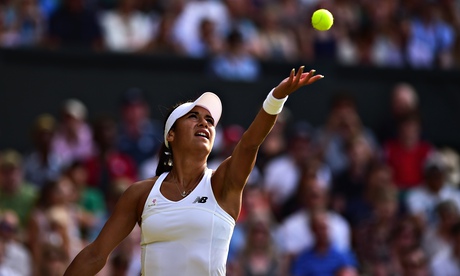
It can be a hard thing to meet your heroes, and a harder thing still to beat them. This was Heather Watson’s first match against Serena Williams, a player she used to idolise as a child. The first time Watson ever came to Wimbledon, when she was “seven or eight” years old, she bought a poster of the Williams sisters, which she then pinned up on her wall. And here she was, more than a decade later, facing the younger of the two on Centre Court. You wondered, when Watson walked out, whether she really believed, deep down, that she could win. If so, she would have been one of the few of the 15,000 present who did. “All I saw,” she said afterwards, “was an opportunity.” She was two points away from taking it, and it said plenty that she was so distraught about failing.
Earlier in the afternoon, Watson was out in the far corner of the practice courts, away from the crowds. There, she spent 30 minutes, the entirety of the session, doing nothing other than work on her return of serve. As hard as her coach was hitting, the practice could only do so much to prepare Watson for the 112mph ace Williams walloped past her to win the second point of the match. Some welcome. Williams hits with such force, Watson was reeling. Literally so. A couple of strokes knocked her clean off her feet. At that point, it felt like Watson may as well have been trying to swim up Niagara Falls. A little historical perspective: no British woman had beaten a world No1 since Sue Barker defeated Chris Evert in 1979.
There were little moments for Watson early on, each treated like a major event by the mustard-keen crowd, all anxious for a reason, of any sort at all, to cheer her on. An ace in the first game, a couple of brilliant pinpoint backhands soon after, all rewarded with rapturous applause. As time ticked by, the intermittent cries of “Come on Heather!” began to sound ever more forlorn. It took Williams just 25 minutes to win that first set. She was too smart, too powerful, too good, and Watson too tense. She was shaping up to be just another piece of roadkill on Williams’ route to the final.
Midway through the second set, something changed. Perhaps Williams let her concentration slip, as she sometimes does when she’s winning so easily. She was gracious enough to say that Watson played so well that she “wasn’t able to keep up”. In the fifth game, Williams hit a smash into the net. Moments later, Watson played a marvellous drop shot that put her 0-30 up. And just like that, the match switched. All of a sudden, what was a procession was now a fair fight.
Williams knew it too. You could tell from the way she started screaming in celebration of her winners. She sent a forehand long, followed it with a double fault and, glory be, Watson had won a break point to go 3-2 up. Centre Court was alive with energy. The fans refused to quieten down, even when Williams broke right back, then held her own serve to lead 4-3. Watson won the next, and then, better yet, won herself another break when Williams sent a forehand wide. So it was Watson’s turn to serve for the set.
Wimbledon seemed almost to stop. The attention of the thousands of fans spread out across the other courts drifted away from what they were watching as they heard the sound from Centre Court, and when they saw, soon after, the scores flash up on the big screens. Watson lost control of her first serve, and delivered a double fault that gave Williams a break point. She should have taken it. But somehow the pressure seemed to have shifted. Where it had been weighing down on Watson in the first set, now it was all on Williams. As odd a phrase as this seems, the Centre Court crowd began to feel genuinely intimidating. Watson saved the break point, and though she squandered the first set point soon after, she won a second when Williams hit a backhand return into the net. One set each.
By now, Williams was struggling. Watson broke her serve in the first game of the third set, and again in the third. At that point, Watson had won six games in a row. But the world No1 is made of tougher stuff than she had shown in that time. The momentum swung again, back Williams’ way. She won the next three games. But Watson, too, had more to give. She scrambled through some brilliant defensive tennis to hold her own serve, then broke Williams again, to love. Now she was serving for the match. The closest she came was deuce. The crowd was now so loud that Williams complained about noise, which only brought forth more boos.
“What’s the toughest away match to play?” Williams was asked afterwards. “A French player at Roland Garros? An Australian at the Rod Laver Arena?” She didn’t think for long. “I’m going to have to go with playing Heather Watson in Great Britain. For sure.”