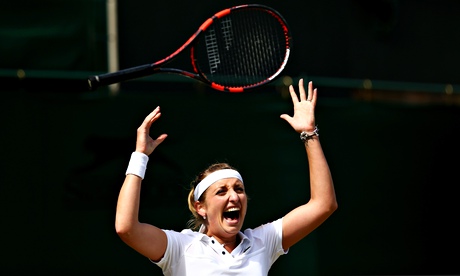
As an overhit forehand whizzed past Timea Bacsinszky, ending her perilous brush with calamity and sending her into the quarter-finals at Wimbledon for the first time, she dropped her racket, raised her hands and screamed with an intensity that might normally have alerted the emergency services.
Certainly there was much to be happy about – 90 minutes earlier her defeat seemed more than likely. Not just a set lost 6-1 but an unhappy period in which she was outflanked and outthought to a degree that seemed irretrievable.
It was more than just a win; the No15 seed’s progress at the expense of the Romanian Monica Niculescu represented another milestone in one of the more compelling stories of grand slam tennis.
In 2011, desperate to escape the demands of her tennis coach father, the one-time Swiss prodigy quit the professional game and secured an apprenticeship to run hotels in the Swiss Alps. There she might have stayed, happy away from the limelight and her domineering father; boosted by the help of a psychiatrist and the mundanity of normal life, had she not received in 2013, completely unsolicited, an email from the French Open informing her of her continued eligibility for the competition.
By then estranged from her father, she resolved to start again. Now aged 26, she seems to have made a good decision.
In China this year, she reached her first WTA final in five years. She made the third round of the Australian Open, before taking titles in Mexico and Monterrey and entering the top 30 for the first time. She lost to Serena Williams at Indian Wells and again at Roland Garros last month, but by then she had reached the semi-final. The German No18 seed Sabine Lisicki succumbed in the third round here. And then there was Niculescu, who had won four of their last five encounters. Victory is even sweeter in context.
“I worked hard for this,” Bacsinszky said. “She did everything she could to break my game and she played to a higher level than her ranking. I had a really bad start. To be able to turn this match around and lift my level meant so much to me.”
The first set was a nightmare for Bacsinszky. She started all guns blazing, clearly intent on dominating her opponent with topspin drives. Niculescu, however, had a gameplan and a fiendish weapon, an unorthodox forehand – part-slice, part-chop delivered with heavy underspin and fizzing across the net improbably low. She deployed it unceasingly, and the damage it wrought gave the world No48 the first set in 35 minutes. The die seemed cast. Ilie Nastase, the Romanian former No1, who arrived mid-set – wearing a beige suit with gold piping and laden with medals – left apparently content.
But even a winning shot can be over-deployed, and soon Niculescu encountered diminishing returns. From the start of the second set, Bacsinszky took greater care returning the slice, and – diagnosing her opponent’s backhand to be less troublesome – she peppered it. The strategy earned her parity, then – as Niculescu herself became frustrated – gave Bacsinskzy the upper hand. The set was tight. Both players broke serve twice, but Bacsinskzy got the telling break to go 6-5 up. She took the set 7-5.
By the final set, her decision to stay aggressive against the blocking and slicing paid dividends. Niculescu was still chasing and defending but much less effectively. As she tired, the slices began to fall short. Worse, they no longer stayed low. Instead they bounced into the Swiss player’s hitting zone. Niculescu lost her serve at the outset, and twice more in succession.
She also lost her plan and sporadically her composure. The last set saw Bacsinszky bossing the rallies and running the Romanian ragged. After 130 minutes, the returnee served for the match. She took the decider 6-2 – the puzzle solved, the result beyond doubt.
Celebrated again, but all smiles now and with tools to cope, Bacsinszky continues to reflect on her time away from the tour. “I don’t know if it really helps me for my forehand or for my backhand,” she said recently. “But it gives you a lot of humility because there are many people in this world working in restaurants, hotels, in the kitchen.”
On Monday she cited meeting ordinary people as the highlight of her real world sabbatical – not least because life before “wasn’t that nice”, but ultimately she missed playing tennis. “Whether it is the first round in Marrakech where the courts are terrible or in Wimbledon or the US or Cincinnati, it’s really the love of the game.”