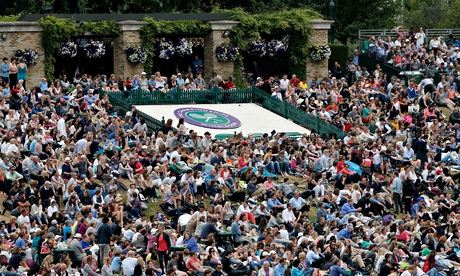
The Centre Court crowd is a curious thing. What makes one man weep, can make another man sing – as long as that man is wearing chinos and sporting a Panama hat.
Huey Lewis may never have taken up a seat in the Royal Box – though almost every other celebrity of any stripe has passed through – but, while the polite chatter, occasional outbursts of giggling and regular Pimm’s breaks are annual manna for debenture holders, they can prove infuriating and sometimes irritating for many others.
The players, most of whom seem genuinely to love the traditions of Wimbledon for all their occasional grumbling about having to stick to the all-white rule, usually maintain the party line that the crowd is wonderful. But Victoria Azarenka on Tuesday raised an inconvenient truth. “I think they might have had a little too many Pimm’s or whatever,” said the former world No1, justifiably annoyed at sections of the crowd giggling at her grunting during her quarter-final defeat by Serena Williams.
“When people are drinking, every time the announcer says, ‘Make sure you hydrate yourself’, I think he means with water, not alcohol.”
John Inverdale, the BBC commentator, could be heard lamenting that the Centre Court was at times “barely a third full” on women’s quarter-final day. That was not the case on Wednesday when, with drizzle in the air and Andy Murray in action there, every seat was unsurprisingly filled – even if at times it seemed that their attention was as much on Prince William and the Duchess of Cambridge in the Royal Box as the action on court.
Yet Inverdale, too, had touched a nerve. Too often too many seats are left unfilled as their occupants leave to make the long trek back to the rarefied air of the hospitality village (where on Wednesday David de Gea, Juan Mata, Gary Lineker and Nicolas Anelka were among those lunching) or in search of refreshment.
And when they are in place can there be any other sporting arena preconditioned to titter so inanely at the slightest provocation? It could be an errant pigeon or a ball boy’s mistake. It could be one of the over-refreshed comedians who shout out “Come on Tim!” during Murray’s matches (a fashion that, eight years after Henman last appeared at Wimbledon, appears mercifully to have had its day).
Of course, there are still electrifying moments. Heather Watson’s valiant defeat by Serena Williams was one; Murray’s march to another semi-final has provided others. When he dashed to meet a Vasek Pospisil drop shot in the final set and sent it back past his bewildered Canadian opponent on the backhand on Wednesday, the roar could have taken off the recently introduced roof. Yet amid plenty of competition, Centre Court remains as much an upper-class social gathering as a sporting event.
A distinction must be made between the show courts and the grounds. The latter have over the years become, if not exactly bastions of equality, then certainly a far more egalitarian experience than was once the case. In a curious inversion of logic those on the outer courts are often more knowledgable tennis fans than those with seats on Centre.
For a very reasonable sum (£25 during the first week, £20 or £15 thereafter), a pleasant day can be passed sampling the action on the outside courts, sitting on Henman Hill/Murray Mount/whatever and taking in the atmosphere. Plus eating, lots of eating. Wimbledon sometimes feels more like a festival of food and consumption than sport, with people stuffing their faces everywhere one looks.
And yet the carefully cultivated “English country garden” atmosphere so successfully marketed to viewers around the world is maintained.
The writer Patrick Collins, in his masterful dissection of sporting tribes Among the Fans, describes why he turned his back on Wimbledon. “It was a place where fawning deference mixed with simple silliness,” he wrote. “A place which giggled like that could have nothing in common with grown-up sport.” But he was persuaded to return to SW19, and to his surprise rather likes the shift he finds, with “the public [now] regarded as guests rather than interlopers”.
It has not happened by accident. The All England Lawn Tennis Club chief executive, Richard Lewis, has maintained the progress made by his predecessor, Ian Ritchie, in subtly modernising Wimbledon, making it feel as if it has entered the modern world while maintaining its traditions.
So one is left in a curious position in which the crowd on Centre Court, the one that is beamed to the world, often emphasise its worst excesses and those elsewhere – queueing, buying, watching, chatting – display its best features.