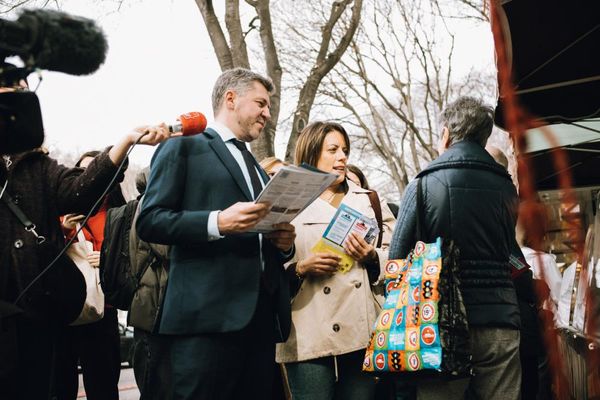
Thirty years ago, the Cheltenham Festival just happened. Now, the weeks leading up to National Hunt’s showpiece are filled with an ever-expanding schedule of media mornings and preview nights. It all helps to prolong the excitement and anticipation before a meeting that has come to dominate the season but takes only four days to run.
There is element of pantomime about many of these events, and the media mornings in particular. Trainers parade a few of their horses, suggest that they are hoping “for a bit of better ground”, and make encouraging noises about the main contenders that stop well short of tempting fate. The script is well-rehearsed, it is just the names of the horses that change.
So it was a refreshing departure when Willie Mullins used the media morning at his County Carlow stable 11 days ago, which was organised and funded by Cheltenham, to let off a firecracker of dissent. Cheltenham’s prize fund of £3.9m, Mullins said, is too small. Much too small, in fact, and in the 14 Grade One events in particular, races in which Mullins will probably saddle at least nine favourites next week.
“When you consider the biggest prize in jump racing, apart from the Grand National, is probably about what you’d have to pay for a nice young jump horse at the moment,” Mullins said, “to me, jump racing has to make a jump up to much better prize money for what it generates for racing. Maybe prize money in Cheltenham for the Grade One races could be, I’d say, at least doubled, if not more, to give what we see in Flat racing, meaningful prizes.” Later, he added: “What people race National Hunt horses for, it’s not fair and it’s not on, for what they do for the sport.”
Coming from a trainer who can expect to take home more – probably much more - of Cheltenham’s £3.9m than any of his colleagues, this was blunt and unexpected criticism. Cheltenham’s response was a little limp by comparison. “We sympathise with Willie and everyone in wishing to see an increase in prize money but it’s something we very much need to look at globally,” Ian Renton, effectively the managing director of Cheltenham, said at a press conference on Wednesday, though he did add that “we are pretty proud of the prize money we put up here.”
This argument is a minor diversion , one which will probably be forgotten as soon as the tapes go up on 10 March. Yet it does highlight several of the obsolete attitudes and assumptions that continue to hold racing back during the other 51 weeks of the year.
The most obvious is summed up by a single word from Mullins, when he talks about the money “you’d have to pay for a nice young jump horse”. It makes owning racehorses sound like jury service: as soon as your annual income reaches a certain level, you may get a letter from Cheltenham which requires you to travel to the French provinces and spend half a million euros on a four-year-old gelding.
This feeds into the associated belief, accepted unthinkingly by many in the sport, that prize money is of over-riding importance to owners. Renton fell into the trap too when he suggested that “everyone” wants to see prize money going up, yet at the highest level, and at Cheltenham above all, the cash value of winning is all but irrelevant.
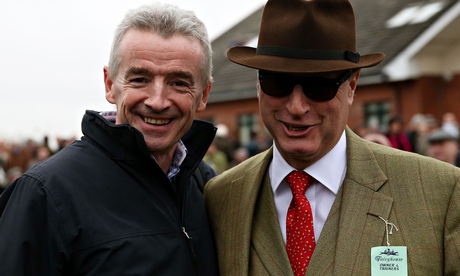
Michael O’Leary, the chief executive of Ryanair and now one of jumping’s most powerful owners via his Gigginstown Stud operation, once suggested that the airline had considered “maybe putting a coin slot on the toilet door, so that people might actually have to spend a pound to spend a penny in the future. Pay-per-pee.” Yet he would probably struggle to guess to the nearest 50 grand how much prize money he has won in the last five years. The same goes for Rich Ricci, who had a colourful career in investment banking and is now a mainstay of the Mullins yard with horses like Douvan, Faugheen and Annie Power.
Unlike trainers, jockeys and bookmakers too for that matter, owners are not in racing to make money. They are in it for the fun, the glory and the ego-boost, and in those terms, Cheltenham offers a return on their investment like no other.
The owners at one end and the punters – both racegoers and gamblers – at the other are the only groups putting money into the sport. Everyone else, in one way or another, is taking it out. So if Cheltenham is to double its prize money – make the fun cheaper for the big owners, in other words – it will need to be more expensive for the punters. Perhaps they could double the ticket prices, or the price of the beer, or both? Would “everyone” be in favour of a prize-money hike then?
Cheltenham has a constant balancing act to perform in selling its unique brand of excitement to owners and punters. The strong and continuing demand for potential Festival horses on the one hand, and the eye-watering price of hotel rooms within a 30-mile radius of the track next week on the other, suggest it is performing it rather well, with no need to make a very rich man like Rich Ricci even richer. That suggestion is not so much pantomime as black farce.