
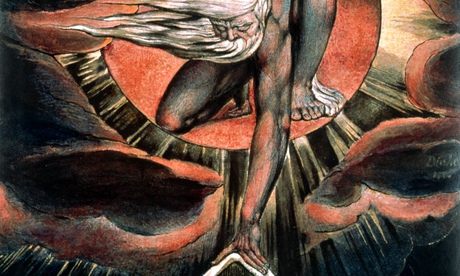
The cramped space in which the artist and poet William Blake produced some of the greatest prints in the history of art will be recreated for an exhibition next month at the Ashmolean Museum in Oxford.
The house, the magnificently named 13 Hercules Buildings, in Lambeth, south London, was demolished in 1918. But the floor plans, made for a Victorian survey of the estate, were recently discovered in the Guildhall library by print-maker and guest curator Michael Phillips. Along with contemporary descriptions by younger artists who made a pilgrimage to Blake’s studio and home, as well as later accounts by art lovers who tried to save it in 1918, the narrow work space including the massive wooden press is being recreated for the exhibition.
In 1790 Blake and his wife, Catherine, moved to the modest but respectable Georgian brick terrace. It was on the narrow staircase that he experienced visions including one that inspired The Ancient of Days, his front-cover design for his 1794 book Europe a Prophecy. The couple planted a vine and a fig tree, both gifts from the painter George Romney, in the back garden. One visitor recounted finding the couple sitting naked, reading from Paradise Lost – Blake explained that they were merely being Adam and Eve. Both of Romney’s gifts were apparently still flourishing when the house was demolished.
Phillips will work in the galleries on some days, producing new prints of Blake’s work. Blake was conventionally trained in printing. But he said his technique – which instead of cutting the lines of the drawing into the plate, involved cutting away everything else leaving the lines in relief – was suggested to him in a vision by his dead brother Robert. The prints, combining his images with his poetry or prose which he had to write freehand in mirror writing on to the plates, were often worked and reworked, and elaborately hand coloured by Blake and his wife. Very few of the original plates survive, and Phillips will be working with replica ones he has created.
Philip Pullman, author and president of the Blake Society, said: “William Blake was a complete original: his power, his tenderness, his wit, his graphic line are like no one else’s, and it’s good to remind people ever so often about his colossal imagination and his moral vision, which are just as potent now after two hundred years as they were when he brought them into the world.”
Ashmolean senior curator Colin Harrison said the exhibition would offer fresh insight into Blake’s working methods. So much scholarship had been devoted to the artist that recent exhibitions tended to be overwhelming, with curators bogged down in the minutiae, Colin said. He described the experience of the blockbuster at Tate Britain in 2000, the largest ever mounted with more than 500 works on display, as “walking into a three dimensional stamp album – wonderful for the aficionado, not very illuminating for the general public”.
• William Blake: Apprentice & Master, 4 December 2014 to 1 March 2015
• This article was amended on 10 November 2014 to correct the name of the exhibiton’s curator Michael Phillips. An earlier version named him as Tom Phillips













