Will Tuckett, choreographer and director
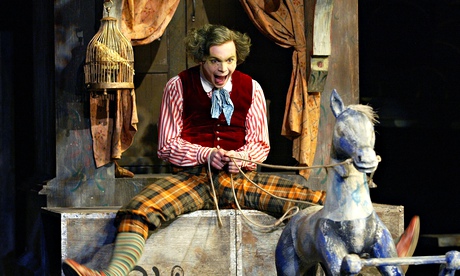
It was 2002 and I’d been part of the Royal Ballet for many years, performing The Nutcracker umpteen times. It’s a great ballet, but in the second half kids just turn off. We needed a new family Christmas show, something more like a piece of theatre, less serious than what was on the main stage.
Kenneth Grahame’s Wind in the Willows is a beautiful and quintessentially English book, but it moves through the seasons and doesn’t scream “Christmas” the way Nutcracker does. It was written in 1908 and has an air of melancholy, a lament for a gentler England that was about to disappear with the war. You can’t help but wonder whether artists of that time sensed something terrible was looming. I decided to set it in an attic and make it about getting old, about nostalgia for the shadows of childhood.
We chose composer George Butterworth, killed at the age of 31 during the battle of the Somme, as our musical starting point. Martin Ward wrote a beautiful score based on his folk-inspired, very English tunes. We approached Andrew Motion to do the adaptation not only because I loved his poetry, but because I respected how seriously he took his poet laureate role, and the kind of Englishness he represented. He did a gorgeous job, perfectly capturing the elegiac tone we wanted without compromising the simple charm of Grahame’s story.
We had the luxury of several weeks of rehearsals. We didn’t spend hours looking at animal videos, but we did think about people you might attribute animal qualities to and vice versa. I choreograph fast: I’m lucky and this was fun. It was a watershed moment. It made me realise this kind of collaborative approach was how I now wanted to work.
At Christmas, you have a responsibility. Your show might be a family’s one big treat, with grandparents, parents and children of all ages coming. We took out anything that could be construed as violent or scary, while ensuring there were elements to give it resonance for adults. It was the first time I’d done any work with puppets: the performers fell in love with them, and audiences of all ages were tickled by these hand puppets doing stupid things.
Ballet geeks will have spotted references to classical Royal shows: the Gaoler’s daughter, for example, was a nod to the widow’s clog dance in Ashton’s Fille mal Gardée, one of my own favourite roles. As far as I know, the snow falling through the auditorium at the end of the first half had never been done before – the snow machines were so incredibly noisy, it was like starting up 15 tractors! Having the policemen chase Toad about the foyer in the interval was a way of giving everyone permission to be a bit stupid and let their hair down. I was thinking: “Let’s just be silly!” I wanted the City bankers in the audience to say, “Oh, sod it” and join in the fun. I wanted 11-year-old boys who’d been dragged away from their Xboxes to have a laugh. I wanted to show you can have red-velvet-curtain quality without the buttoned-up-ness.
Andrew Motion, narration
Was I interested in writing a poem-libretto narrative? It’s not reallymy kind of thing, I said. I hadn’t written for children before. But why not?I’d just been appointed Poet Laureate and was getting acquainted with the idea of doing things that were outside my natural patch. And it’s a book I knew well. I remember my father doing the fight scenes. I think it was the only thing he ever read to me. Of course, I see now that to him it was about class war – and appealed for all the wrong reasons.
It’s a strange book you have to take for what it is: a lament for a disappearing time. I didn’t want to do anything disloyal to it, but nor did I want to be totally innocent about it. It was important to set it in its time. Grahame might not have liked the idea, but I’m sure he knew at some level this was the end of something. I tried to reflect this in a way that didn’t spoil the fun.
I took very few words from Grahame’s actual text. I thought it was my job to write the thing – so I did. Two songs only were lifted straight from the book. I was astonished to discover that the Ducks’ Ditty was from there. It had featured in one of the most agonising times of my life: as a boy, I volunteered in a fit of madness for a singing competition. To this day, I have the most anguished, fever-inducing memory of performing that damn song in a blather of terror with my dear mum mouthing the words at me.
Will gave me carte blanche. It was my idea to make the narrator Grahame as an older man, looking back, looking back. Will interpreted it brilliantly with touches such as pulling Mole out of the rug. I remember the first time I sat down with my children to watch it, thinking: “Bloody hell, this is incredibly good fun – finally I’ve written something they can commit to!” And that thrilling moment when the snow falls – it’s as Christmas should be. The whole project was an enormously enjoyable experience -. I’m always asking Will if we can do another show together!
• The Wind in the Willows is at the Vaudeville theatre, London WC2, until 17 January. Details: Royal Opera House