Not for nothing was Barry O’Farrell’s first media conference as the premier at a ferry wharf in western Sydney. The night before, the Coalition’s ship had come in. The biggest swing in Australian political history had cut through Labor’s western Sydney heartland, flipping seats the Liberals had “never dreamt of winning”, O’Farrell said.
For the voters in traditional Labor territory in Granville, Smithfield, Campbelltown, and the other unlikely seats now in Liberal hands, the former premier – and minister for western Sydney – had a goal: “That people who have voted for us for the first time do understand by the next election that we have kept the faith, that we have delivered for them.”
As it appears increasingly likely that O’Farrell’s successor, Mike Baird, will be elected premier on Saturday, the spotlight shifts to contests in Sydney’s west. If key seats such as Penrith, Holsworthy, Seven Hills and Drummoyne stick by Baird, the 2011 wipeout looks less a backlash against Labor excesses and more a permanent shift in the New South Wales political landscape.
Bigger than Shanghai in area, with a population greater than that of South Australia, western Sydney looms large in political calculations. Insiders speak of subjecting policies to the “Penrith test”. Sydney’s tabloid Daily Telegraph runs a “Fair go for the west” campaign and lauds the region as “real Australia”.
This idealisation casts its own fog. “One of the biggest mistakes commentators make, and even people in parliament, is to talk about the region as if it’s this amorphous, homogenous concept,” says Michelle Rowland, the Labor member for the federal seat of Greenway.
“Across the region and even with my electorate you have huge demographic differences.”
A “western Sydney” policy such as extending light rail to Parramatta, as both parties have promised to do, would mean little to voters in Blacktown, Rowland says. “Those in Blacktown refer to Parramatta as the eastern suburbs.”
Ethnic diversity rises and falls across the region. In areas such as Liverpool about 150 nationalities cluster together. Blacktown’s most common surname is Singh. New housing estates on the city’s western fringes contribute to this influx of new voters. It makes for volatile electorates, Rowland says.
“The level of ‘rusted-on-ness’ in a lot of these new areas is markedly lower than other parts of Sydney. It’s predominantly people who didn’t grow up in the local area and probably had little engagement in the political process.”
One seat to watch will be Holsworthy, formerly Menai, in the city’s south-west. The electorate, which takes in an army base and defence housing, was once a Liberal stronghold. The margin is still 10%, but successive redistributions have seen its boundaries migrate towards Liverpool, and towards clusters of immigrant and working-class communities.
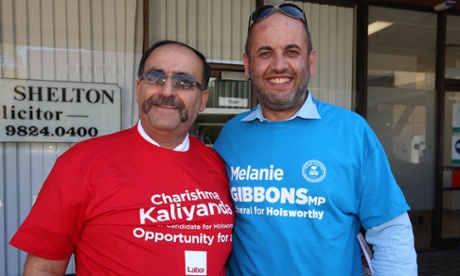
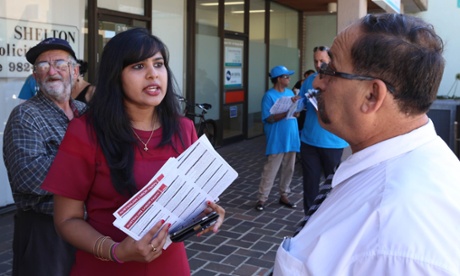
At a pre-polling booth in George Street, Liverpool, on Thursday last week, campaigners wearing oversize party T-shirts over their clothes sweltered in 30-degree heat. Ali Karnib, a Labor man in red sporting a handlebar moustache squabbled with his Liberal counterpart over debt, public transport and whether “leased” was another of saying “sold”. Periodically they would switch to Arabic and discuss more prosaic matters: how’s your old man? Coming to dinner on Saturday? “Labor, Liberal, it’s just politics,” Karnib shrugged.
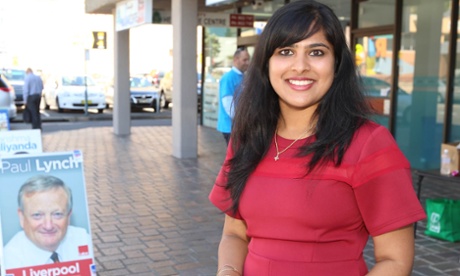
The youngest face at the booth belonged to the Labor candidate, 27-year-old Charishma Kaliyanda. Her parents arrived in Australia from India when she was four, giving her a unique perspective on the bread-and-butter work of state governments, often dismissed as mere service delivery.
“Having seen my parents struggle to establish a new life in a place that they’ve chosen has been incredibly eye opening and it makes you a lot more sensitive to some of the challenges that migrants face,” she said.
“Sometimes people aren’t aware, or aren’t sensitive to the fact these services are important. And when you come from a background where you’ve relied on these services and you see, daily, reasons for them to exist and be strong and well resourced, you prioritise them.”
Her mother stood at the entrance of the booth nearby holding a wad of how-to-vote cards. If elected, Kaliyanda will be the state’s youngest MP – and probably the last still living with her parents. “You know, ethnic families,” she grinned. “Can’t leave until you’re married or move interstate.”
Local councillors such as Tony Hadchiti, the president of the Western Sydney Regional Organisation of Councils, are keen to milk perceptions of the region’s importance.
“Everyone has woken up to western Sydney being a powerhouse,” he tells Guardian Australia. “We’ve gone away from the days where western Sydney was always neglected – though we’re not 100% there yet.”
Already the Coalition has announced the creation of a Western Sydney Leadership Dialogue (“It’s quite simple: western Sydney’s time has come,” Baird said) and promised billions in new infrastructure, including roads and public transport to a proposed second airport at Badgerys Creek.
The Baird government has completed a rail link to the city’s south-west and commenced a second to the north-west. The controversial WestConnex motorway would be another artery connecting the region, the airport and the central business district. This past weekend saw an extra $300m promised for an upgrade of Campbelltown hospital. Penrith would also enjoy the benefits of the National Disability Insurance Scheme from July 2015, Baird announced, a full year earlier than the rest of the state.
Labor has countered, saying that the Baird government’s cuts to services have hit western Sydney particularly hard. Waiting times are up at least 30% at Westmead, Nepean and Liverpool hospitals. Labor met a 92% on-time running target for the Western Line train every year from 2008 – a feat the Coalition hasn’t been able to match in its term. Unemployment also is up across the region, reaching 9.3% in the city’s south-west.
More jobs is the linchpin, Hadchiti says. “If there’s a job where people live it means less travel time. Less travel time is less pressure on public infrastructure. It helps with educational issues because it means less time travelling and more time spent sitting with the kids doing homework.
“If we get jobs right, we are going a long way.”
A Liberal, Hadchiti is keen to cast the 2011 election as a watershed. “The people of western Sydney four years ago said you can’t take us for granted any more. We won’t vote the way our parents voted. Whether you’re Liberal or Labor, you’re not in a safe seat any more.”
But the veteran political analyst Malcolm Mackerras says this is “overblown”. “I think western Sydney has a fair number of marginal seats, and fair number of Labor seats, and there’s one safe Liberal seat,” he says.
Despite a catastrophic swing – more than double the state’s previous record – Labor still held core seats such as Auburn, Fairfield, Lakemba, Canterbury, Bankstown and Liverpool, he says.
Predictions of a western Sydney rout at the 2013 federal election were similarly exaggerated. “In the end Labor held almost every seat,” he says. “It is still Labor heartland.”
He thinks the real opportunity for the Liberals to redraw the political map was in their gains in Newcastle and the Hunter – a historic chance probably squandered by a succession of resignations in the wake of spectacular hearings at the Independent Commission Against Corruption.
“When the Liberals did well in 2011, they won a significant number of seats in western Sydney. But all of them will go back to Labor one day,” Mackerras says.
Most Liberal gains in the region hang on knife-edge margins, including East Hills (0.2%), Prospect (1.1%), Macquarie Fields (1.8%) and Granville (3.8%).
“Half the seats will go back next Saturday,” he said. “And the rest will go back when there’s another Neville Wran or Bob Carr in charge of the Labor party.”